Comander Perimeter Security System
Engineering and Installation Manual
Page 18 of 72
1.8.4 Comander as a Subsystem – Adding PIDS to 10G Vision
Another possible application for Comander is to operate as a subsystem which adds a
perimeter intruder detection capability to an existing system – in this case a Geoquip's
flagship "Gthernet 10G Vision" system.
"10G Vision" provides a 10-Gigabit Ethernet infrastructure designed to carry large
volumes of CCTV camera data. Like the Comander system, 10G Vision uses a Ring
architecture for fault-tolerance, but it is equipped with high-specification optical fibre
connections which can operate at up to 10Gb/s: this provides sufficient bandwidth for
simultaneous connection and monitoring of large numbers of CCTV cameras. The
cameras are connected to devices called "Nodes", each of which has five 100Mb/s
Cat5e connections, and four optical fibre connections. The Cat5e connections are
used for cameras or other IP devices, while the fibre connections are used to connect
the Nodes together in Rings.
This scenario opposite shows a 10G Vision installation in which 58 CCTV cameras are
connected together using three separate Rings. Perimeter Intruder Detection is
provided using 72 segments of Interceptor cable fixed to perimeter fencing, connected
to the rest of the system using four Comander Marshalling Boxes and Racks. Each
Rack is connected to its nearest Node using Cat5e Ethernet.
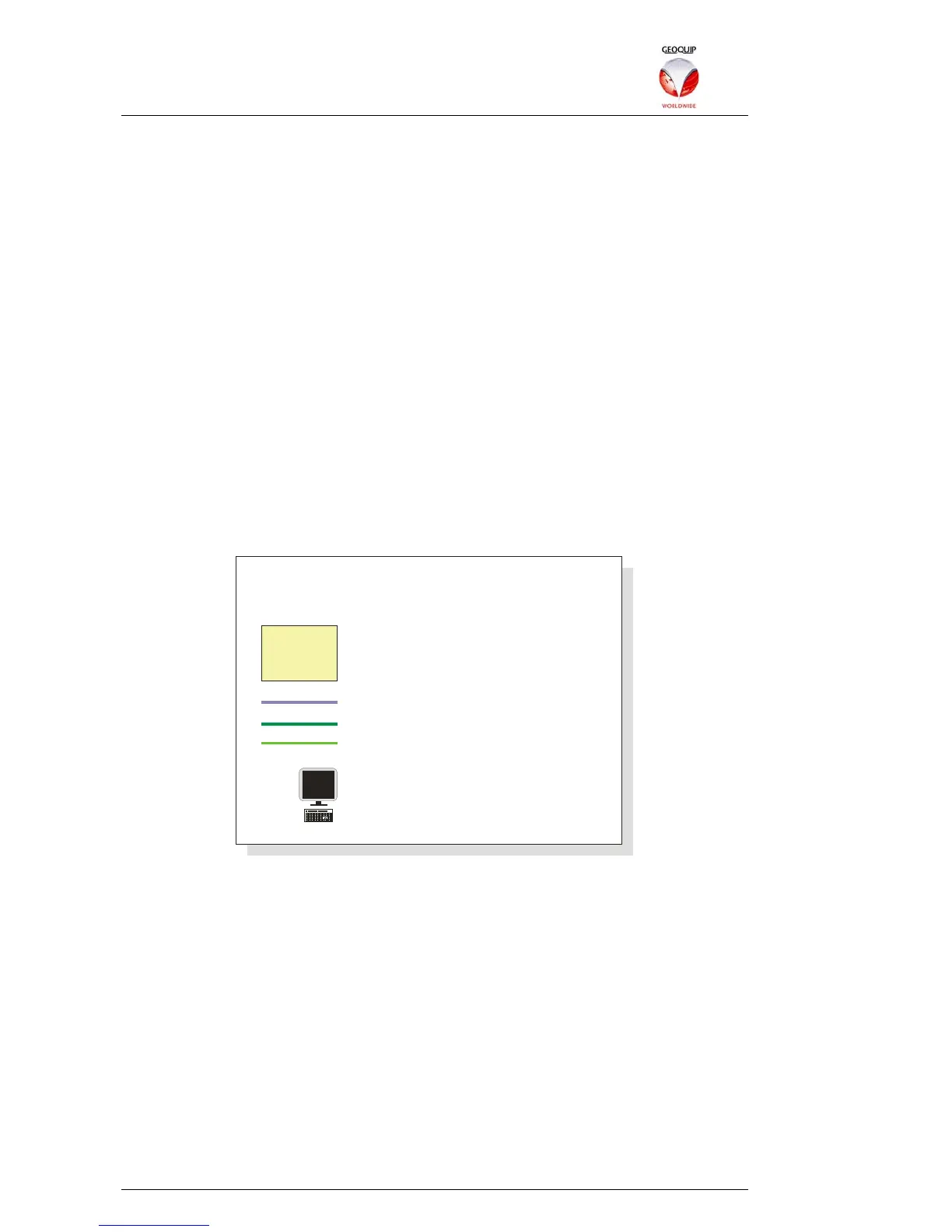
The network connections are illustrated using colour-coding to indicate the different
parts of the system, as follows:
A B C D
1 2 3 4 5
10.2.3.25
CAT5 Connections
IP Address
Fibre Connections
East and West Local Fibre Rings
Master Fibre Ring
CCTV Matrix and/or
Geolog Vision SMS Computers
CAT5 Ethernet
10G Vision Node
Key To Network Connections & Devices
}
The site is split into two segments, East (IP 10.2.4.x) and West (IP 10.2.3.x), each of
which has its own Local Ring, and its own Control Room – the Ring is made using two
of the fibre connections on each Node. The other two fibre connections on each Node
are used to build an entirely separate Ring which connects all the Nodes in the system
to a Master Control Room. This dual-Ring architecture provides excellent fault-
tolerance, and the Network Topology feature of the Comander Rack makes it simple to
detect and locate faults or breaks in any of the Rings.
Each Comander Rack located around the perimeter is connected as an Ethernet spur
to an unused 100Mb connection on the nearest 10G Vision Node. The Comanders
might be located in weatherproof cabinets close the perimeter to minimise the amount
of feeder cabling required, or in the nearest Control Room.
The Comanders are allocated IP addresses in the 10.2.5.x range. Because the
communications between Comanders and other devices happens at the Ethernet level,
the Comanders can be configured with a 24-bit subnet mask to minimise IP network
access (though a 16-bit netmask will also work).



 To Next Page