
 Need help?
Do you have a question about the Grandstream Networks GHP6 Series and is the answer not in the manual?
Information regarding compliance with safety standards like FCC/CE and UL.
Warnings about power adapters and firmware downgrade policy.
Details on product warranty, replacement, and refund policies.
Details the accessories included in the GXW42XX package for unpacking.
Step-by-step instructions to connect the GXW42XX gateway to the network.
Overview of software capabilities including codecs, SIP profiles, and protocols.
General operational procedures for the GXW42XX gateway.
How to use the built-in voice prompt menu for device configuration.
Instructions on how to dial phone numbers or extensions.
Explains direct IP calling without a SIP proxy and necessary elements.
Method for direct IP calling using the Interactive Voice Response menu.
Method for direct IP calling using star codes.
Procedure for transferring a call without speaking to the recipient first.
How to initiate direct IP calls using a star code.
How to force a specific voice codec for a call.
How to enable Secure Real-time Transport Protocol for calls.
Steps to configure the device using the voice prompt menu.
How to configure the device to obtain an IP address via DHCP.
Instructions to access the device's web-based configuration interface.
Configuration for STUN Server to help with NAT traversal.
Setting to enable NAT traversal when the gateway is behind a firewall.
Displays product model, part number, software version, and uptime.
Shows MAC address, IP mode, IP address, subnet mask, gateway, and DNS server.
Configuration for IP address mode, DNS server, and DHCP settings.
Settings for PPPoE connection including account ID, password, and service name.
Options for enabling and configuring the management interface.
Controls access methods for the management interface (HTTP/HTTPS/SSH).
Allows blocking access for specific IP addresses on the WAN side.
Disables configuration updates via the keypad.
Options for how the device checks for and applies firmware updates.
Customizable port for HTTP access to the web interface.
Customizable port for HTTPS access to the web interface.
Manages IP lists for controlling SSH and web access.
Specifies IPs allowed to access web and SSH from the WAN side.
Enables or disables the TR-069 service for remote management.
Sets the URL for the TR-069 Auto Configuration Server.
Enables or disables the SNMP feature for network monitoring.
IP addresses of SNMP trap receivers.
Configuration for RADIUS authentication for web access.
Address of the primary RADIUS server.
Selects the mode for 802.1X authentication.
Enters the MD5 password for 802.1X mode.
Enables or disables the OpenVPN® feature.
Specifies the IP address or FQDN for the OpenVPN® Server.
Uploads the user-specified SSL certificate for SIP over TLS.
Customizes the SIP TLS Private Key for SIP over TLS.
Specifies which CA certificates the gateway needs to trust.
Specifies the IP address or URL of the NTP server for time synchronization.
Configures the date/time based on the specified time zone.
Configures the protocol used to send syslog messages (UDP, SSL, TLS).
IP address or URL of the system log server.
Enables or disables override for call detail records (CDR).
Starts or stops Ethernet capture for debugging.
Configuration for system ring cadence for all incoming calls.
Configures ring tone frequencies and patterns for FXS ports.
Disables the Direct IP Call function.
Configures automatic reboot schedule for the device.
Basic profile settings including activation and SIP server configuration.
Configures network parameters like QoS and DNS mode for profiles.
Core SIP settings including transport, registration, and proxy configuration.
Sets the time before a SIP session is considered timed out.
Enables session timer even if remote party does not support it.
Selects fax mode: T.38 or Pass-Through.
Configures a preference list for voice codecs.
Sends early INVITE for each key press when dialing a number.
Defines rules for dialing numbers, including prefixes and number patterns.
Enables or overrides individual call feature settings.
Resets all call features to their default settings via Web UI.
Customizes ring tone based on caller ID.
Settings for individual FXS ports, including SIP User ID and authentication.
User account information provided by the VoIP service provider.
Configures an auto dial number when offhook.
Maps FXS ports to GXW410x FXO ports.
Maps FXS ports to an FXO gateway's IP address.
How to upgrade firmware using TFTP, HTTP, or HTTPS protocols.
Step-by-step guide for performing a local firmware upgrade.
Warning about deleting configuration and instructions for factory reset.
 General
| Bluetooth | No |
|---|---|
| USB Port | No |
| Conference | 3-way |
| Wall Mountable | Yes |
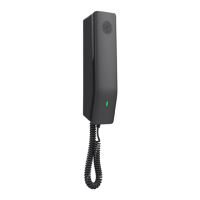
| Model | GHP620, GHP620W |
| Type | IP Phone |
| HD Audio | Yes |
| Ethernet Ports | 2 (10/100/1000 Mbps) |
| Power over Ethernet | Yes (802.3af) |
| Wi-Fi | Yes (GHP620W) |
| Audio Codecs | G.711, G.722, G.726, iLBC, Opus |
| Protocols | SIP, RTP, RTCP, HTTP, HTTPS, ARP, ICMP, DHCP, DNS, NTP, TFTP, STUN, LLDP, SRTP, TLS |
| SIP Accounts | 2 |








 To Next Page

