8 REFRIGERANT PIPING & REFRIGERANT CHARGE
! CAUTION
MakesurethatrefrigerantpipinginstallationcomplieswiththelegislationEN378andlocallegislation.
8.1 PIPING MATERIALS
1 Prepare locally-supplied copper pipes.
2 Select the piping size with the correct thickness and correct
material which can have sucient pressure strength.
3 Select clean copper pipes. Make sure there is no dust and
moisture inside. Blow the inside of the pipes with oxygen
free nitrogen to remove any dust and foreign materials
before connecting pipes.
? NOTE
• Asystemwithno moisture oroil contamination willgivemaximum
performance and lifecycle compared to that of a poorly prepared
system.Takeparticularcaretoensureallcopperpipingiscleanand
dryinternally.
• Thereisnorefrigerantinthecycleoftheindoorunit.
! CAUTION
• Allexternalpipingshallbeselectedinsizeanddimensionavoiding
anymechanicalstrengthduetocontractionorexpansion,vibrationor
refrigerantpulsation.
• Allthepipingshallbeprotectedagainstanyenvironmentaleffectlike
waterfreezing,corrosion,etc.Whenexiblepipeisused,precautions
shallbetakenagainstmechanicaldamages,excessivestressesby
torsionoranyother.
• Flarenutconnectionsshallbeaccessibleformaintenancepurposes.
• Ensurethatrefrigerantpipingisearthedpriortounitsinterconnection
andincaseofadditionalrefrigerantchargingisrequired.
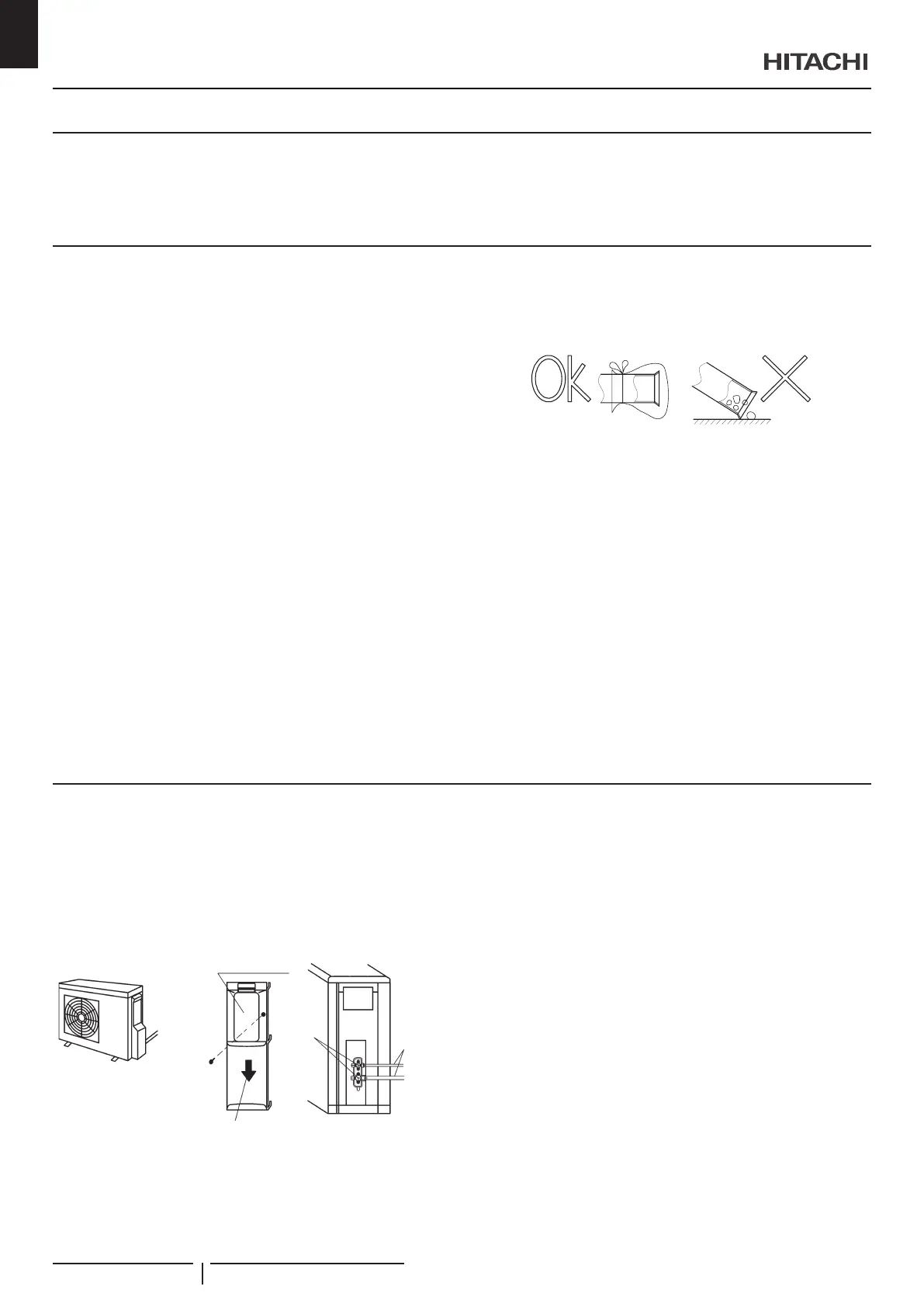
• Captheendofthepipewhenpipeistobeinsertedthroughahole.
• Donotputpipesonthegrounddirectlywithoutacaporvinyltapeat
theendofthepipe.
• Ifpipinginstallationisnotcompleteduntilnextdayoroveralonger
period of time, braze off the ends of the piping and charge with
oxygenfreenitrogenthroughaSchradervalvetypeaccessttingto
preventmoistureandparticlecontamination.
• Do not use insulation material that contains NH
3
because it can
damagecooperpipematerialandcanbeasourceoffutureleakage.
After connecting the refrigerant piping, seal the refrigerant pipes
by using the eld-supplied insulation material. Insulate the unions
and are-nuts at the piping connections completely. Insulate the
liquid piping and gas piping completely to avoid decreasing of
performance and dewing on the surface of the pipe.
! CAUTION
• Do not use insulation material that contains NH3 because it can
damagecooperpipematerialandcanbeasourceoffutureleakage.
• Completely insulate both refrigerant gas piping and liquid piping
betweentheindoorunit(s)andtheoutdoorunit.
• Ifnotinsulated,dewwilloccuronthepipingsurface.
8.2 PIPING CONNECTION FOR OUTDOOR UNIT
1 Take the piping cover away from the unit. Then fetch the
pipes through the rear side and route piping according to
the installation place as shown in the gure. Make holes
by cutting along the guideline at the rear of the cover or
punching with a driver. Remove the burr with a cutter, and
place a insulation (eld supplied) to protect cables and
pipes.
Pipe cover
Rear side
piping
Screw
Stop
valve
Direction to remove pipe cover
Connecting
piping
2 Attach the pipe cover in order to prevent rainwater from
entering inside the cabinet.
3 Use a pipe bender for pipe bending work when connecting
pipes.
4 Check to ensure that the stop valves are completely closed
before connecting pipes.
5 Connect the eld supplied refrigerant pipes to the indoor unit
and outdoor unit. Apply the oil thinly at the seat are nut and
pipe before tightening.
REFRIGERANT PIPING & REFRIGERANT CHARGE
PMML0548 rev.0 - 04/2020 - A10648790A
8
EN





 To Next Page