EasyManua.ls Logo

HP 654A - Section IV: Theory of Operation; 4-1. General Description; 4-7. Oscillator Circuit; 4-11. Buffer Amplifier

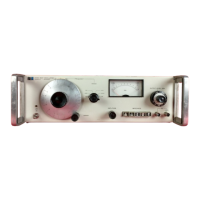
HP 654A
82 pages
Print Icon
To Next Page IconTo Next Page
To Previous Page IconTo Previous Page
Loading...
Model
654A
Section
IV
SECTION
IV
THEORY
OF
OPERATION
4-1.
GENERAL
DESCRIPTION.
4-2.
The
Model
654A
Test
Oscillator (
see
Block
Diagram,
Figure
7-1)
contains
a
Wien
Bridge
Frequency
Adjustable
Oscillator (
10
Hz
to
10
MHz)
followed
by
a
Buffer
Amplifier
and
a
Balanced
Amplifier
with
a
single
ended
input
and
balanced
output.
The
output
of
the
Balanced
Amplifier
is
a
leveled,
sinusoidal
signal;
this
signal
passes
through
Balanced
Attenuators
and
a
Balance
and
Unbalance
Impedance
Switch (
output
impedance
switching
network)
to the
front
panel
output
connectors.
4-3.
An
Average
Responding
Detector
monitors
the
output
from
the
Balanced
Amplifier
to
provide
two
dc
currents
(proportional
to
the
signal
level);
one
current
flows
to
the
meter
circuits
and
the
other
to
the
Amplitude
Control
Integrator.
Automatic
leveling
of
the
654A
signal
is
achieved
by
means
of
the
Amplitude
Control
Integrator
which
compares
the
current
from
the
Average
Detector
with
the
current
from
an
Amplitude
Current
Reference
to
,
regulate
the
current
through
the
lamp
of
a
photosensitive
control
device (
A2DSV1).
The
lamp
controls
the
imped-
ance
of
a
resistive
divider
at
the
input
of
the
Buffer
Amplifier
so as
to
maintain
a
constant
output
level
from
the
Balanced
Amplifier.
The
output
level
attenuators
provide
attenuation
in
10
dB
and
1
dB
steps
at
the
output
connectors
and
a
front
panel
AMPLITUDE
control
gives
2
dB
of
continuous
output
level
adjustment
by
varying
the
current
from
the
Amplitude
Current
Reference.
4-4.
The
current
from
the
Average
Detector
which
flows
to
the
meter
circuits
is
divided
into
two
parts:
a
fixed
amount
of
current (
approximately
1.25
ma)
flows
into
the
Meter
Offset
Current
Reference
and
the
remainder
flows
to
the
meter.
In
this
way
the
meter
is
offset
so
that
it
indicates
only
over
the
range
of -
1
dBm
to +
1
dBm.
The
current
flowing
into
the
Meter
Offset
Current
Reference
is
held
constant
by
the
Meter
Differential
Amplifier
which
clamps
the
input
of
the
current
reference
to
a
virtual
ground.
4-5.
A
Counter
Emitter
Follower
provides
isolation
between
the
oscillator
circuit
and
the
rear
panel
COUNTER
OUTPUT.
Regulated
Power
Supplies
provide
the +
31
V
and -
26
V
required
to
operate
the
654A.
4-6.
CIRCUIT
DESCRIPTION.
4-7.
OSCILLATOR
CIRCUIT (
Schematic
No.
1,
Figure
7-21
4-8.
The
frequency
adjustable
Oscillator
drives
the Buffer
Amplifier
with
a
stable
sine
wave
at
a
frequency
determined
by
the
setting
of
the
FREQUENCY
RANGE
switch
and
the
FREQUENCY
dial.
The
circuit
is
a
Wien
Bridge
Oscillator
which
has
a
standard,
frequency
selective,
RC
leg
and
a
resistance
leg
modified
by
the
addition
of
a
variable
impedance (
A2CR1
and
A2CR2).
A2Q26
and
A2Q1
through
A2Q6
comprises
the
amplifier
section
and
A2Q7
is
a
peak
detector
which
provides
negative
feedback
to
the
bridge
for
leveling.
Two
types
of
feedback
are
used;
positive
feedback
from
the
frequency
selective
network
drives
the
base
of
A2Q3
through
the
source
follower
A2Q1,
and
negative
feedback
from
the
resistive
side
of
the
bridge
drives
the
base
of
A2Q2.
A2Q2
and
A2Q3
form
a
differential
amplifier.
Only
at
the
selected
frequency
does
the
positive
feedback
overcome
the
negative
feedback
to
sustain
oscillations.
4-9.
The
six
frequency
ranges
are
selected
by
means
of
the
RC
networks
mounted
on
the
FREQUENCY
RANGE
switch (
S2);
continuous
adjustment
of
the
frequency
on
each
range
is
accomplished
by
rotating
the
FREQUENCY
dial,
which
controls
the
setting
of
the
tuner
capacitors
C 1
A,
CI
B
and
C1C.
The
signal
from
the
amplifier
output (
from
A2Q5
and
A2Q6)
is
developed
across
the
RC
network
of
the
bridge;
at
the
selected
frequency,
where
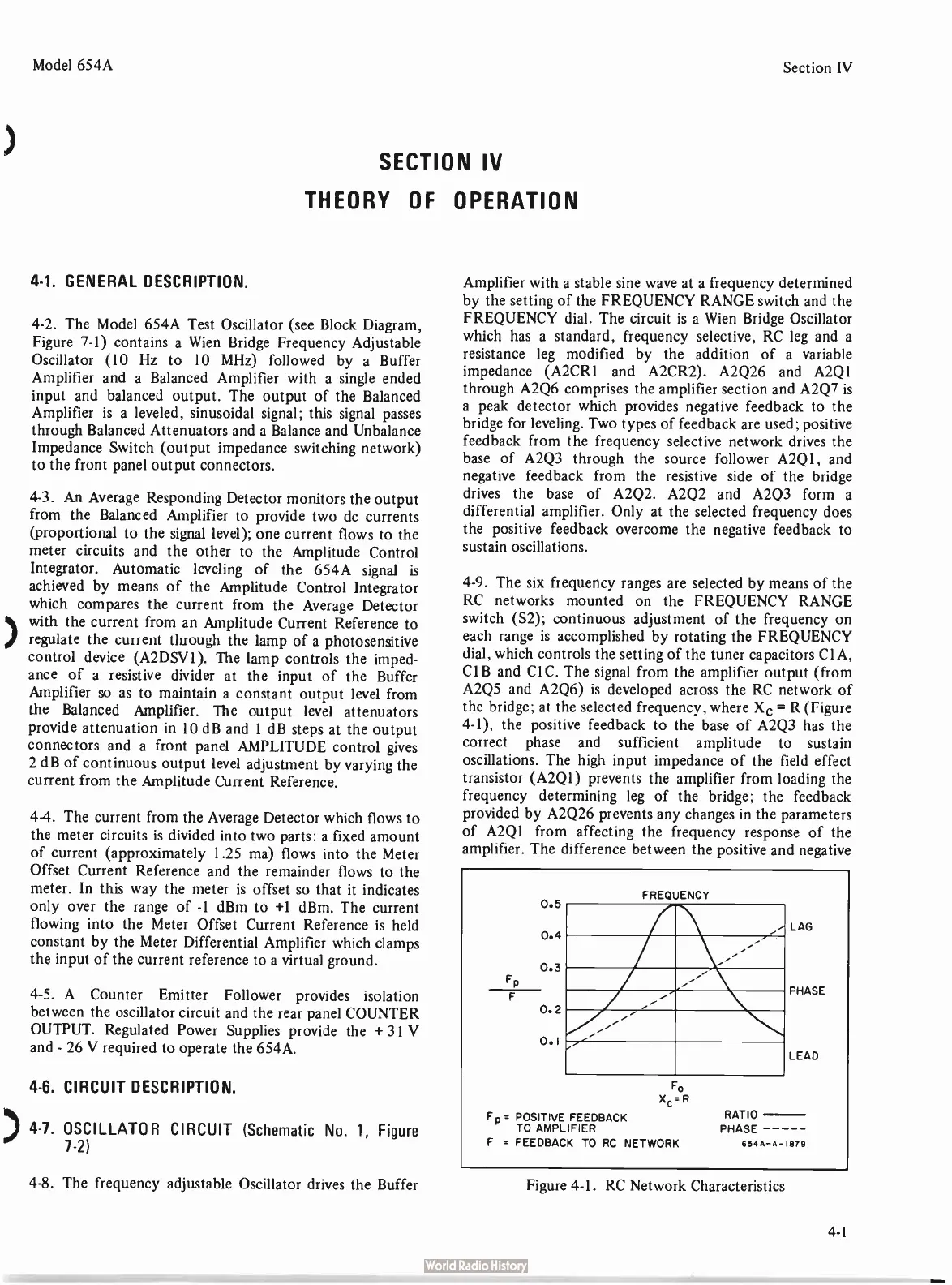
Xc
=
R (
Figure
4-1),
the
positive
feedback
to the
base
of
A2Q3
has
the
correct
phase
and
sufficient
amplitude
to
sustain
oscillations.
The
high
input
impedance
of
the
field
effect
transistor (
A2Q1)
prevents
the
amplifier
from
loading
the
frequency
determining
leg
of
the
bridge;
the
feedback
provided
by
A2Q26
prevents
any
changes
in
the
parameters
of
A2Q1
from
affecting
the
frequency
response
of
the
amplifier.
The
difference
between
the
positive
and
negative
0.5
0.4
0.3
0.2
FREQUENCY
0.1
F0
X,
R
F =
POSITIVE
FEEDBACK
TO
AMPLIFIER
F =
FEEDBACK
TO
RC
NETWORK
LAG
PHASE
LEAD
RATIO
PHASE
654A-
A-1879
Figure
4-1.
RC
Network
Characteristics
4-1

Related product manuals