EasyManua.ls Logo

HP 654A - 10 Mhz Low Pass Filter; Hum and Noise Check 5-1

HP 654A
82 pages
Print Icon
To Next Page IconTo Next Page
To Previous Page IconTo Previous Page
Loading...
Section
V
Model
654A
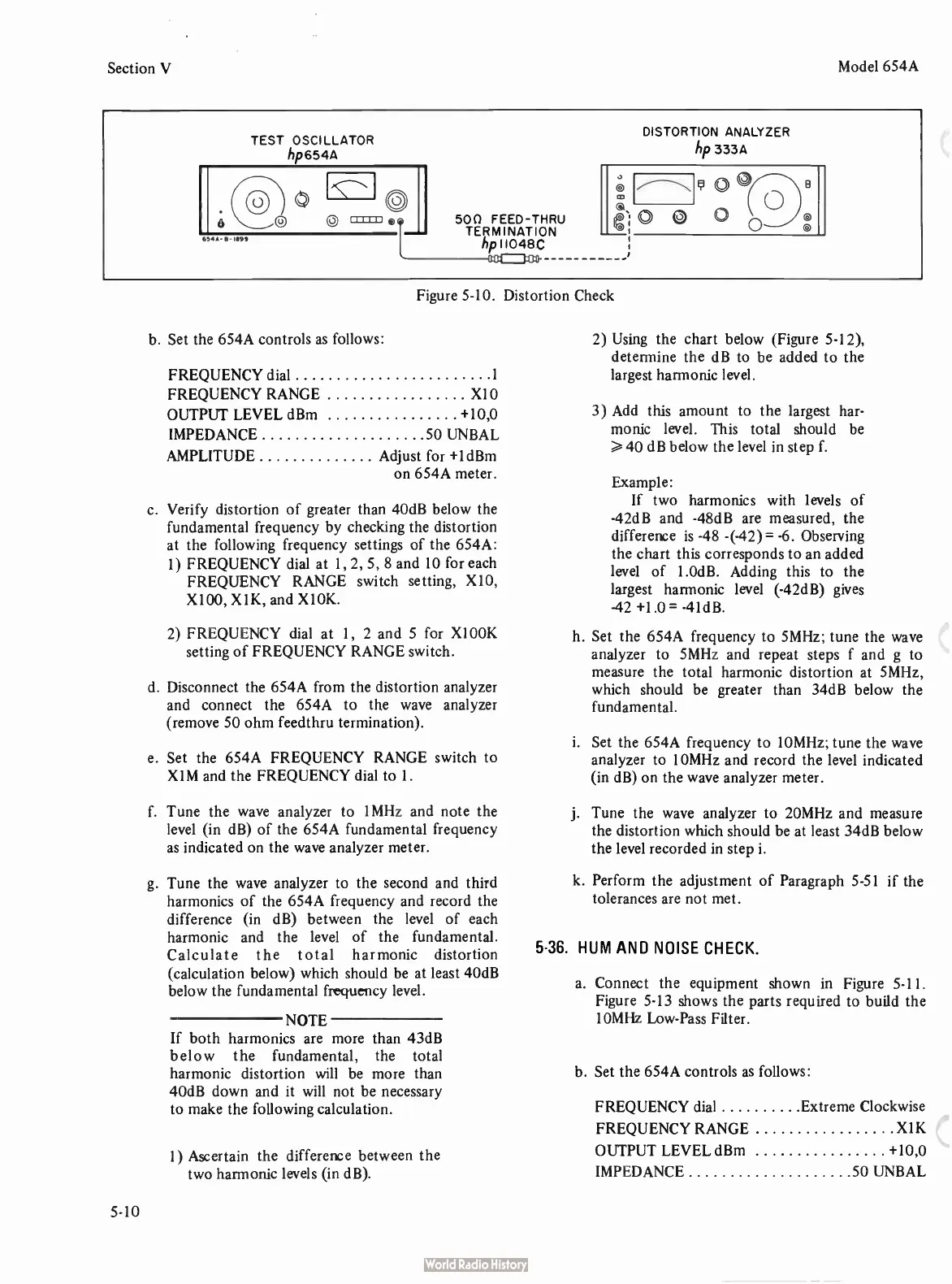
TEST
OSCILLATOR
hp654A
am
65.-
B-1899
© o
500
FEED-THRU
TERMINATION
hp11048C
DISTORTION
ANALYZER
hp
333A
Figure
5-10.
Distortion
Check
b.
Set
the
654A
controls
as
follows:
FREQUENCY
dial
1
FREQUENCY
RANGE
X10
OUTPUT
LEVEL
dBm +
10,0
IMPEDANCE
50
UNBAL
AMPLITUDE
Adjust
for +
1dBm
on
654A
meter.
c.
Verify
distortion
of
greater
than
40dB
below
the
fundamental
frequency
by
checking
the
distortion
at
the
following
frequency
settings
of
the
654A:
1)
FREQUENCY
dial
at
1,
2,
5,
8
and
10
for
each
FREQUENCY
RANGE
switch
setting,
X10,
X100,
X1K,
and
Xl0K.
2)
FREQUENCY
dial
at
1,
2
and
5
for
X1OOK
setting
of
FREQUENCY
RANGE
switch.
d.
Disconnect
the
654A
from
the
distortion
analyzer
and
connect
the
654A
to
the
wave
analyzer
(remove
50
ohm
feedthru
termination).
e.
Set
the
654A
FREQUENCY
RANGE
switch
to
X1M
and
the
FREQUENCY
dial
to
1.
f.
Tune
the
wave
analyzer
to
1MHz
and
note
the
level (
in
dB)
of
the
654A
fundamental
frequency
as
indicated
on
the
wave
analyzer
meter.
g.
Tune
the
wave
analyzer
to
the
second
and
third
harmonics
of
the
654A
frequency
and
record
the
difference (
in
dB)
between
the
level
of each
harmonic
and
the
level
of
the
fundamental.
Calculate
the
total
harmonic
distortion
(calculation
below)
which
should be
at
least
40dB
below
the
fundamental
frequency
level.
NOTE
If
both
harmonics
are
more
than
43dB
below
the
fundamental,
the
total
harmonic
distortion
will
be
more
than
40dB
down
and
it
will
not
be
necessary
to
make
the
following
calculation.
1)
Ascertain
the
difference
between
the
two
harmonic
levels (
in
dB).
2)
Using
the
chart
below (
Figure
5-12),
determine
the
dB
to
be
added
to
the
largest
harmonic
level.
3)
Add
this
amount
to
the
largest
har-
monic
level.
This
total
should
be
40
dB
below
the
level
in
step
f.
Example:
If
two
harmonics
with
levels
of
-42dB
and -
48dB
are
measured,
the
difference
is -
48 -(-
42)= -
6.
Observing
the
chart
this
corresponds
to
an
added
level
of
1.0dB.
Adding
this
to
the
largest
harmonic
level (-
42dB)
gives
-42 +
1.0= -
41dB.
h.
Set the
654A
frequency
to
5MHz;
tune
the
wave
analyzer
to
5MHz
and
repeat
steps
f
and
g
to
measure
the
total
harmonic
distortion
at
5MHz,
which
should
be
greater
than
34dB
below
the
fundamental.
i.
Set
the
654A
frequency
to
10MHz;
tune
the
wave
analyzer
to
10MHz
and
record
the
level
indicated
(in
dB)
on
the
wave
analyzer
meter.
J.
Tune
the
wave
analyzer
to
20MHz
and
measure
the
distortion
which
should be
at
least
34dB
below
the
level
recorded
in
step
i.
k.
Perform
the
adjustment
of
Paragraph
5-51
if
the
tolerances
are
not
met.
5-36.
HUM
AND
NOISE
CHECK.
a.
Connect
the
equipment
shown
in
Figure
5-11.
Figure
5-13
shows
the
parts
required
to
build
the
10MHz
Low-
Pass
Filter.
b.
Set
the
654A
controls
as
follows:
FREQUENCY
dial
Extreme
Clockwise
FREQUENCY
RANGE
X1K
OUTPUT
LEVEL
dBm +
10,0
IMPEDANCE
50
UNBAL
5-10

Related product manuals