EasyManua.ls Logo

HP 654A - Page 40

HP 654A
82 pages
Print Icon
To Next Page IconTo Next Page
To Previous Page IconTo Previous Page
Loading...
Section
V
Model
654A
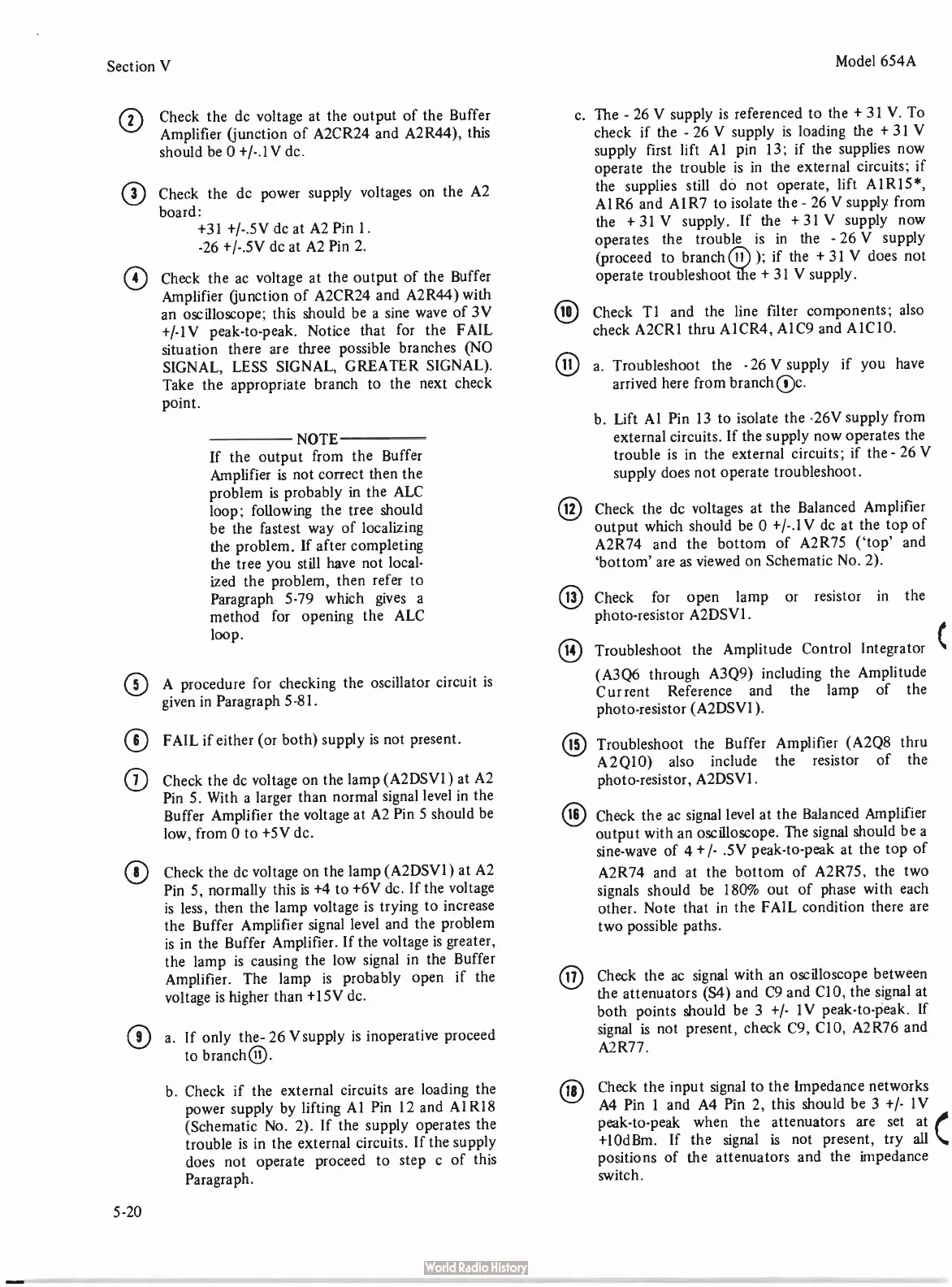
Check
the
dc
voltage
at
the
output
of
the
Buffer
Amplifier (
junction
of
A2CR24
and
A2R44),
this
should
be
0 +/-.
1V
dc.
Check
the
dc
power
supply
voltages
on
the
A2
board:
+31 +/-.
5V
dc
at
A2
Pin
1.
-26 +/-.
5V
dc
at
A2
Pin
2.
Check
the
ac
voltage
at
the
output
of
the
Buffer
Amplifier (
junction
of
A2CR24
and
A2R44)
with
an
oscilloscope;
this
should
be
a
sine
wave
of
3V
+/-1V
peak-
to-
peak.
Notice
that
for
the
FAIL
situation
there
are
three
possible
branches (
NO
SIGNAL,
LESS
SIGNAL,
GREATER
SIGNAL).
Take
the
appropriate
branch
to
the
next
check
point.
NOTE
If
the
output
from
the
Buffer
Amplifier
is
not
correct
then
the
problem
is
probably
in
the
ALC
loop;
following
the
tree
should
be
the
fastest
way
of
localizing
the
problem.
If
after
completing
the
tree
you
still
have
not
local-
ized
the
problem,
then
refer
to
Paragraph
5-79
which
gives
a
method
for
opening
the
ALC
loop.
A
procedure
for
checking
the
oscillator
circuit
is
given
in
Paragraph
5-81.
FAIL
if
either (
or
both)
supply
is
not
present.
Check
the
dc
voltage
on
the
lamp (
A2DSV1)
at
A2
Pin
5.
With
a
larger
than
normal
signal
level
in
the
Buffer
Amplifier
the
voltage
at
A2
Pin
5
should
be
low,
from
0
to +
5V
dc.
Check
the
dc
voltage
on
the
lamp (
A2DSV1)
at
A2
Pin
5,
normally
this
is +
4
to +
6V
dc.
If
the
voltage
is
less,
then
the
lamp
voltage
is
trying
to
increase
the
Buffer
Amplifier
signal
level
and
the
problem
is
in
the
Buffer
Amplifier.
If
the
voltage
is
greater,
the
lamp
is
causing
the
low
signal in
the
Buffer
Amplifier.
The
lamp
is
probably
open
if
the
voltage
is
higher
than +
15V
dc.
0
a.
If
only
the-
26
Vsupply
is
inoperative
proceed
to
branch®.
b.
Check
if
the
external
circuits
are
loading
the
power
supply
by
lifting
Al
Pin
12
and
Al
R18
(Schematic
No.
2).
If
the
supply
operates
the
trouble
is
in
the
external
circuits.
If
the
supply
does
not
operate
proceed
to
step
c
of
this
Paragraph.
c.
The -
26
V
supply
is
referenced
to
the +
31 V.
To
check
if
the -
26
V
supply
is
loading
the +
31
V
supply
first
lift
Al
pin
13;
if
the
supplies
now
operate
the
trouble
is
in
the
external
circuits;
if
the
supplies
still
do
not
operate,
lift
A1R15*,
Al
R6
and
Al
R7
to
isolate
the -
26
V
supply
from
the +
31
V
supply.
If
the +
31
V
supply
now
operates
the
trouble
is
in
the -
26
V
supply
(proceed
to
branch
11 );
if
the +
31
V
does
not
operate
troubleshoot
e +
31
V
supply.
Check
Ti
and
the
line
filter
components;
also
check
A2CR1
thru
A1CR4,
AlC9
and
AICIO.
a.
Troubleshoot
the -
26
V
supply
if
you
have
arrived
here
from
branch
C)c.
b. Lift
Al
Pin
13
to
isolate
the -
26V
supply
from
external
circuits.
If
the
supply
now
operates
the
trouble
is
in
the
external
circuits;
if
the -
26
V
supply
does
not
operate
troubleshoot.
Check
the
dc
voltages
at
the
Balanced
Amplifier
output
which
should
be
0 +/-.
1V
dc
at
the
top
of
A2R74
and
the
bottom
of
A2R75 ('
top'
and
'bottom'
are
as
viewed
on
Schematic
No.
2).
Check
for
open
lamp
or
resistor
in
the
photo-
resistor
A2DSV1.
Troubleshoot
the
Amplitude
Control
Integrator
(A306
through
A3Q9)
including
the
Amplitude
Cur
rent
Reference
and
the
lamp
of
the
photo-
resistor (
A2DSV1).
Troubleshoot
the
Buffer
Amplifier (
A2Q8
thru
A 2
Q10)
also
include
the
resistor
of
the
photo-
resistor,
A2DSV1.
Check
the
ac
signal
level
at
the
Balanced
Amplifier
output
with an
oscilloscope.
The
signal
should
be
a
sine-
wave
of
4 +/- .
5V
peak-
to-
peak
at
the
top
of
A2R74
and
at
the
bottom
of
A2R75,
the
two
signals
should
be
180%
out
of phase
with
each
other.
Note
that
in
the
FAIL
condition
there
are
two
possible paths.
0
Check
the
ac
signal
with
an
oscilloscope
between
the
attenuators (
S4)
and
C9
and
C10,
the
signal at
both
points
should
be
3 +/-
IV
peak-
to-
peak.
If
signal
is
not
present,
check
C9,
C10,
A2R76
and
A2R77.
Check
the
input
signal
to
the
Impedance
networks
A4
Pin
1
and
A4
Pin
2,
this
should
be
3 +
1-
IV
peak-
to-
peak
when
the
attenuators
are
set
at
+10dBm.
If
the
signal
is
not
present,
try
all
positions
of
the
attenuators
and
the
impedance
switch.
5-20

Related product manuals