EasyManua.ls Logo

HP 654A - 5-101. Servicing Rotary Switches; 5-103. Servicing Tuner Assembly

HP 654A
82 pages
Print Icon
To Next Page IconTo Next Page
To Previous Page IconTo Previous Page
Loading...
Section
V
Model
654A
b.
AC
waveshape
should
have
the
same
wave
shape
as
shown
on
Schematic
No.
2.
If
you
have
a
flatness
problem,
check
the
wave
shape
for
symmetry
and
see
if
output
capacitor
C9
or
CIO
are
leaking.
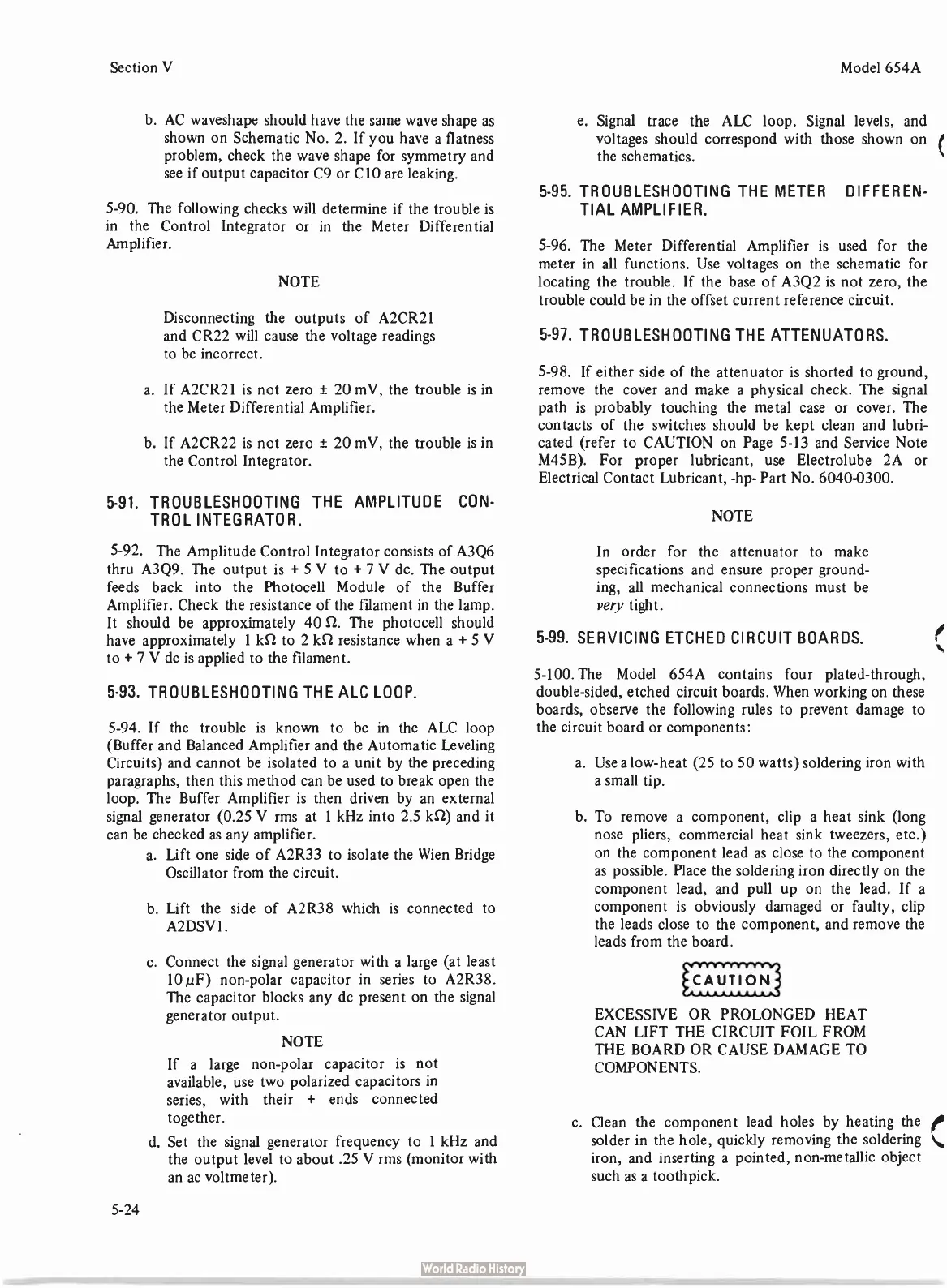
5-90.
The
following
checks
will
determine
if
the
trouble
is
in
the
Control
Integrator
or
in
the
Meter
Differential
Amplifier.
NOTE
Disconnecting
the
outputs
of
A2CR21
and
CR22
will
cause
the
voltage
readings
to
be
incorrect.
a.
If
A2CR21
is
not
zero ±
20
mV,
the
trouble
is
in
the
Meter
Differential
Amplifier.
b.
If
A2CR22
is
not
zero ±
20
mV,
the
trouble
is
in
the
Control
Integrator.
5-91.
TROUBLESHOOTING
THE
AMPLITUDE
CON-
TROL
INTEGRATOR.
5-92.
The
Amplitude
Control
Integrator
consists
of
A3Q6
thru
A3Q9.
The
output
is +
5 V
to +
7 V
dc.
The
output
feeds
back
into
the
Photocell
Module
of
the
Buffer
Amplifier.
Check
the
resistance
of
the
filament
in
the
lamp.
It
should
be
approximately
40
SI
The
photocell
should
have
approximately
1
kn
to
2
kft
resistance
when
a +
5 V
to +
7 V
dc
is
applied
to
the
filament.
5-93.
TROUBLESHOOTING
THE
ALC
LOOP.
5-94.
lf
the
trouble
is
known
to
be
in
the
ALC
loop
(Buffer
and
Balanced
Amplifier
and
the
Automatic
Leveling
Circuits)
and
cannot
be
isolated
to
a
unit
by
the
preceding
paragraphs,
then
this
method
can
be
used
to
break
open
the
loop.
The
Buffer
Amplifier
is
then
driven
by
an
external
signal
generator (
0.25
V
rms
at
1
kHz
into
2.5
ka)
and
it
can
be
checked
as
any
amplifier.
a.
Lift
one
side
of
A2R33
to
isolate
the
Wien
Bridge
Oscillator
from
the
circuit.
b.
Lift
the
side
of
A2R38
which
is
connected
to
A2DSV1.
c.
Connect
the
signal
generator
with
a
large (
at
least
10
liF)
non-
polar
capacitor
in
series
to
A2R38.
The
capacitor
blocks
any
dc
present
on
the
signal
generator
output.
NOTE
If
a
large
non-
polar
capacitor
is
not
available,
use
two
polarized
capacitors
in
series,
with
their +
ends
connected
together.
d.
Set
the
signal
generator
frequency
to
1
kHz
and
the
output
level
to
about .
25
V
mis
(
monitor
with
an
ac
voltmeter).
e.
Signal
trace
the
ALC
loop.
Signal
levels,
and
voltages
should
correspond
with
those
shown
on
the
schematics.
5-95.
TROUBLESHOOTING
THE
METER
DIFFEREN-
TIAL
AMPLIFIER.
5-96.
The
Meter
Differential
Amplifier
is
used
for the
meter
in
all
functions.
Use
voltages
on
the
schematic
for
locating
the
trouble.
If
the
base
of
A3Q2
is
not
zero,
the
trouble
could
be
in
the
offset
current
reference
circuit.
5-97.
TROUBLESHOOTING
THE
ATTENUATORS.
5-98.
If
either
side
of
the
attenuator
is
shorted
to
ground,
remove
the
cover
and
make
a
physical
check.
The
signal
path
is
probably
touching
the
metal
case or
cover.
The
contacts
of
the
switches
should
be
kept
clean
and
lubri-
cated (
refer
to
CAUTION
on
Page
5-13
and
Service
Note
M45B).
For
proper
lubricant,
use
Electrolube
2A
or
Electrical
Contact
Lubricant,
-
hp-Part
No.
6040-0300.
NOTE
In
order
for
the
attenuator
to
make
specifications
and
ensure
proper
ground-
ing,
all
mechanical
connections
must
be
very
tight.
5-99.
SERVICING
ETCHED
CIRCUIT
BOARDS.
5-100.
The
Model
654A
contains
four
plated-
through,
double-
sided,
etched
circuit
boards.
When
working
on
these
boards,
observe
the
following
rules
to
prevent
damage
to
the
circuit
board
or
components:
a.
Use
a
low-
heat (
25
to
50
watts)
soldering
iron
with
a
small
tip.
b.
To
remove
a
component,
clip
a
heat
sink (
long
nose
pliers,
commercial
heat
sink
tweezers,
etc.)
on
the
component
lead
as
close
to
the
component
as
possible.
Place
the soldering
iron
directly
on
the
component
lead,
and
pull
up
on
the
lead.
If
a
component
is
obviously
damaged
or
faulty,
clip
the
leads
close
to
the
component,
and
remove
the
leads
from
the
board.
EXCESSIVE
OR
PROLONGED
HEAT
CAN
LIFT
THE
CIRCUIT
FOIL
FROM
THE
BOARD
OR
CAUSE
DAMAGE
TO
COMPONENTS.
c.
Clean
the
component
lead
holes
by
heating
the
solder
in
the
hole,
quickly
removing
the
soldering
iron,
and
inserting
a
pointed,
non-metallic object
such
as
a
toothpick.
5-24

Related product manuals