63
Preventative maintenance schedule
Product Support: www.instron.com
Make daily checks of system
Before operating the system each day, a general check of the system is highly recommended. Performing
a good general check on a daily basis is an important part of preventative maintenance. It also allows the
operator to become familiar with the system, and with what is considered normal behavior and normal
appearance. Once familiar with the system, operators will be more likely to notice any abnormalities that
could indicate problems, or potential problems, with the system. Before operating the system each day:
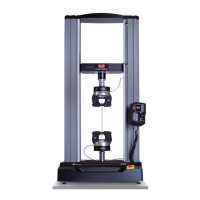
• Check that the frame is square and not out of alignment. This can be a simple visual check. Stand
away from the frame and check that all horizontal components (i.e. the compression table,
adjustable crosshead and tension crosshead) are parallel with each other and aligned vertically. Also
check that all vertical components (i.e. all columns) are parallel with each other and aligned
horizontally. Misalignment indicates that a larger problem exists.
• Check that all testing fixtures (compression plates, bend fixtures, external tension accessories,
adapters, etc.) are free of dirt, damage and deformation. Any fixture with damage or deformation
should be corrected before use!
• Check the tightness of the socket head cap screws in the retaining rings that support the tension
crosshead on the columns.
• Check that power is adequately supplied to the electronics. Start up the system and check all
indicator lights on the user control panel, HPS controls and 59 Series control unit. Check that the
lights are not too bright or too dim, and that they don’t flicker. If any of these conditions exist, this
could indicate a problem with the power supply in the 59 Series control unit or with system main
power (customer supply).
• Visually inspect the following for signs of oil leakage. Investigate any leakage and correct
appropriately. It is not necessary to remove any covers from equipment unless an oil leak is found.
• Any exposed hydraulic hoses - this may indicate leakage from loose connections or from
damaged hoses.
• Around the base of the frame - this may indicate leakage from internal hydraulic connections,
from the HPS, or from the hydraulic cylinder.
Remove covers as necessary to investigate any oil leakage; see “Remove and install base
covers” on page 64. If an oil leak is suspected from the hydraulic cylinder, see “Inspect the
hydraulic cylinder” on page 70 for guidance.
• Check that all cables are free of wear and chafing, have adequate slack to prevent excessive strain
on connectors, and have tight connections.
If any of these checks reveal a potential problem, the problem should be investigated and corrected
before the system is operated. For assistance in troubleshooting the system, contact your local Instron
Services department as directed on page 20.


 To Next Page