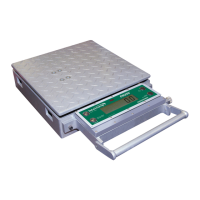
How to fix low battery on Intercomp CW250 Scales?
- KkdavisAug 15, 2025
If your Intercomp Scales display a low battery warning, replace the battery. If you're using rechargeable batteries, connect the charger. Warning: Do not charge alkaline cells.
How to fix low battery on Intercomp CW250 Scales?
If your Intercomp Scales display a low battery warning, replace the battery. If you're using rechargeable batteries, connect the charger. Warning: Do not charge alkaline cells.
What to do if Intercomp Scales show overcapacity?
If your Intercomp Scales indicate overcapacity, the solution is to reduce the load on the scale.
Why Intercomp CW250 show Zero Range Error?
A Zero Range Error on Intercomp Scales occurs when the scale attempts to zero off a load that is outside the specified zero range setting. To resolve this, remove the load from the scale and press the zero button.
What does load cell error mean on Intercomp CW250?
If the self-test shunt-current circuitry detects one or multiple load cell errors on your Intercomp Scales, this indicates that a load cell may have failed or there is a bad connection. "XX" represents the cell or connection that has failed: xx = 1-8 (single digit) if there is a single load cell failure, or xx = 2-digit hex code if multiple cells failed.
Why do Intercomp CW250 show run-time overload limit circuitry error?
A run-time overload limit circuitry error on Intercomp Scales suggests that a load cell may have failed or there is a bad connection. The "xx" indicates the specific cell or connection that has failed: xx = 1-8 (single digit) if there is a single load cell failure, or xx = 2-digit hex code if multiple cells failed.
What to do if accumulation conditions are not met on Intercomp CW250 Scales?
If certain conditions for accumulation have not been met on your Intercomp Scales, it's because the current weight is negative, zero, or the weight is in motion. The scale won't accumulate and will display the error message "?? .???" if the weight should be temporarily removed between accumulations.
How to fix AD converter failure on Intercomp Scales?
If the AD converter fails on your Intercomp Scales, the circuit board may need to be repaired or replaced.
How to fix EEPROM failure on Intercomp Scales?
If your Intercomp Scales experience an EEPROM failure, the scale will require recalibration.
What causes display error on Intercomp CW250?
A display error on Intercomp Scales means that the number is too large to fit on the display.
Lists key features of the CW250 scale.
Lists available optional accessories for the CW250 scale.
Details the general and display controls of the CW250 scale.
Covers voltage, batteries, charging current, and battery life.
Describes speed, accuracy, and calibration interval.
Specifies operating humidity and temperature ranges.
Outlines dimensions, weight, and overload capacity.
Details radio frequency, license requirements, and range.
Information on batteries, battery life, and technical notes for RF models.
Overview of the CW250 scale operation.
Explains the components and indicators of the scale's LCD display.
Instructions for powering the scale on and off.
Describes how to print and accumulate weights.
Explains how to switch between local and total weight displays.
Details the function of the ZERO key for zeroing and clearing accumulated totals.
Steps to set the scale number and total number of scales in a system.
Explains how to set the host designation for network control.
Instructions for setting the serial output mode and baud rate.
Describes the On-Demand serial output mode.
Details the data format for serial output in continuous mode.
Describes the "Accumulating Print Axle" mode and its print ticket format.
Details the "Accumulating Print Standard" mode for weighing multiple items.
Step-by-step guide for performing weight accumulations.
Instructions on how to enter the Mode Menu.
Lists parameters, functions, notes, and defaults in the Mode Menu.
Configures backlight and set points (S1, S2).
Displays firmware version and sets averaging parameters.
Configures auto shutoff, print mode, and baud rates.
Sets measurement units, protocol, and interface baud rate.
Configures radio enable status and radio channel.
Sets Personal Area Network ID and encryption key.
Pre-calibration steps and jumper settings.
Explanation of the calibration enable jumper's function and placement.
Steps to enter the calibration menu.
Lists calibration parameters, functions, and defaults.
How to skip parameters and set the unit of measure.
Setting graduation breakpoints for scale calibration.
Configures ADC rate, auto zero tracking, and zero range.
Setting the graduation size for display readings.
Explains applying load weights for calibration.
Applying and entering the first and second calibration weights.
Applying and entering the third and fourth calibration weights.
Steps to finalize calibration and secure settings.
Lists common error messages and their definitions.
Explains diagnostic codes used in calibration and troubleshooting.
Details the pin configuration of the PT connector.
Information needed when requesting service.
| Display Type | LCD |
|---|---|
| Auto Shut-off | Yes |
| Capacity | 250 lb / 110 kg |
| Power Source | Battery (9V) |
| Accuracy | ± 0.1 lb / 0.05 kg / 0.01 st |
| Resolution | 0.1 lb / 0.05 kg |