32
JPK Instruments NanoWizard
®
Handbook Version 2.2
The mechanical stability of the sample mounting is also critical for hig
h resolution
imaging. A solid base, such as a metal stub or glass microscope slide is a good start.
The mica or other substrate should then be glued with a crosslinking glue or epoxy. If
the imaging is only in air, then solvent-based glues like supergl
fast-
setting glue) are a convenient alternative. Superglue is not stable in water, and will
swell, become soft and lose material into the liquid. So even if the liquid should not
come into contact with the glue, it is not recommended.
A 2-
part epoxy makes a stable, solid bond that will not be affected by contact with
liquids and will not drift or move with time. Although this is usually slower than
superglue, it is worth the extra time preparing the substrates, to avoid later time-
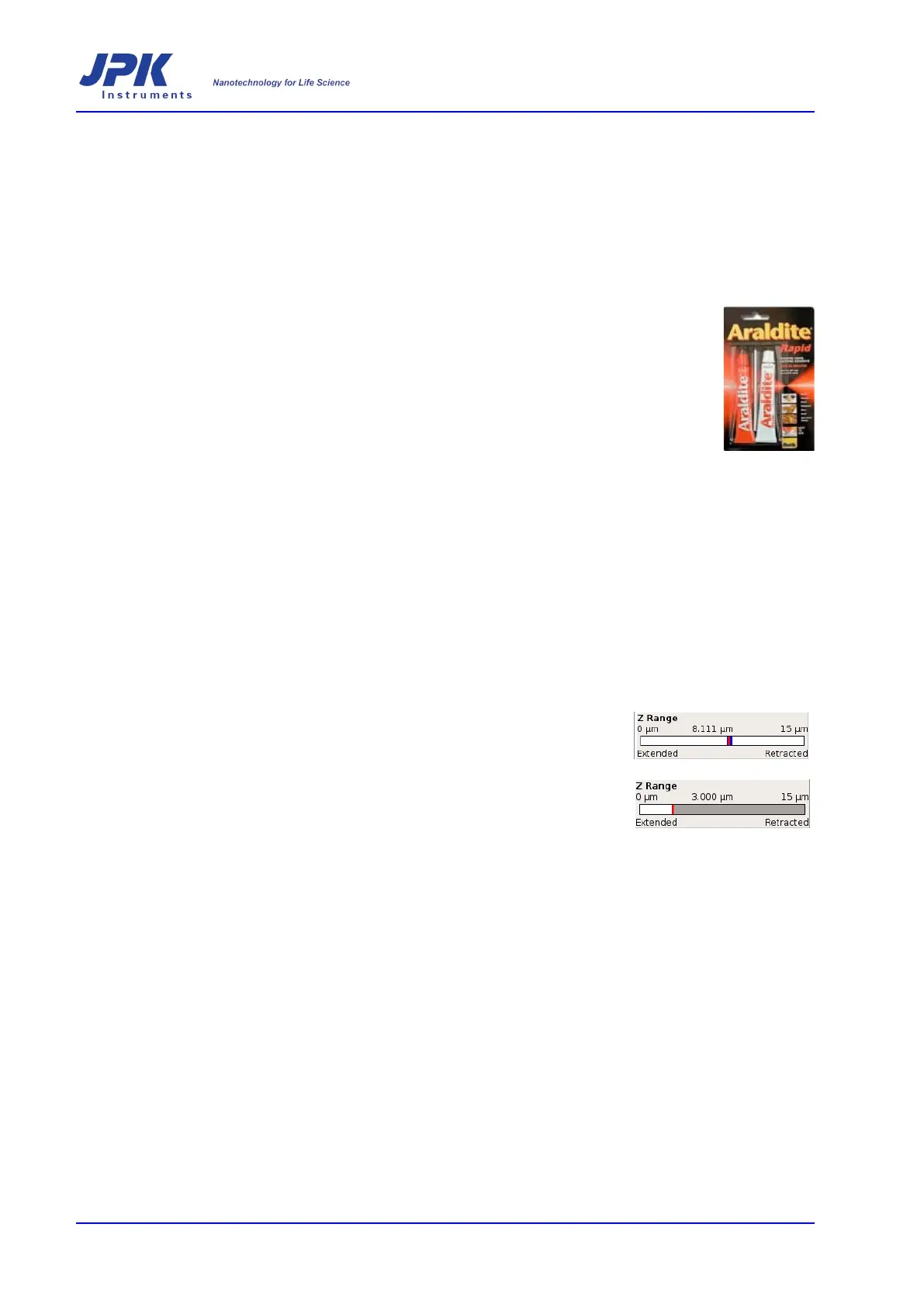
consuming experiments being contaminated. Fast setting epoxies (for instance, 5-
minute Araldite Rapid) give good results. UV-
setting glue is also a good alternative if a
UV lamp is available – this gives good mechanical results, fast setting and very
good
optical properties (for example the Optical Adhesive range from Norland).
Double-
sided tape is never recommended for high resolution imaging! When the tape
is stuck, there is usually some shear on the surface. The elastic polymer components
tend
to relax back over time, giving large drift over hours or even days. The results can
be reasonable if the tape is stuck very carefully, but it is not worth preparing precious
samples using this kind of mounting, only to discover that the sample drifts too
Use all the advantages available from the AFM system
The NanoWizard
®
AFM system has several features to optimize
minimize
drift and vibrations. The setup should be checked carefully to make sure that
all thes
e things are being used to best advantage. For instance, do not forget to
release the bio-
sample holder in the Life Science stage by moving the sample holder
positioning screws back approximately half a revolution. Check that all cables are
loose (no wei
ght or force dragging on them), and fixed to the vibration isolation table so
they do not transmit vibrations from the environment. Note also that the z-
should be reduced in order to increase the bit-
resolution and reduce the electronics
noise. The 15 micron range of the NanoWizard
®
AFM system can easily be reduced to
3.0 or 1.5 microns using the software, to optimize the z-resolution.
If the AFM is set up on an optical microscope, and the sample is mounted on mica,
then it can be u
seful to turn on the optical microscope at the beginning to check the
sample surface. Ideally there is nothing to see, but this is a good check before wasting
cantilevers on a contaminated sample. Using optical phase contrast settings, for
instance, even
small layers or patches of contamination are visible, along with bacteria
or other things that could cause problems. A quick check with optical microscopy can
save time and cantilevers by discounting samples, or by choosing a good area to start
imaging.
Large mica steps are also visible, particularly where there are broken or
damaged regions. Regions on the mica near large steps or broken regions should be
avoided for high resolution imaging.


 To Next Page