JPK Instruments NanoWizard
®
Handbook Version 2.2a
21
properties. There are many different options, depending on the particular
application, but a couple are introduced here.
Hydrophobic cantilevers
Hydrophobic tips can be used to image hydrophilic surfaces (e.g. proteins) under
high-humidity condi
tions with small forces and thus high resolution. The adhesion
between hydrophobic and hydrophilic surfaces is lower than between similar
surfaces, so the sample disruption should be less. Silanization is one method to
change the chemical
groups on the surface of the cantilever, and make it more
hydrophobic. An example of a silanization protocol is given in this handbook, see
Section 9.2.
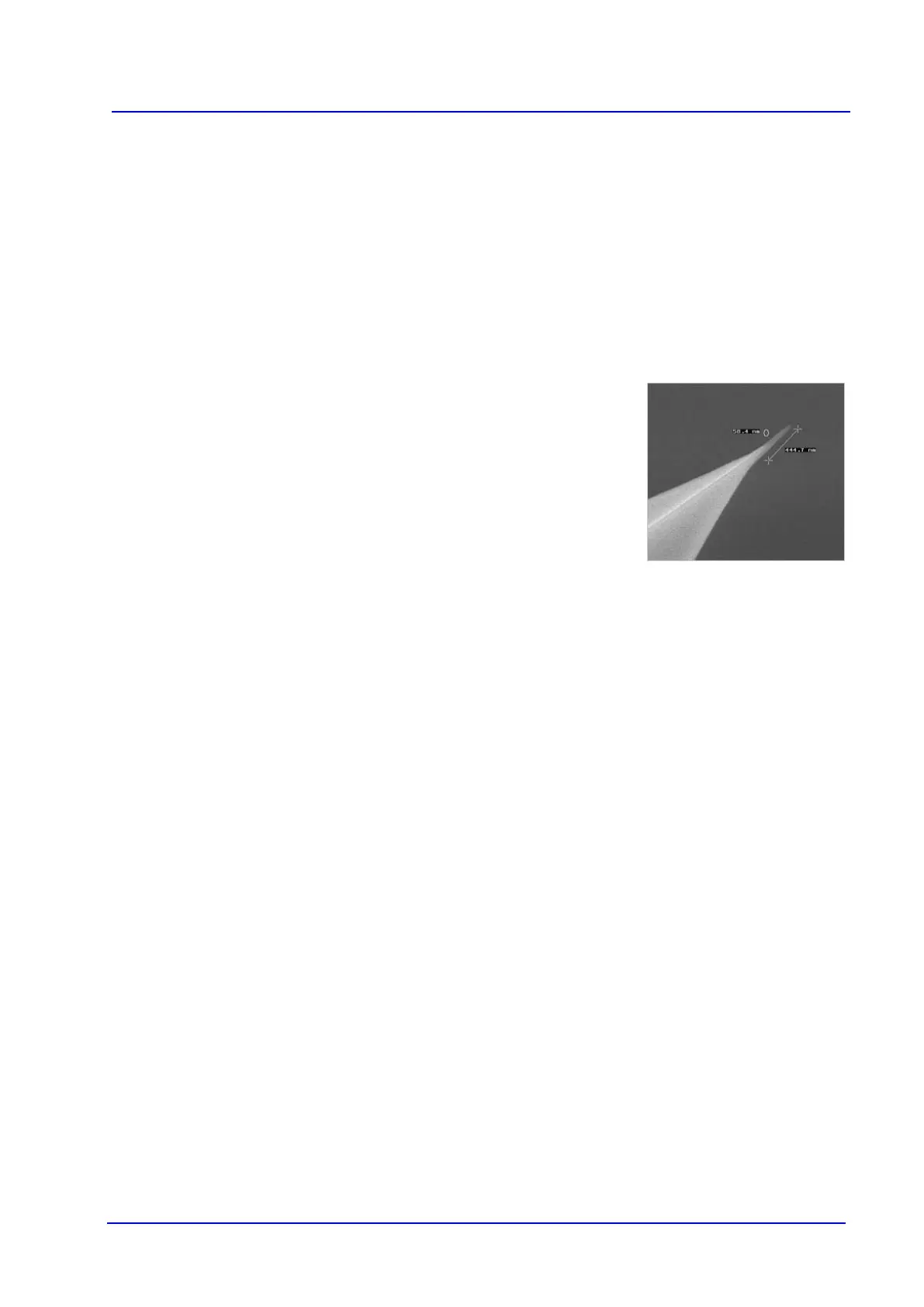
EBD tips
Electron beam deposited (EBD) tips are AFM tips that have been modi
a narrow tip-on-the-tip. Normally shaped silicon intermittent-
modified in scanning electron microscopes. The elec
tron beam focused on top of
the tip deposits a small column of carbon, leading to a tip with narrow ra
dius and
high aspect ratio. The carbon is from the hydrocarbon contamination in the
vacuum chamber of the SEM.
The high aspect ratio of the tip is one advantage of this method, and allows
imaging of structures such as grooves or troughs, that are not i
maged well by tips
with conventional shapes. The amorphous carbon surface may also be less
adhesive than the bare silicon tips for imaging samples such as proteins. Each tip
must be individually modified, however, and this is not practical for most AFM u
on grounds of either access to equipment, or cost to purchase such tips.
Knapp, HF, Wiegräbe, W, Heim, M,
Eschrich, R, Guckenberger, R.
Biophys. J. 69 (1995) 708-
715.
"Atomic force measurements and
manipulation of Langmuir-
Blodgett
films with modified tips”
4.5 Spring constant
Background information
The analysis of force curves uses force against tip-sample separation. This means
the vertical deflection signal from the detector has to be converted from Volts into
Newtons, and the z-position signal needs to be corrected for the deflection of the
AFM tip along the same axis.
The spring constant calibration (N/m) is generally the most difficult part of the
calibration.
There are various different methods to calibrate the spring constant of
an AFM cantilever, and unfortunately all of them have significant problems. If
experiments are compared where different methods are used, sometimes
differences of 10-20% can be seen
. The methods are reasonably consistent if they
are used carefully, so it is often good to pick one particular method and calibrate all
cantilevers as consistently as possible. This means the data from different
cantilevers can be combined well to give g
ood statistics. Then it is just important to
realize
that there will be some systematic difference between the results from
different methods.


 To Next Page