JPK Instruments NanoWizard
®
Handbook Version 2.2a
39
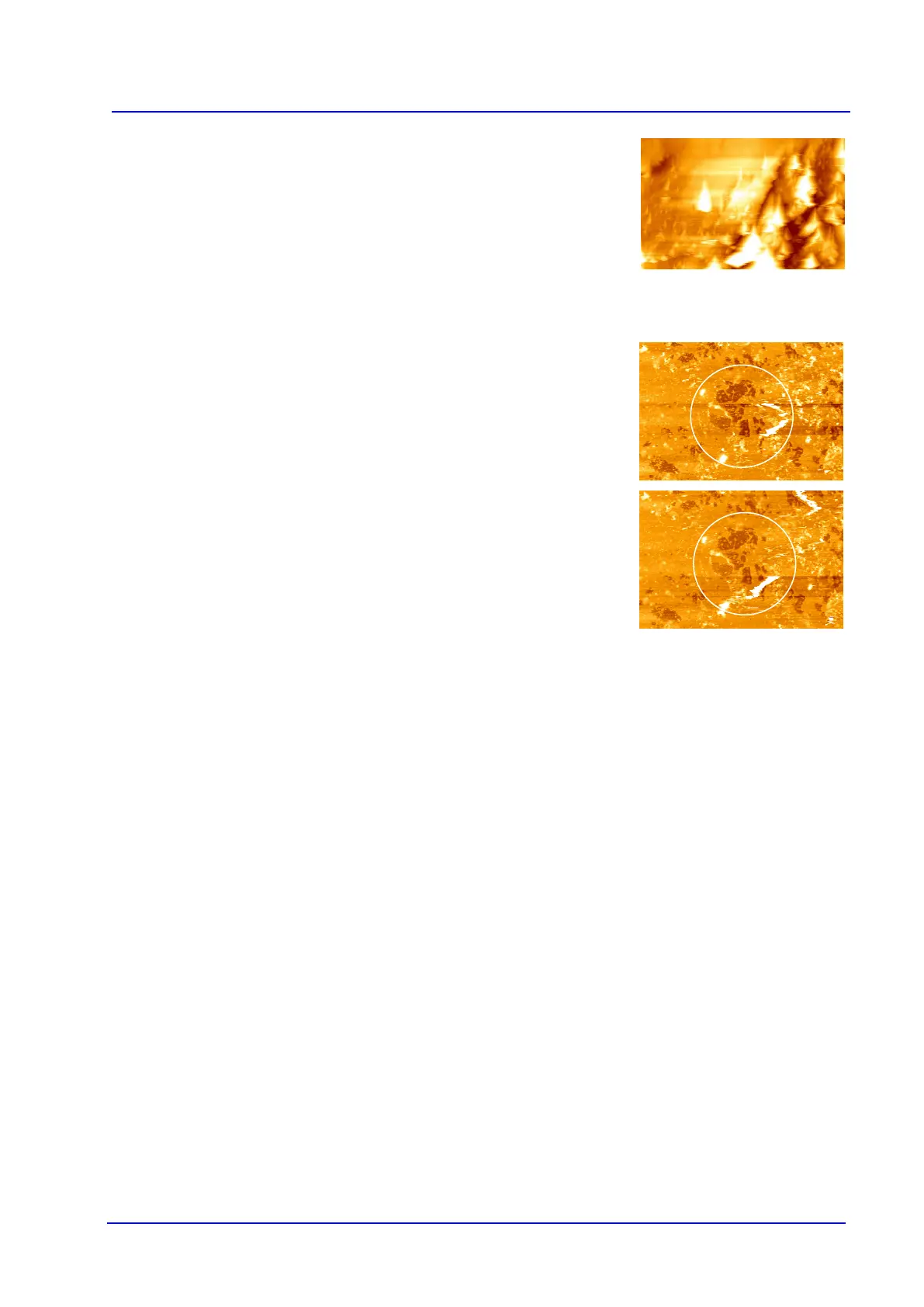
Dull or dirty tips generally lead to fea
tures on the surface that have the same shape
and orientation. In this case, what is imaged is actu
ally the shape of the tip, and the
sharper features in the sample act as a probe.
7.3 Contamination
The sample itself may contribute to SPM image artifacts
, if there is loose debris or
contamination from the sample surface.
This polymer coated glass slide shows a well-defined sub-
also loose debris on the surf
ace (seen as the white streaks), which is moved
around by the tip. Loose debris on the sample sur
face is moved by the cantilever
to other areas of the sample. Some of the sample structure is con
the two images, but the higher debris on the
surface changes from scan to scan.
(Image sizes 25 x 25 µm, intermittent contact mode)
7.4 Other imaging considerations
Tip shape and interaction forces
Since an interaction force is measured by the cantilever, then the probe always
also exerts some for
ce on the sample. This can cause problems of distortion or
damage to the sample, which may move under this force, particularly since many
biological samples are soft and delicate, and require particularly careful AFM
imaging. The choice of probe and scan
ning conditions is very important,
depending on the sample to be imaged.
Commercial probes are available with a variety of cone angle and tip radii for
different applications; high resolution imaging will require a sharp tip with a high
aspect ratio to accurately reproduce the sample. There are other artifacts
that
commonly occur in scanning, however, in addition to the ones from the
geometrical shape of the tip. The interaction forces may also compress or drag
parts of the sample, moving objects or chan
ging the height or width of soft features
in the images. For a given imaging force, the local pressure on the surface will
depend on the contact area, and in some cases the use of ultra sharp tips can
cause more problems with distortion and damage than th
resolution. See also Section 5.5 and Section 5.6
for a discussion of imaging soft
samples with a large height difference, for the specific example of cell imaging.


 To Next Page