JPK Instruments NanoWizard
®
Handbook Version 2.2a
45
8.3 Young’s Modulus of materials
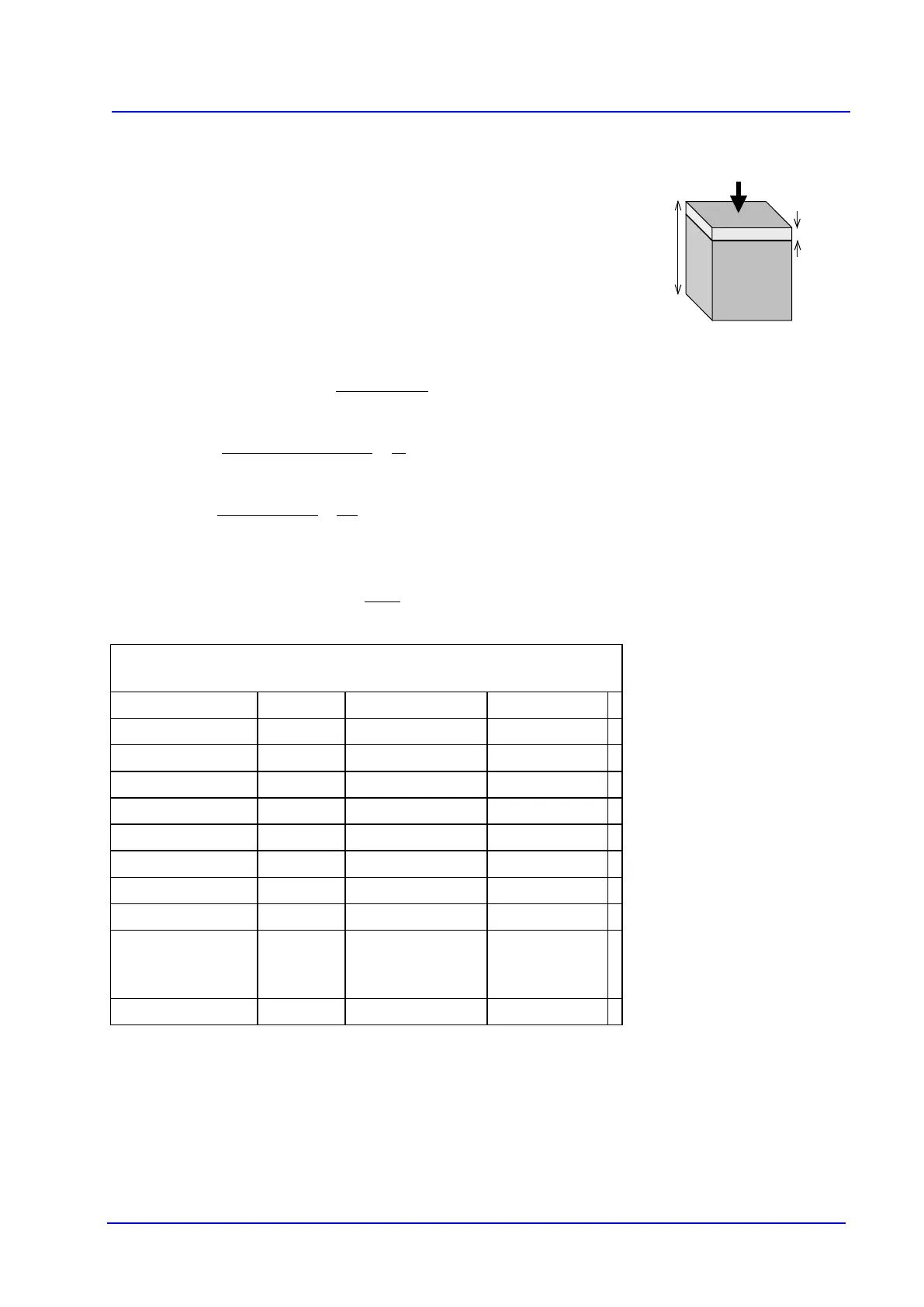
The Young's Modulus is an elastic property of a material, and is defined as the
stress of a material divided by the strain. This is a normalized
compressibility - the higher the value the stiffer is the sample.
The Young’s Modulus, E is given by:
strain tensile
stress tensile
E =
A
F
area sectional-cross
force tensile
stress tensile ==
L
L
length original
extension
strain tensile
∆
==
Substituting (2) and (3) into (1) gives:
Typical E-values for some materials
9
9
9
9
9
9
9
9
9
Carbon nanotubes
Single-walled (SWNT)
~ 1000 GPa
~ 1000 ּ 10
9
Pa
9
~ 10,000,000 bar
9
*Cluzel, P., et al., Science (1996)
271, 792
If a piece of material is compressed
homogeneously, the calculation of the Young’s
Modulus is straightforward. For AFM measurements, however, the indentation
geometry is m
ore complicated, because the surface is locally indented with a
specific tip shape and fitting is required. The Hertz model
used to analyze AFM force-distance curves to extract the elasticity.
However, the
Hertz model makes serious assumptions about the sample, for example that it is


 To Next Page