4
JPK Instruments NanoWizard
®
Handbook Version 2.2
imaged in physiological conditions. There is no need for staining or coating, and
no requirement that the sample sh
ould conduct electrons. Therefore high
resolution imaging is possible in physiological buffer or medium, and over a range
of temperatures. Living cells can be imaged, as well as single molecules such as
proteins or DNA. The force contrast gives 3-dimens
ional topography information,
as well as the possibility to access other information such as the mechanical
properties or adhesion.
1.5 AFM cantilevers
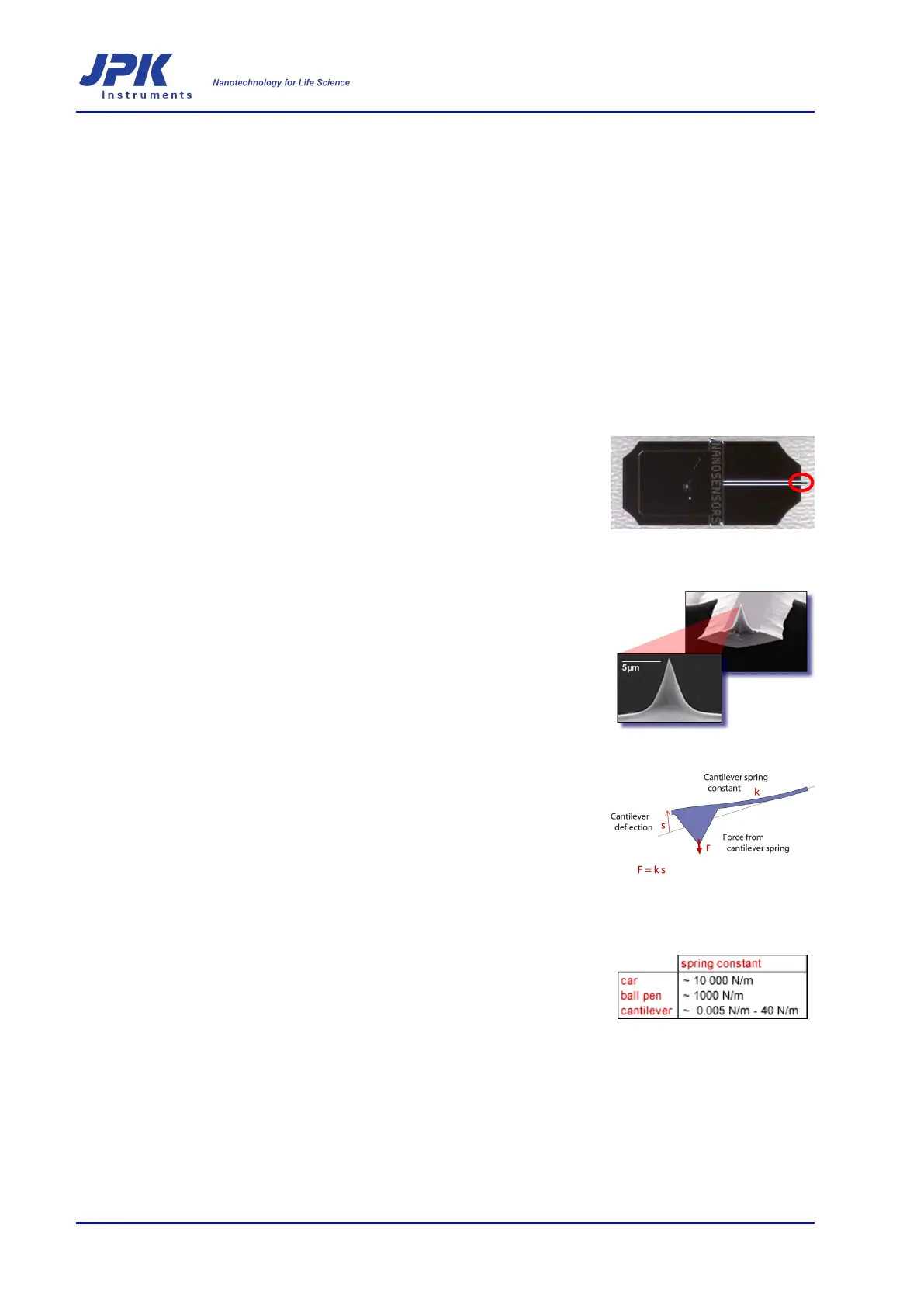
Cantilevers are fabricated on chips
What you get when you order cantilevers is a small micro-precision-
machined
rectangular or triangular piece of silicon or silicon nitride with a shiny surface. The
minute cuboid you can see is not the cantilever itself, but the chip that holds the
cantilever. Generally you need a magnifying glass to see the cantilever at
the
narrow side of the chip. Sometimes there are two or more cantilevers attached to
the narrow edges of the chip.
What you are unable to see without a good optical microscope is the tip at the end
of the cantilever. Typically the tip is a few microns
long, and shaped like a pyramid
or a cone. The radius and angle of the end of the tip determines the imaging
quality.
Cantilevers can be thought of as springs.
From physics lessons in school, you may recall that the extension of springs can be
described by Hooke's Law
F = - k * s.
This means: The force F
you need to extend the spring depends in a linear way on
the distance s that you extend it. This linear behavior
just means that if you double
the deflection of the spring, the force is also doubled.
The four damping springs of a car's wheels have a higher spring constant than the
spring in your ball pen. The spring constants of the commercially available
cantilevers vary over four orders of magnitude; cantilevers with spring constants
between 0.
005 N/m and 40 N/m are commercially available. You can deduce the
properties of a cantilever from its outer shape. Thicker and shorter ones tend to be
stiffer and have higher resonant frequencies.
chip
cantilever


 To Next Page