16
JPK Instruments NanoWizard
®
Handbook Version 2.2
3.3 Applications
There are a huge number of potential applications of force spectroscopy, ranging
from nano-mechanical investigations of elastic properties to pro
tein unfolding and
investigations of single chemical bonds, so only a brief overview is possible here.
Virtually any sample can be studied using force spectroscopy, and different
interactions or tip coatings and shapes will all give complementary informat
Molecular interactions
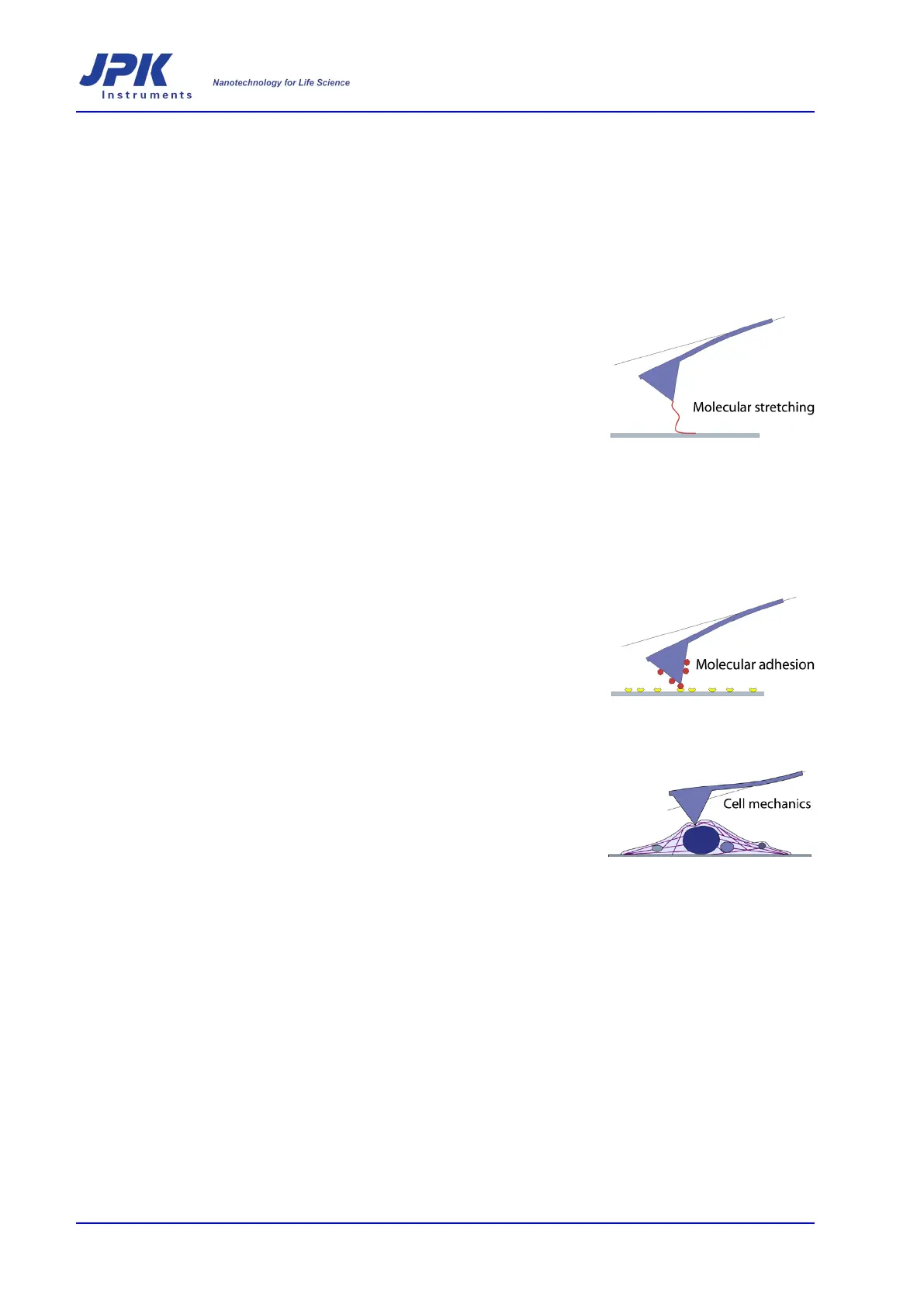
When molecules are attached to the tip and/or the sample, the stretching, unfolding
or adhesion of single molecules can be studied. Long chain molecules, such as
DNA or dextran can be stretched between the ti
p and the sample. The stiffness,
persistence length and internal molecular transitions can be studied. The melting
transition in DNA can be seen as the backbone rearranges under raised tension.
Molecules with complex 3-dimensional structure, such as m
any proteins, can be
unfolded in a controlled way so that the structural units can be investigated. Titin
and bacteriorhodopsin are examples of proteins that have been intensively studied.
Membrane proteins can be pulled out of the membrane, and the “pop
ping” out of
individual alpha-helices has been seen.
The adhesion can be measured between molecules attached to the tip and to the
sample. These can be antibodies and antigens or other receptor-
adhesive forces can be measured and mapp
ed over the surface, and information
extracted about the energy and kinetics of the binding. These techniques have
also been applied to the binding between complementary and mismatched DNA
strands.
Cellular mechanics and interactions
The viscoelastic r
esponse of cells can be studied by using the cantilever to indent
the cell. On living cells, the changes in mechanical properties can be seen as the
cell divides, or when drugs such as cytochalasin, which disrupts the cytoskeleton,
are added. Mechanosensi
tive cells such as osteoblasts or ear cells can be
stimulated with the cantilever, and the response monitored. Adhesion maps over
the surface are also possible to investigate the distribution of receptors.
The following table gives an overview of some i
nteractions, and the part of the
force curves that they are measured in.


 To Next Page