38
JPK Instruments NanoWizard
®
Handbook Version 2.2
When imaging very small features, dull or blunt tips result in images with features
that appear much wider than the actual size. With very sharp tips, the image width
more closely represents the actua
l feature width. The height d of the feature
however, is accurately represented in both cases, for this idealized
example. In a
real imaging situation, sample compression and deformation also needs to be
taken into consideration and can cause other imaging artifacts.
Most commercially available probes have tip radii in the range of 5 -
cone angles in the range 20-
70 degrees, but the tips can be modified in a variety of
ways to produce other shapes or sizes. Examples include using electron bea
m
deposition to grow an amorphous carbon spike on the tip, using a focused ion
beam to mill the tip to a desired shape, or attaching carbon nanotubes to provide a
very high aspect ratio tip.
7.2 Artifacts from damaged tips
The part of the tip that interacts with the sample is often a critical source of artifacts
in AFM. Even unused tips may have two points at their very end. Double
tips may
also occur on worn tips that have been damaged during scanning.
Double tips
Sometimes, rather than having a single sh
arp end, the tip may have two or more
“end points”. In this case, each may contribute to the image, causing a vari
effects.
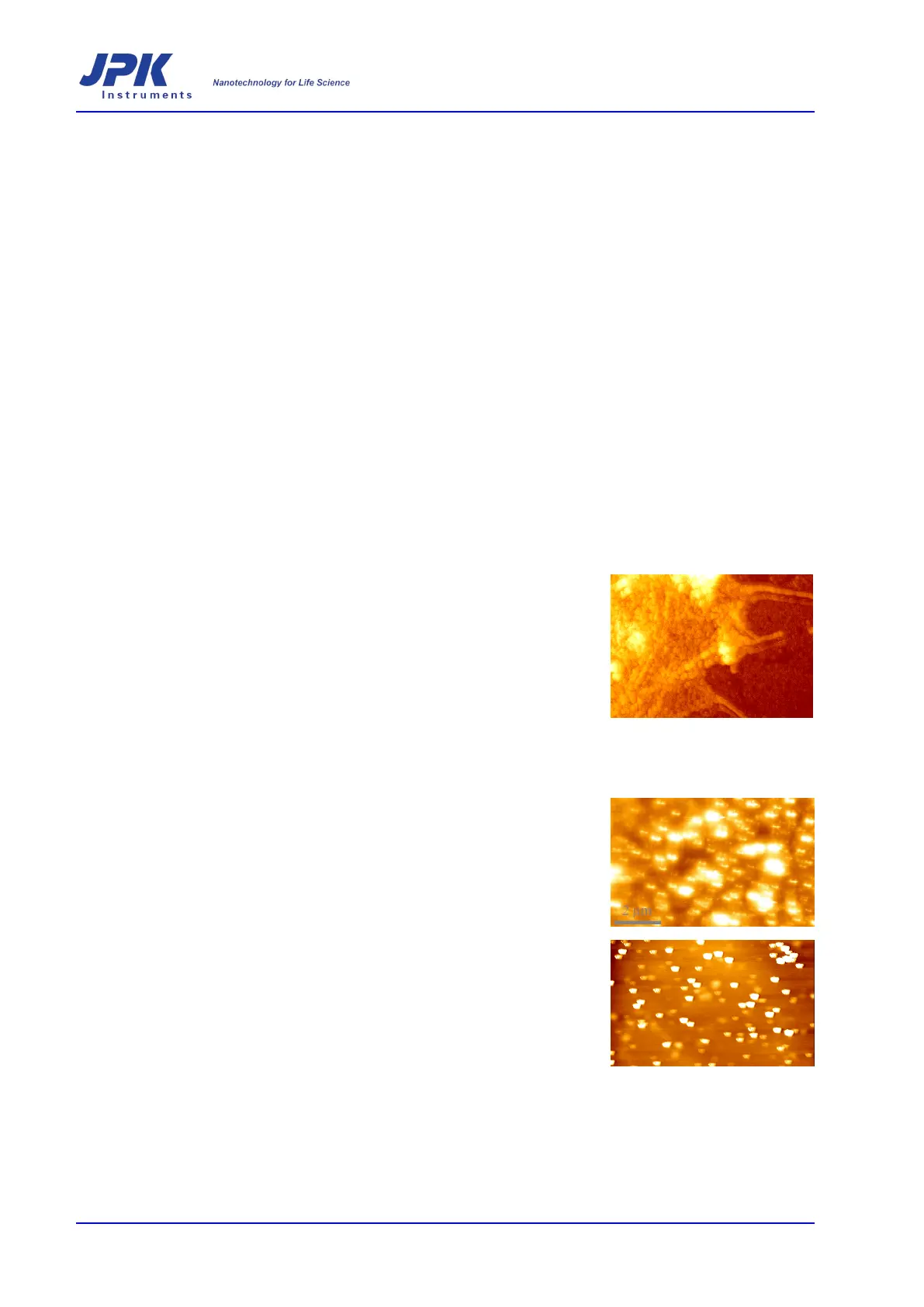
In the image shown here of the edge of a cell, the fingers stick
seem to be around 200nm wide and appea
r in pairs. This shadowing or doubling of
the features is a characteristic artifact
of a double tip. Note that at the edge, where
there are separate features, it is eas
ier to see the effect, while it could more easily
be missed over the cell body where the surface has more, smaller features.
Other tip shapes
A damaged tip often does not have two distinct tip end points, but some
complicated tip shape that interacts with the surface. Repeatedly occurring
features “rubber stamped” over the surface, such
as can be seen in the example
here, are a common artifact
caused by a poor tip shape. All the features have a
characteristic shape and the same orientation.
Another example of repeatedly occurring fea
tures caused by a dull tip. Here the tip
is quite blunt, and has a triangular shape.


 To Next Page