48
JPK Instruments NanoWizard
®
Handbook Version 2.2
Detergent treatment
Where biological material has adsorbed to the tip (for example after imaging living
cells or sticky protein aggregates), detergent treatment can be
useful to remove
material from the tip. Either a pure detergent can be used (for example, triton or
SDS), or a special mixture for cleaning cell culture glassware (e.g. Hellmanex, for
instance as a 2% solution). Often the best results are achieved by lea
ving the
cantilevers for a long time and heating. For example, leave the cantilevers
overnight at 40 or 50 ˚C in a petri dish on a hotplate.
Mild cleaning, particularly suitable for
biological contamination.
9.2 Silanization and APTES treatment
Silane treatment can be used to change the surface properties, different treatments
can be used on glass, mica, and also cantilevers . Either a solution or vapor
treatment can be used, the vapor method usually gives cleaner results.
Aminopropyltriethoxysilane (APTES) can be used to make the surface of glass or
mica both more hydrophobic and positively charged. After tre
will have amine –
NH2 groups that are positively charged in aqueous solutions. The
chemical needs to be high quality (high purity) or the surface contamination will be
larger than the proteins or other sample to be imaged. The chemical
is rather toxic,
so should generally be used in a fume cupboard.
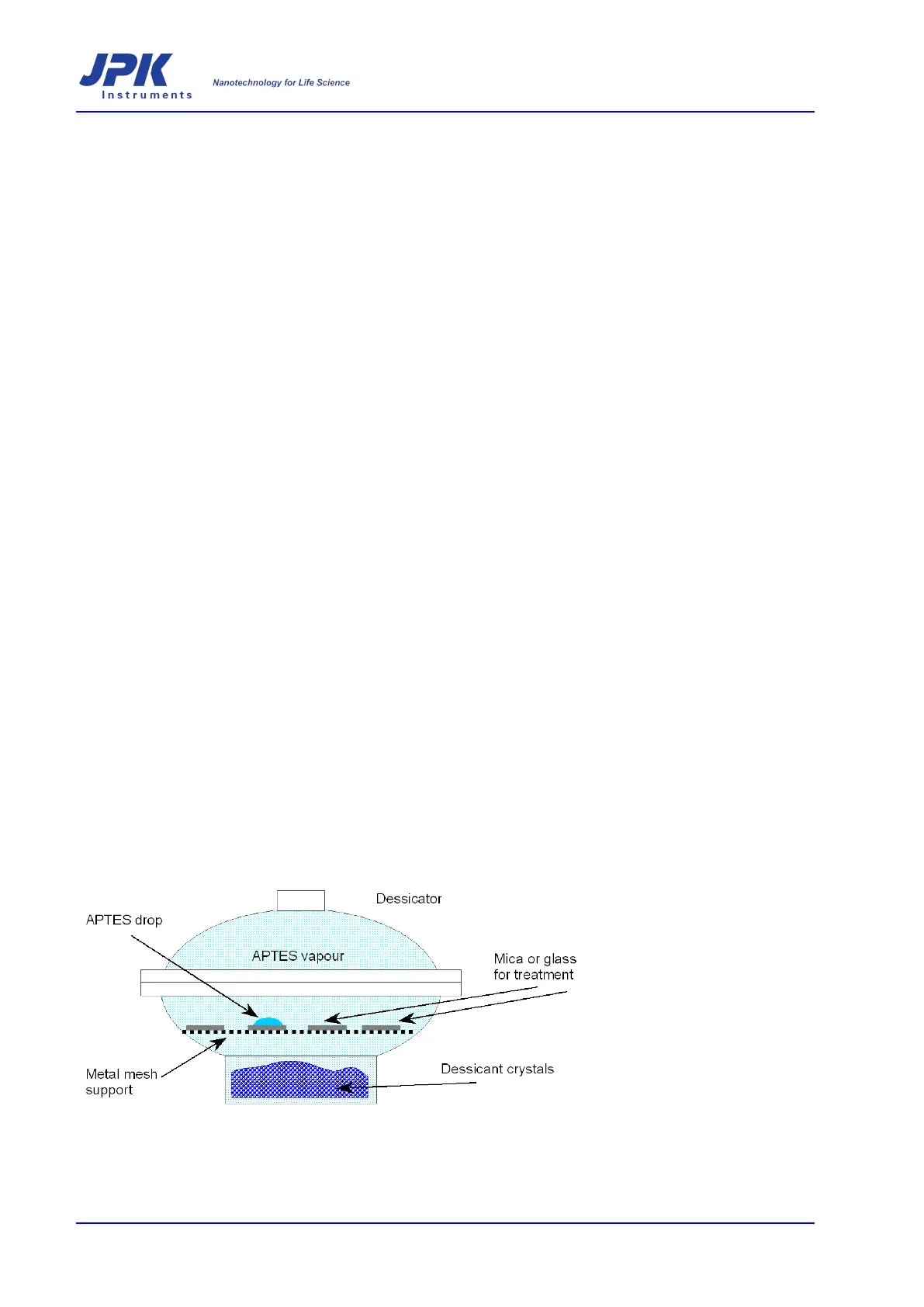
The reaction should be done in small clean desiccator; this is the vapor
coating, so you need an enclosed space for the vapor
to react with the surface.
The dry conditions are i
mportant to prevent the APTES crosslinking to form large
aggregates. Freshly cleave several pieces of mica, or placed cleaned glass
coverslips on the metal mesh support in the desiccator
. Put one extra piece of mica
for the APTES liquid – note this must al
so be freshly cleaved! Place a droplet of
APTES on this mica. For a smallish (around 20 cm diameter) desiccator
, 20
microlitres APTES is enough.
Leave for around 2 hours to treat a freshly cleaved mica surface. The reaction is
rather faster with gla
ss, if coverslips are treated for example, clean them first and
try a treatment for 15-30 minutes.
At the end, the droplet of APTES will have turned into a whitish silicate solid, this is
not used, and the mica can be cleav
ed again to remove the reacted APTES. The
other pieces of mica should now have reacted with the vapor. The surface is best


 To Next Page