JPK Instruments NanoWizard
®
Handbook Version 2.2a
35
Settings
In contact mode, the most important thing is to reduce the force by reducing the
setpoint. After a successful approach the deflection setpoint should be decreased until
the contact with the surface is lost. After that, the setpoint should be incre
ased until the
tip is just tracking the surface. The gains can then be increased to the maximum values
to get a good image. The scan speeds for contact mode can be rather higher than
intermittent contact mode, because there is no limitation from the canti
lever resonance.
This is especially the case for very flat surfaces, such as the protein crystals mentioned
above, where scan rates of over 5 Hz can be used.
6.4 Imaging hints – imaging in air
Generally, imaging protein samples in air is much easier than
in liquid, since the dry
proteins are much more stable, and not so likely to be moved around by the tip. The
particles are harder and do not tend to stick to the cantilever so much, so cantilever
contamination is less of a problem. Sometimes it is good t
o test sample preparation by
imaging first in air –
as the contamination is much less of a problem, more samples can
be quickly checked for surface coverage or contamination. When the right preparation
parameters are found, then the liquid imaging can start.
Cantilevers
For contact mode in air, the choice of cantilever is quite wide. Since the dry proteins
are much harder than the hydrated proteins, and they are usually very well stuck down,
then the range of spring constants go
es from the softest cantilevers up to the medium
contact mode cantilevers, for instance 0.01 -
0.5 N/m. For intermittent contact mode,
standard non-
contact mode cantilevers can be used in air (stiffness around 40 N/m,
resonant frequency around 300 kHz). As in liquid, the oxide sharpened or super-
sharp
versions of cantilevers can give a significant improvement in the image resolution.
Settings
Standard contact mode settings are generally fine for imaging molecules in air. As in
liquid, reducing the for
ce and increasing the gains are the main points, but the imaging
is generally not as sensitive. In intermittent contact mode, the main difference to other
samples is that a small oscillation amplitude may be better. Again aim for around 10
nm amplitude (
this time the sensitivity must be estimated, for instance by measuring on
an old cantilever, since the stiff cantilevers will definitely blunt the tip if used for
sensitivity measurements). Larger amplitudes may be required if the sample is
contaminated or sticky
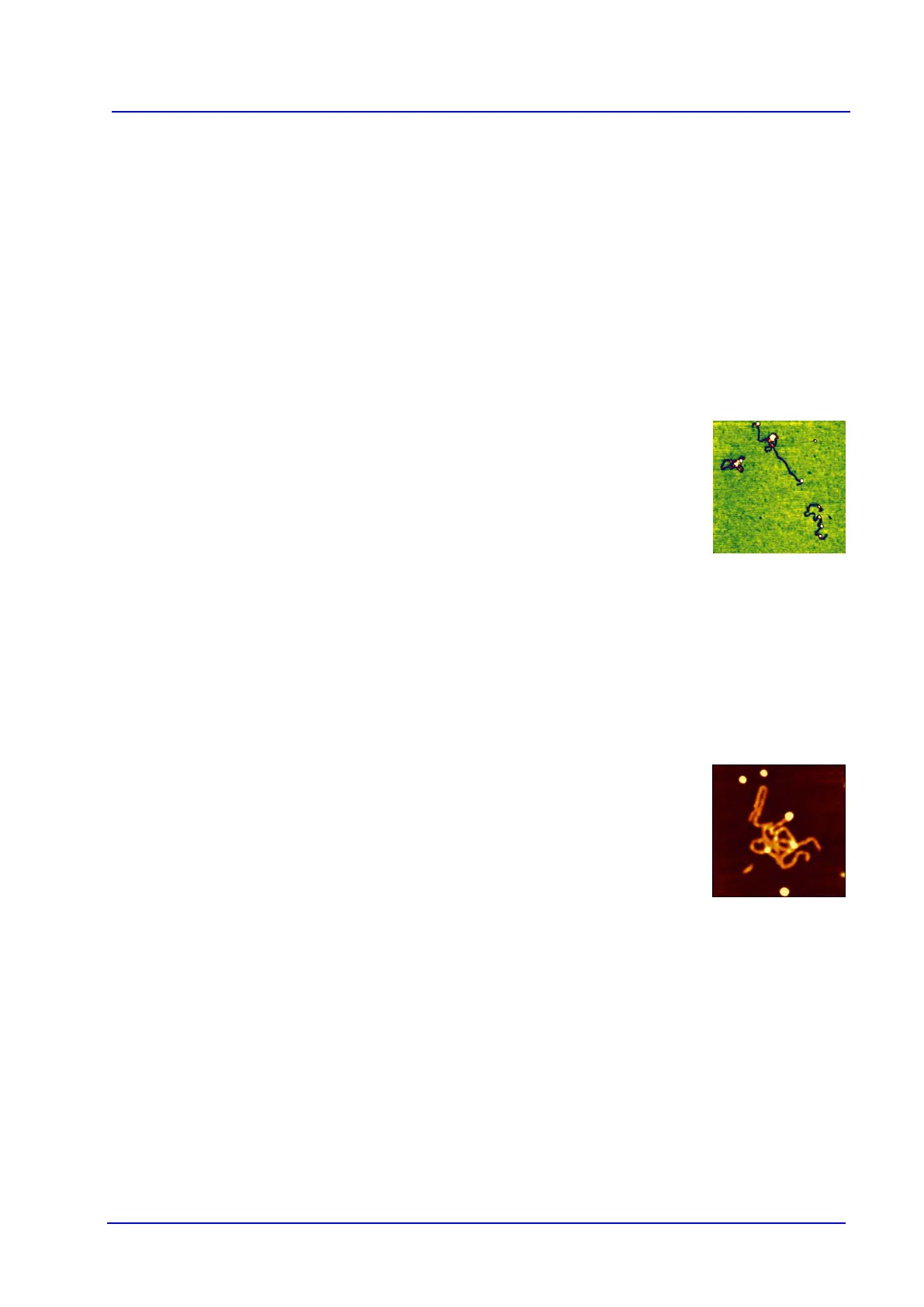
Dendrimer molecules
6.5 Simple DNA protocol for imaging tests
Unfamiliar samples are more difficult to image, because there may be many
unexpected problems with sample preparation, contamination etc. Sometimes it is
good to start with a simple ex
ample to become familiar with the settings. This DNA
protocol is fairly simple and reliable, so well suited to imaging testing.


 To Next Page