JPK Instruments NanoWizard
®
Handbook Version 2.2a
31
6. Single molecule imaging
6.1 Preparation is key
The AFM is well suited to biomolecular imaging, because of the high resolution and the
ability to work in liquid. For high resolution im
aging, however, the setup needs to meet
high standards across all areas –
in the sample preparation, cleanliness, and of course
in the hardware and drift or vibration reduction. When imaging cells, contamination on
the nanometer scale has a negligible eff
ect on the imaging. When imaging single
molecules, any contamination will be visible in the images, and may completely
obscure the molecules that are intended for imaging.
Start by making sure everything is clean
• Keep all tools (substrate, cantilever, c
antilever holder, tweezers, pipettes, pipette
tips) as clean as possible, if possible sterile.
•
Items that can be cleaned should be cleaned in an ultrasonic bath and rinsed in
ethanol and milli-Q water and blown dry.
• The best results are often obtained when
sterile disposable plasticware is used for
preparing and storing samples and buffers.
• Keep all chemicals (buffers, milli-
Q water, cleaning liquids like ethanol) as clean as
possible. Keep ultrapure water and low-to medium salt buffers in the fridge. Try
avoid using stock solutions directly –
pour enough for one experiment into a
separate sterile container and close the stock solution immediately.
• Make up buffers fresh whenever possible, filter before use with a syringe filter.
• If anything needs drying
, use a nitrogen cylinder with a suitable gas regulator to
blow the object dry (but make sure that the nitrogen is filtered and comes out of a
clean tube). This removes the liquid droplets from the surface, rather than allowing
them to dry onto the surface and leave all the contaminants.
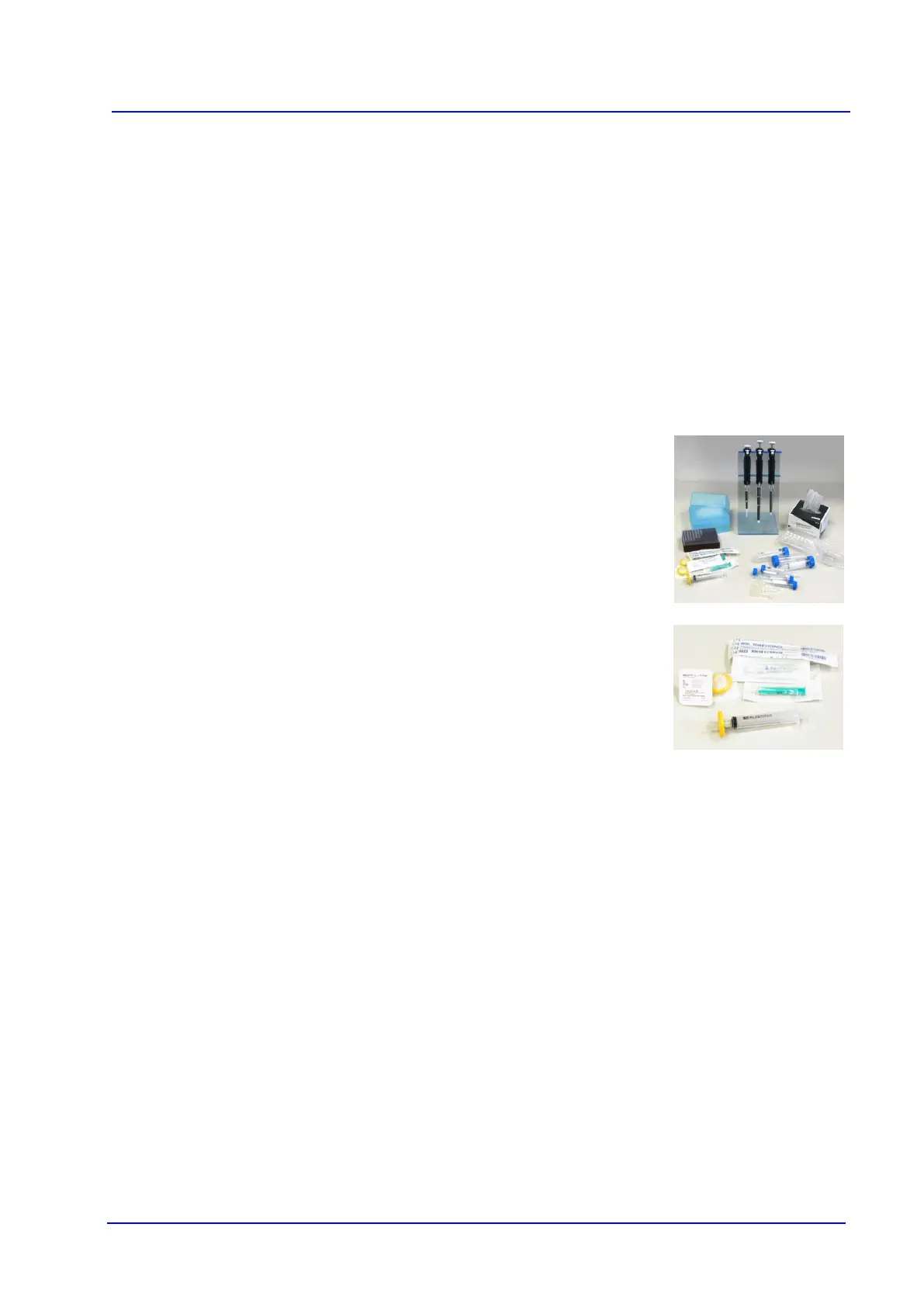
Basic lab equipment
Use a good sample substrate and mount it carefully
Generally, for imaging single proteins the substrate mica works best. The surface is so
flat that even the smal
lest features can be seen on the large, molecularly flat regions,
and it is easy to obtain a really clean surface by cleaving the mica. The mica surface is
highly hydrophilic, and negatively charged in aqueous solutions. HOPG (highly
oriented pyrolitic g
raphite) is another possibility, for molecules that will stick to a
hydrophobic surface. This also has molecularly flat terraces, although they tend to be
smaller and show more frequent step edges. A piece of high quality silicon wafer is
also a possibil
ity for hydrophobic samples, if this is from a good source and well
handled. This generally has to be chemically cleaned before use.
Almost all other surfaces have a higher roughness, and so are only suitable for larger
molecules or complexes. Cove
rslips generally have the smoothest surface of glass
samples, and can be conveniently cleaned with water and ethanol, although this may
not be enough to remove all contamination.


 To Next Page