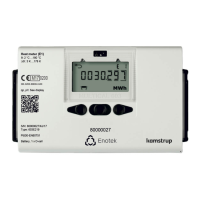
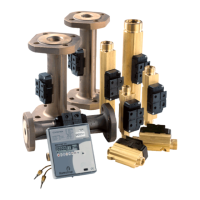
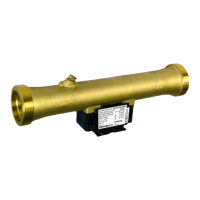
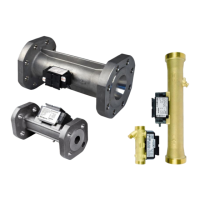
TECHNICAL DESCRIPTION flowIQ® 3100
38 Kamstrup A/S • Technical Description • 5512-1242_B1_GB • 05.2015
In principle, flow is determined by measuring the flow velocity and multiplying it by the area of the
measuring pipe:
where:
is the flow
is the flow velocity
is the area of the measuring pipe
The area and the length which the signal travels in the sensor are well-known factors. The length which the
signal travels can be expressed by
, which can also be written as:
where:
is the measuring distance
is the sound propagation velocity
is the time
In connection with ultrasonic flow sensors the velocities
and
can be stated as:
and
respectively
where:
is velocity of sound in water.
Using the above formula you get:
which can also be written as:
22
2
)()(
)()(
FC
F
LT
FCFC
FCFC
LT
−
×=∆
⇓
+×−
−−+
×=∆
As
,
can be omitted and the formula reduced as follows:
To minimize the influence from variations of the velocity of sound in water, the latter is measured via
absolute time measurements between the two transducers. These measurements are subsequently in the
built-in ASIC converted into the current velocity of sound, which is used in connection with flow
calculations.


 To Next Page
 Loading...