Page 7.7 - 8 COMBIVERT F5-A, -E, -H © KEB, 2012-10
Speed control
7.7.2 Determination of the mass moment of inertia
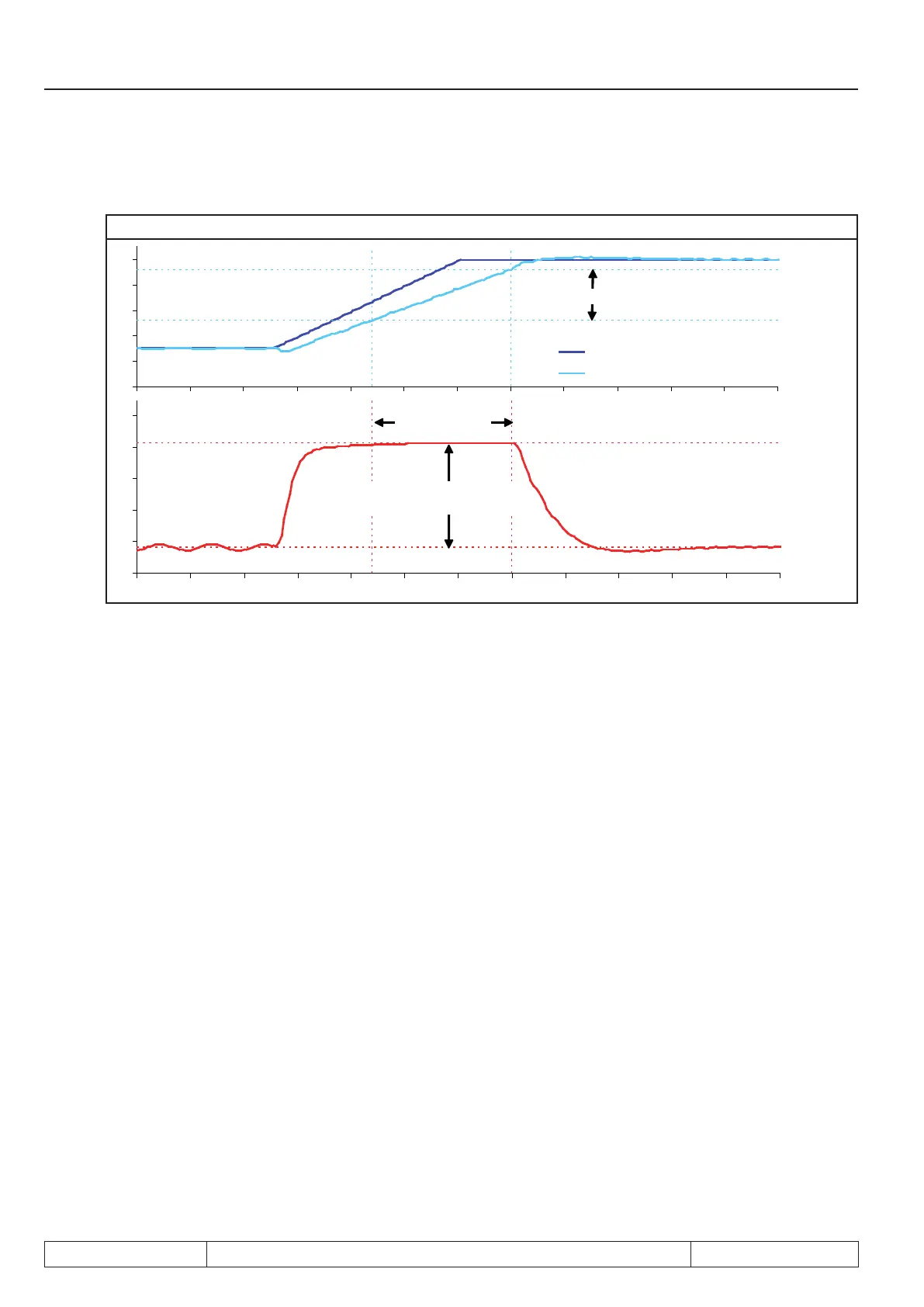
Process to determination of the mass moment of inertia
time
Torque Speed
acceleration torque
Delta M = 662 Nm
Delta t = 0.26s
Delta n = 402 rpm
Set speed
calculated actual speed
The knowledge of the mass moment of inertia of the system (= motor + rigidly coupled load) is required for
the automatic calculation of the speed controller parameters as well as for the pre-control of the acceleration
torque.
If this mass moment of inertia is unknown, it can be determined by an acceleration test.
For this the system must be accelerated with dened, constant torque. It must be guaranteed that no signicant
and acceleration-independent load torque occurs by the application.
The following formula is valid:
∆t
———
∆n
J = 95493 x ∆M x
Example: Ramp-up was recorded with COMBIVIS:
0.26 s
——————
402 rpm
J = 95493 x 662 Nm = 40886 kgcm
2
In order to eliminate the effect of friction from the calculation, you can determine the mass moment of inertia a
second time in similar manner, however by deceleration test. The average value of both inertia, which is deter-
mined at ramp-up or deceleration must be entered in parameter cS.25 „inertia (kg cm^2)“.


 To Next Page
 Loading...