09/2021 ECO Gold 115 / 134
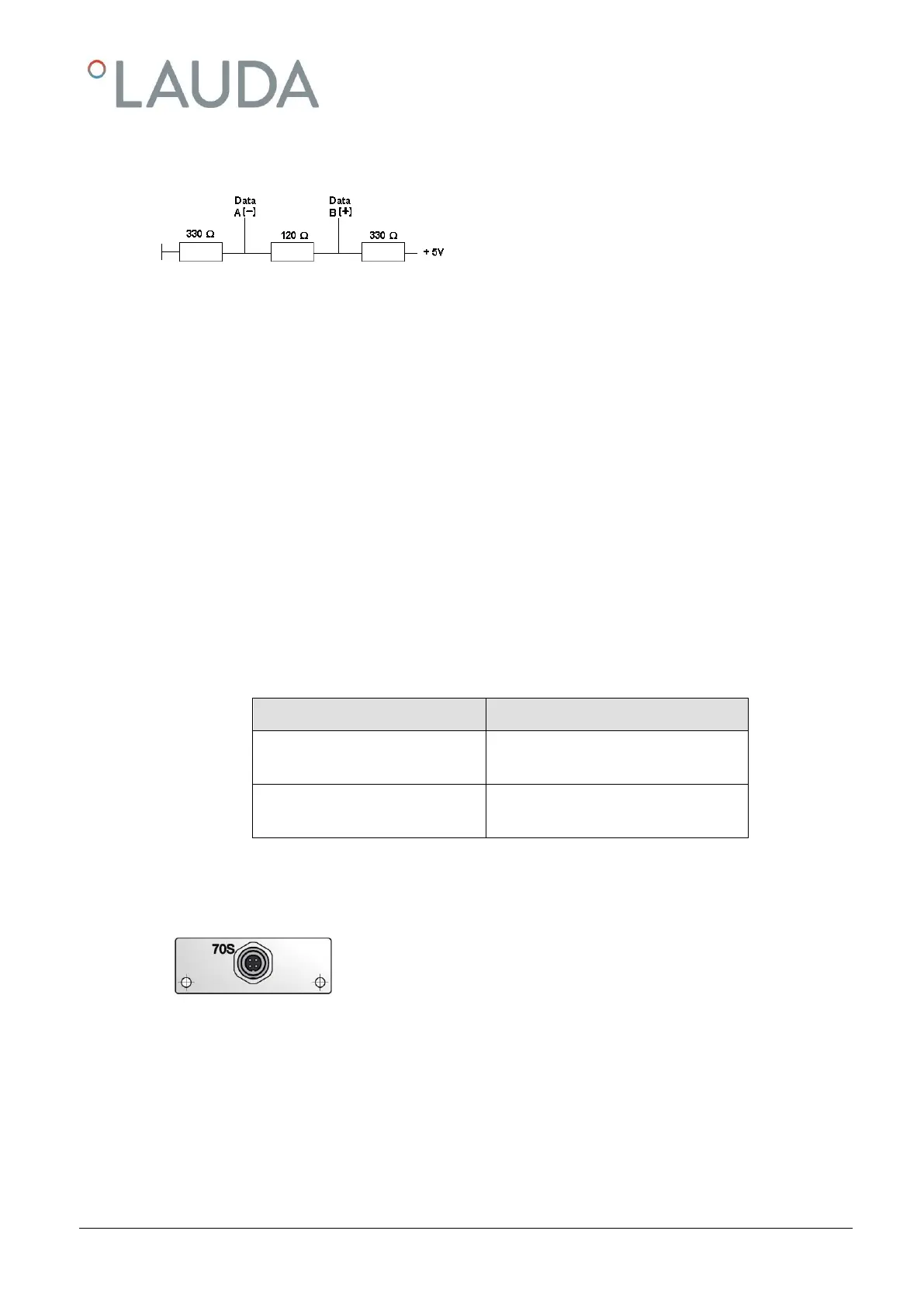
An RS 485 bus requires essentially a bus termination in the form of a terminating network, which provides a defined idle
state in the high impedance phases of bus operation. The bus termination is as follows:
Generally, this terminating network is integrated on the PC plug-in card (RS 485).
19.3.4 RS 485 protocol
Note the following aspects:
The interface operates with one stop bit, no parity bit and with eight data bits.
Transfer speed alternatively: 2400, 4800, 9600 (factor setting) or 19200 baud.
The device address always precedes the RS 485 commands. Up to 127 addresses are possible. The address
must always consist of three figures
(A000_... to A127_...).
The command from the computer must be terminated with a CR.
The response from the thermostat is always terminated with a CR.
CR = Carriage Return (Hex: 0D)
Set-value transfer of 30.5 °C to the thermostat with address 15.
19.4 LiBus module
LiBus module (catalogue number LRZ 920) has a socket (70S) for connec-
ting components via the LAUDA device bus LiBus (Command remote con-
trol, shut down/reverse flow protection, cooling water valve).
LiBus = LAUDA internal device BUS (CAN-based)
For extension cord for LiBus, see accessories ( 9)



 To Next Page