Measuring
27
3.7.2 Testing Selective FI-Circuit Breakers (Types S+ G):
This measuring function serves to test the protective measures „Fault-current-
protection circuit“ when using selective (short-term delayed) and conditionally
surge-current-proof fault-current circuit breakers. It is possible to measure contact
voltage, earth/ground connection resistance or loop resistance as well as tripping
time at nominal fault currents of I
DN
10, 30, 100, 300 or 500 mA (for U
L-PE
< 152 V
only 10, 30, 100 mA).
For this measurement the same rules and notes apply as described in section
3.7.1. Therefore only the differences from the test of standard FI-circuit breakers
are explained below.
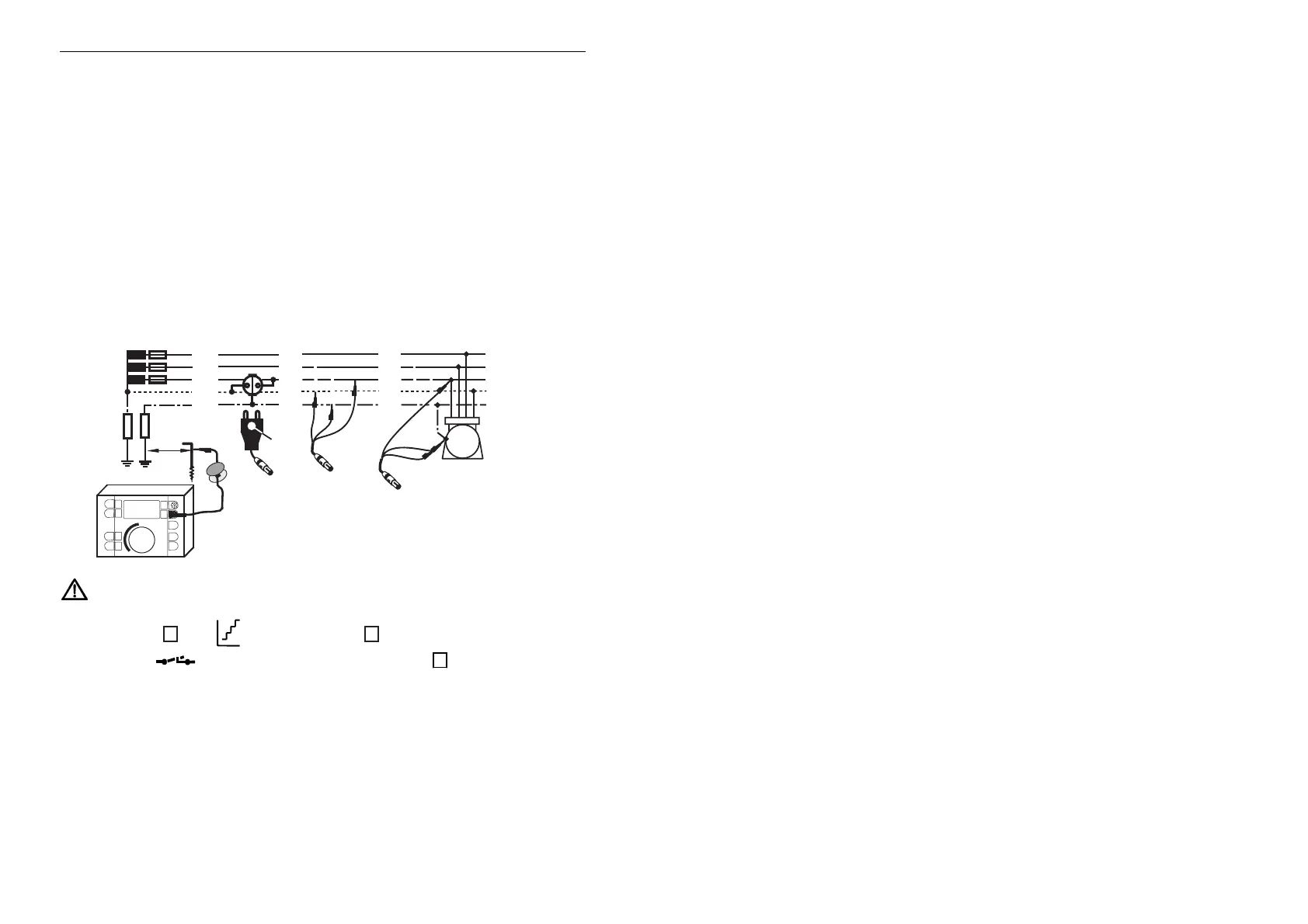
Measuring Process:
L
1
= brown
L
2
= black
L
3
= purple
Instrument
Marker
L3
L1
L2
L
2
L
1
L
3
N
P
E
(PEN)
L3
L1
L2
Instrument
Instrument
M
Connection for use with a probe
Probe
FI
RB
> 20m
RA
Observe overload capacity and connect instrument as shown.
Turn central selector in mode RCD to desired nominal fault current I
DN
.
Press key
n
nn
n „
S
, x5, “ until the symbol
S
is displayed.
Press key T „ “for measurement without tripping the
S
FI-circuit breakers.
Press key R „Start“.
For the check with tripping, a 30 s measuring pause is inserted after prechecking,
during which a countdown from 60 to 0 takes place on the display (see also „Notes
on the Measuring
Sequence“). This phase can be disabled by again pressing key
R „Start“ t is,
however, essential for determining the true tripping time and must therefore not be
disabled for tripping-time measurements.
Read measured value, contact voltage „U
L
“. Repeated pressing of key S
„Display” brings up the loop resistance „R
S
“, in case of use of a probe the


 To Next Page