DeviceNet / CANopen
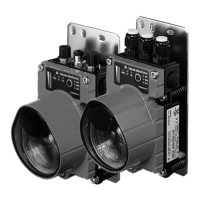
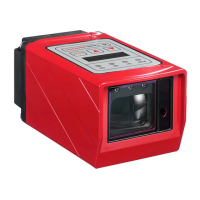
Leuze electronic DDLS 200 41
TNT 35/7-24V
9.3 Device configuration DeviceNet / CANopen
9.3.1 Baud rate conversion
Through the use of an optical data transmission system, the bus is divided into two segments. Differ-
ent baud rates can be used in the physically separated segments. The DDLS 200s then function as
baud rate converters. During baud rate conversion, it must be ensured that the bandwidth of the seg-
ment with the lower baud rate is adequate for processing the incoming data.
9.3.2 Sorting (switch S4.1)
With the aid of switch S4.1, sorting of the internal memory can be activated and deactivated. If sorting
is deactivated (switch S4.1 = OFF, default), CAN frames are handled according to the FIFO principle
(First-In-First-Out).
If sorting is active (switch S4.1 = ON), CAN frames are sorted according to their priority. The message
with the highest priority in memory is the next one to be put onto the connected network for arbitration.
9.3.3 Bus length as a function of the baud rate
Switch position
S3
Baud rate
Max. cable length
per bus segment
Interface
0 (default) 125kBit 500m CANopen / DeviceNet
1 250kBit 250m CANopen / DeviceNet
2 500kBit 100m CANopen / DeviceNet
3 10kBit 5000m CANopen
4 20kBit 2500m CANopen
5 50kBit 1000m CANopen
6 800kBit 50m CANopen
7 1000kBit 30m CANopen
NOTE
The mechanical expansion of the bus system can be increased through the use of the
DDLS 200.
DDLS200_E.book Seite 41 Mittwoch, 19. Februar 2020 12:22 12


 To Next Page
 Loading...