In the beginning it might serve
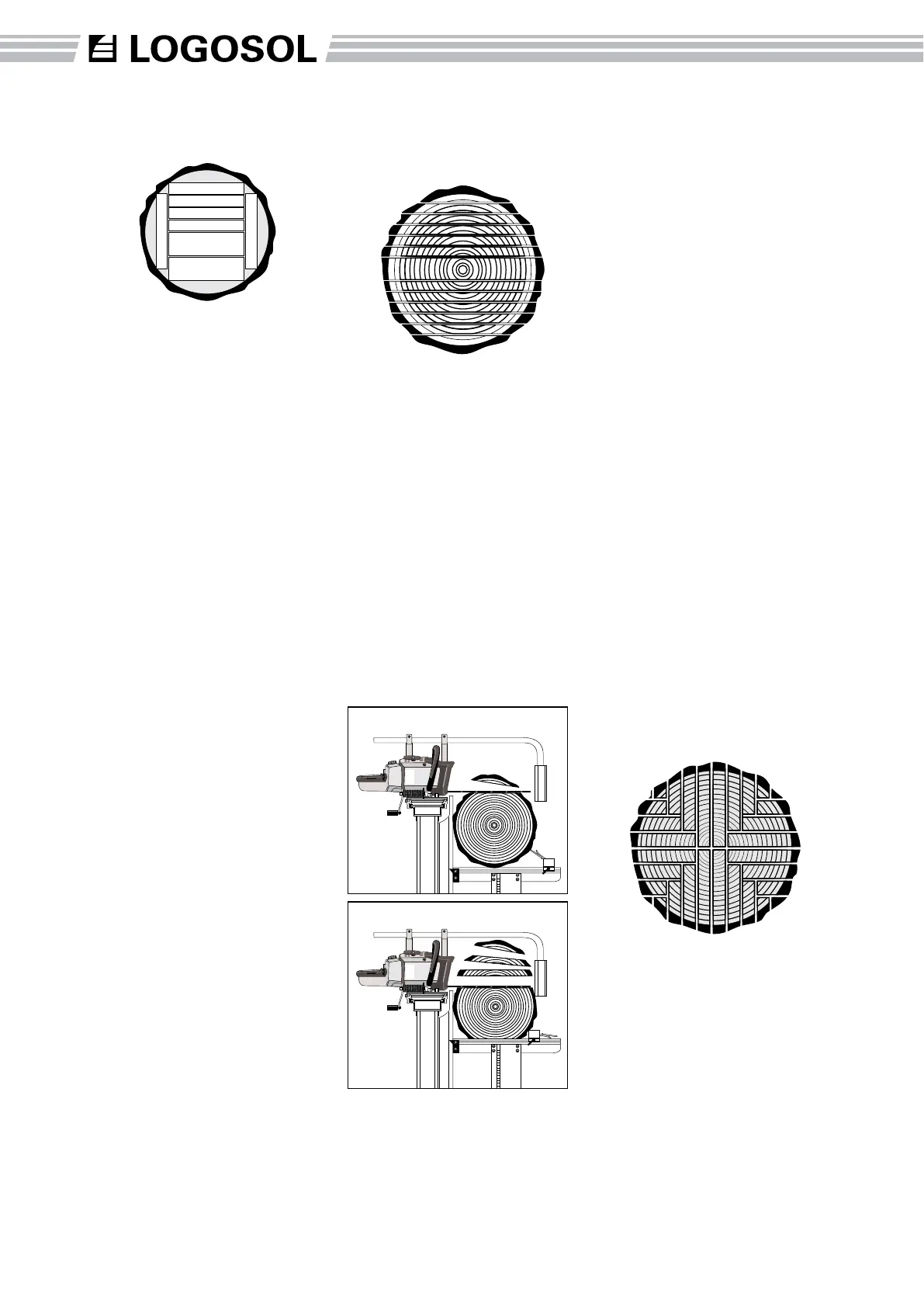
you well to make a drawing on
the butt end of how you want to
piece the log. Use a thick marker
so that the line corresponds to
the saw kerf.
Remember that:
When the log rests on a bark
surface, the log bed at the top
end is set higher than the one
at the root end.
When a sawn surface faces
down, the log beds are set at
the same height.
Compensate for the kerf with
one click (1/4”) whenever the
cut is above the guide bar.
Do not compensate for the
kerf when the cut is below the
guide bar.
The last board may not be
thinner than 2”.
Make sure you do not saw
into the edge support spring
arms.
Many of us here at Logosol
can share our years of sawing
experience with you. As a new
Logosoloist, if you have any
questions call us. We’ll be happy
to provide you useful tips.
Sawing tips
Through sawing
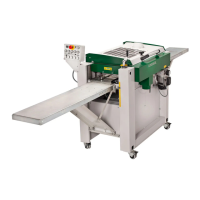
When you are going to slice a
log in this way it is best to saw
off a thin slab rst and then turn
that side downwards. In this
way the log will rest on an even
surface on at least one of the
log beds, preventing movement
between cuts and ensuring even
boards.
Turn the log when you approach
the centre.
Figure out the height where you
should start and then saw.
The example shown in the
drawing calls for the first cut
after the log is turned to be at
8 1/4”, calculated as follows:
1+1+1+1+1+2= 7. For each +
add 1/4” to compensate for the
kerf. The total is (5x 1/4) + 7 =
8 1/4”.
In this way the nal cut will be
correct and you will have a
minimum of wastage.
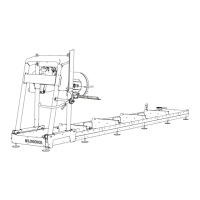
Quarter sawing provides you
with the finest material. You
obtain optimal grain direction in
all boards, something that is a
great advantage for carpentry
work and the like. The price is in
time, in difculty and in that you
obtain several different width
boards. Do not quarter saw
small logs.
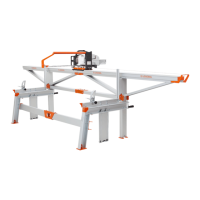
At times it can be best to slice
the log entirely into wane-edged
boards. This way it is possible
to get a bit more from each log.
The price for the gain is that it
takes a bit more time because
of the need for after-trimming. If
ne carpentry wood is the aim,
it might be best to trim one side
before drying. The last trim can
be done when you know what
the board will be used for –
everything to allow maximum
use of the wood.
26
Quarter sawing



 To Next Page