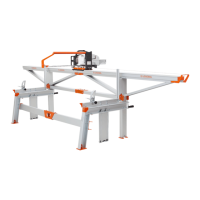
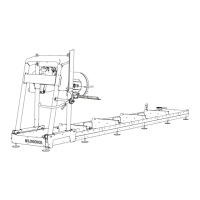
Fine-tuning the M7
Read the pages 28 and 29
about possible reasons for
getting wrong measurements
when sawing.
Provided that the Logosol
Sawmill is correctly adjusted
according to the instructions
on pp 22-24, measurements
deviations are not generally
due to the sawmill itself.
When you are sawing boards
from a beam, without turning
it over, the setting of the
Logosol Sawmill has no
importance whatsoever as
regards the thickness of the
board. The deviation you
get is due to movements
of the log while you are
sawing, or defectiveness of
the cutting equipment. You
have to take into account
that the measurements of
unprocessed boards always
vary. You do not get millimetre
precision until you have
planed the boards.
I n n o r m a l c a s e s w e
recommend you not to
carry out the steps 1-5
below.
In some special cases there
might be need for an exactly
adjusted sawmill, e.g. in case
you want to cut large beams
that have as exact angles
between the cut surfaces as
possible.
There are adjustments that
you can carry out on your
sawmill to further increase
the sawing precision. In
case you want to do this, it
is vital that you follow the
entire instructions, and take
the steps 1-5 in order. The
adjustments normally take
1-3 hours, provided that you
have prepared the sawmill
and have all necessary tools
easy of access. However, the
more meticulous you are the
longer time it takes. When
measuring, you should not
be more precise than 0.5 mm
(0.02”).
To obtain a sawill that stays
adj u s ted r e g ard l e ss o f
vibrations and rough handling,
we have designed the M7
to have as few adjusting
screws as possible. Instead,
you use schims, thin strips
of sheet metal, as spacers.
Adjustments made by this
method are more exact and
are not affeted by vibrations.
Read all the steps 1-5, before
starting the adjustment.
Necessary measure
tools:
Set square. Check your set
square by placing it on a level
surface and drawing a thin
line along the set square.
Rotate the set square 180
degrees and draw another
thin line next to the rst. These
two lines should be exactly
parallel to each other.
Setting block. Make a small
block that is exactly 51.5 mm
(2.03”).
Thickness gauge. (Alterna-
tively a piece of schims that
is 0.5 mm (0.02” thick.)
Two exactly straight boards,
with a length of at least 1 m
(3.3 ft).
Callipers.
Sheet metal schims 0.2 mm
(0.008”) and 0.5 mm (0.02”).
Preparations.
The sawmill must be bolted
to a rm surface and the feet
adjusted so that the horizontal
beams (between the long and
the short legs) are parallel to
each other. If you have tted
a support leg to the sawmill,
it should also stand on a rm
surface. Clean the sawmill
carefully. You will attain the
best precision if a bar shorter
than 50 cm (20”) is used.
Remove the saw chain but
ret the bar on the saw. While
adjusting, use the bar length
you will primarily use.
1. Make sure the bar is
straight.
Even a new bar can be
crooked. Place the chainsaw
carriage (or the E 5000) on a
level surface and with the bar
mounted, but not the chain.
Check the distance between
the bar and the surface. Note
down the measurement you
get closest to the chainsaw
and the measurement at the
bar nose. Turn the bar over and
measure again. Now, the rst
inner measurement should
agree with the second inner
measurement. Likewise, the
two measurements at the bar
nose should agree with each
other. If the measurements
deviate, the bar is crooked.
(The two inner measurements
do not have to be same as the
outer ones, though.)
Remedy: Adjust the bar before
continuing the fine-tuning.
Use protective gloves.
33



 To Next Page