36 Chapter 4: Matrox Solios eV-CL hardware reference
Matrox Solios eV-CL hardware reference
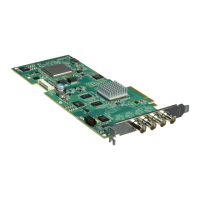
This chapter provides information on the Matrox Solios eV-CL hardware. It covers
the architecture, features, and modes of their acquisition section. In addition, it
covers the Matrox Solios eV-CL hardware related to the transfer of data. A
summary of the features of Matrox Solios eV-CL, as well as pin assignments for
the various connectors, can be found in Appendix B: Technical information.
Acquisition path This manual uses the term acquisition path to refer to a path that has the
components to digitize or capture a video input signal. The term independent
acquisition path is used to refer to an acquisition path that can, if required, acquire
data from an input source independently from another such path on the same
frame grabber. Each independent acquisition path has its own programmable
synchronization generator (PSG) to manage all video timing, synchronization,
triggering, timers, and the auxiliary input and output signals for the path.
MIL-Lite uses the concept of a MIL digitizer to represent the acquisition path(s)
with which to grab from one input source of the specified type. When several MIL
digitizers are allocated, their device number along with their DCF identify if they
represent the same path(s) (but perhaps for a different input format) or
independent path(s) for simultaneous acquisition. MIL-Lite uses the concept of
a data input channel to identify which input source to use when several of its type
are connected to the same acquisition path(s) (for example, grab from channel 0
(video source A) or channel 1 (video source B) of digitizer 0).
Digitizer
configuration format
To program the acquisition section, allocate a MIL digitizer using MdigAlloc()
with an appropriate DCF (supplied or created) and digitizer device number; to
select the required input channel, use MdigControl() with M_CHANNEL
*
. If
you find a DCF file that is suitable for your video source, but you need to adjust
some of the more common settings, you can do so directly, without adjusting the
file, using the appropriate MIL-Lite function. For more specialized adjustments,
use the Matrox Intellicam program to adjust the DCF file. Using Matrox
Intellicam, you can set the active video region, the sampling clock, and all the
other parameters related to the timing of the video signal (that is, standard and
non-standard video, interlaced or non-interlaced) in your DCF file.
*. As of MIL 10.


 To Next Page