Connecting video sources 31
❖ If using both Camera Link connectors to connect to the same video source
(single-Medium or single-Full configuration), the cables you choose must be of
the same type and length. Otherwise, the cables can have different propagation
delays.
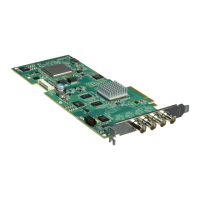
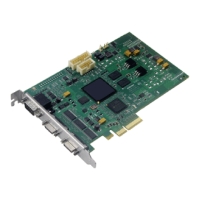
Connecting to Matrox Solios eV-CLBL or eV-CLFL boards
Matrox Solios eV-CLBL and Matrox Solios eV-CLFL boards have the following
connectors:
• Two Camera Link-compliant video input connectors. Used to receive video
input, timing, and synchronization signals and transmit/receive communication
signals between the video source and the frame grabber.
• Internal auxiliary I/O connectors (44-pin/10-pin or 32-pin). Used to transmit
timing and synchronization signals, and transmit/receive auxiliary signals. The
connector is located on the edge of the board, making the signals accessible from
inside the computer enclosure.
Matrox Solios eV-CLBL and Matrox Solios eV-CLFL come with either the
44-pin/10-pin connectors, for use with the DBHD-44/DB-9 cable adapter
bracket, or the 32-pin connector, for use with the dual DBHD-15 cable adapter
bracket.
To access the signals of the internal auxiliary I/O connector from outside of the
computer enclosure, you might have installed the corresponding adapter board.
It has the following connectors:
• External auxiliary I/O connector 0 (DBHD-44 or top DBHD-15). Used to
transmit/receive auxiliary signals. Additionally, the DB-44 connector is also used
to transmit timing and synchronization signals.
• External auxiliary I/O connector 1 (DB-9 or bottom DBHD-15). Used to
transmit/receive auxiliary signals.


 To Next Page