38
SYSTEM
However, moisture content alone is not a reliable indicator for predicting microbial responses
and chemical reactions in materials. The limitations of moisture content measurement are
attributed to differences in the intensity that water associates with other components.
3.4.2 WATER ACTIVITY
Water activity (a
w
) is a measurement of the energy status of the water in a system. The
value indicates how tightly water is bound, structurally or chemically, within a substance.
The lower a sample’s water activity, the more tightly bound that water is within the sample.
The concept of water activity is of particular importance in determining product quality
and safety. It predicts safety and stability with respect to microbial growth, chemical and
biochemical reaction rates, and physical properties.
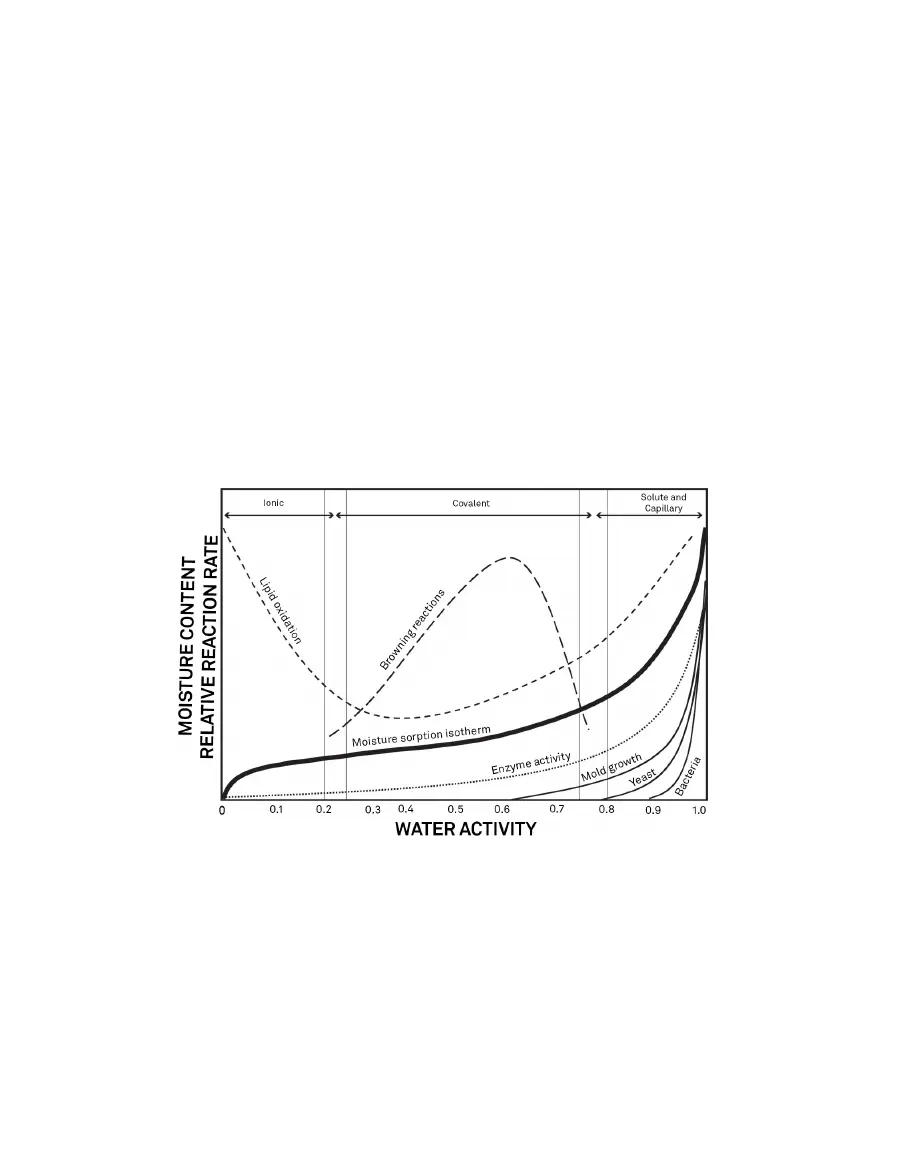
Water activity is a measure of the energy status of the water in a system and is a far better
indicator of product stability than moisture content. Figure58 shows how the relative
activity of microorganisms, lipids, and enzymes relate to water activity. While other factors,
such as nutrient availability and temperature, can affect the relationships, water activity is
the best single measure of how water affects these processes.
Figure58 Water activity diagram adapted from Labuza (1976)
Researchers measure the water activity of a system by equilibrating the liquid phase water
in the sample with the vapor phase water in the headspace and measuring the relative
humidity of the headspace. In the AQUALAB, a sample in a sample cup is sealed inside the
sample chamber, which contains a fan, a dew point sensor, and an infrared thermometer.
The fan speeds equilibrium and controls the boundary layer conductance of the dew
point sensor. The dew point sensor measures the dew point temperature of the air in the
chamber, and the infrared thermometer measures the sample temperature. From these
measurements, the relative humidity of the headspace is computed as the ratio of the dew
point temperature saturation vapor pressure to the saturation vapor pressure at the sample


 To Next Page