© Microhard 32
3.0 Hardware Features
Config Button:
The Config button on the pMDDL5824 can be used to either reset the modem into its factory default
configuration, or it can be used to perform a firmware recovery procedure.
Factory Default Settings: While power is applied and the pMDDL5824 in an operational state, press and
hold the Config Button for more than 10 seconds to reset to a factory default Master, alternatively hold the
button for 5 seconds for a factory default Slave.
Firmware Recovery: To load the firmware on the unit it is recommended to use the normal WebUI to
perform a firmware update (Maintenance). In the event that the firmware cannot be loaded using the
standard WebUI (non responsive unit), pressing and holding the Config Button while powering-up the
module will force the pMDDL5824 into a firmware recovery mode. There are 3 main modes, HTTP, TFTP
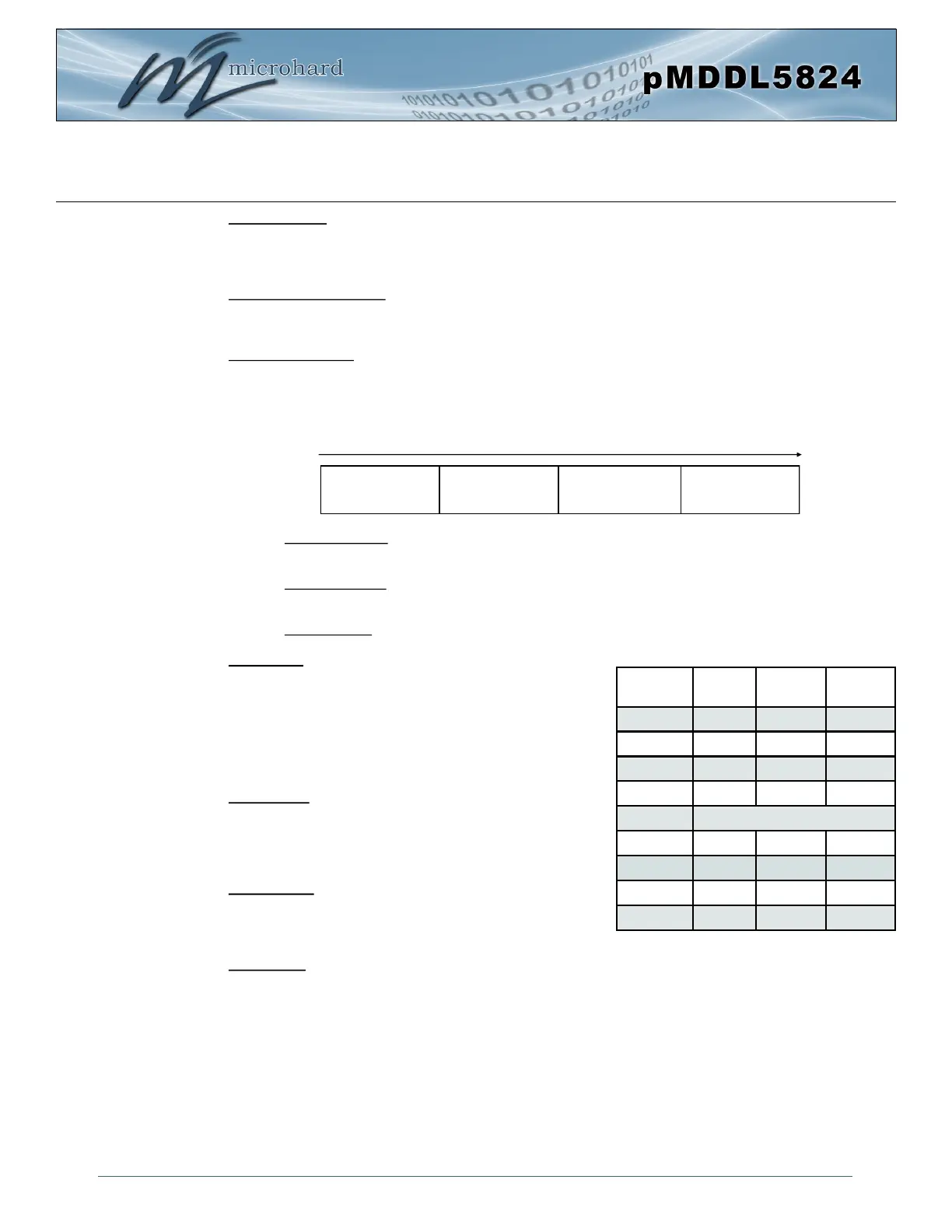
and Master Reset. The table below shows the time required to hold the Config button while power is
applied:
HTTP Recovery: Set an IP on a PC to 192.168.1.1. Open a web browser and Navigate to
192.168.1.39. This will open a simple webpage which will allow a firmware file to be loaded.
TFTP Recovery: Set an IP on a PC to 192.168.1.1. Use a TFTP session to push the firmware file
to the modems recovery IP of 192.168.1.39. See Appendix for Firmware Recovery Procedure.
Master Reset: Runs Master Reset, file system is erased.
Serial Port:
The RS232/485 Serial data port can be used to communicate
with Serial devices or it can be configured to operate as a
console port. See Table 3-3 for pin assignments.
RS232/RS485 modes are selected through the serial port
configuration in the WebUI.
CPU/Status:
The CPU/Status LED indicates that power has been applied
to the module. A Solid LED indicates normal operation, while
flashing indicates boot or firmware upgrade status.
TX/RX LEDs:
The TX/RX LEDs indication wireless traffic to/from the
pMDDL5824 module.
RSSI LEDs:
The RSSI LEDs indicate the Received Signal Strength on the Wireless Link. On a Master it will indicate an
average RSSI value based on connected units. On a Slave the RSSI LEDs will represent the signal
strength between the Slave and the Master it is connected to. (The more LEDs illuminated, the stronger the
signal)
0 to 5 seconds
HTTP Recovery
5 to 10 seconds
TFTP Recovery
10 to 15 seconds
Master Reset
15+ seconds
No Effect
Table 3-3: Data DE9 RS232 Pin Assignment
Pin
No.
RS232
RS485
Full-Dup
RS485
Half-Dup
1 DCD
2 RXD TX- Data-
3 TXD RX+
4 DTR
5 Ground
6 DSR
7 RTS RX-
8 CTS TX+ Data+
9 N/C


 To Next Page