STATUS - NTP
basis. In this mode the identity of the peer need not be known in advance, since the asso-
ciation with its state variables is created only when an NTP message arrives. Furthermore,
the state storage can be reused when the peer becomes unreachable or is operating at a
higher stratum level and thus ineligible as a synchronization source.
Symmetric active mode is intended for use by time servers operating near the end nodes
(highest stratum) of the synchronization subnet. Reliable time service can usually be main-
tained with two peers at the next lower stratum level and one peer at the same stratum level,
so the rate of ongoing polls is usually not significant, even when connectivity is lost and error
messages are being returned for every poll.
leap indicator (LI):
The Leap Indicator (LI) is a two-bit binary number in the NTP packet header that provides
the following information:
n Advance warning that a leap second adjustment will be made to the UTC timescale at the
end of the current day. Leap seconds are events mandated by the world time authority
(BIPM) in order to synchronize the UTC time scale with the earth's rotation.
n Whether the NTP daemon is synchronized to a timing reference. The settings on the
NTP - Prefs (on page 50) page affect LI behavior.
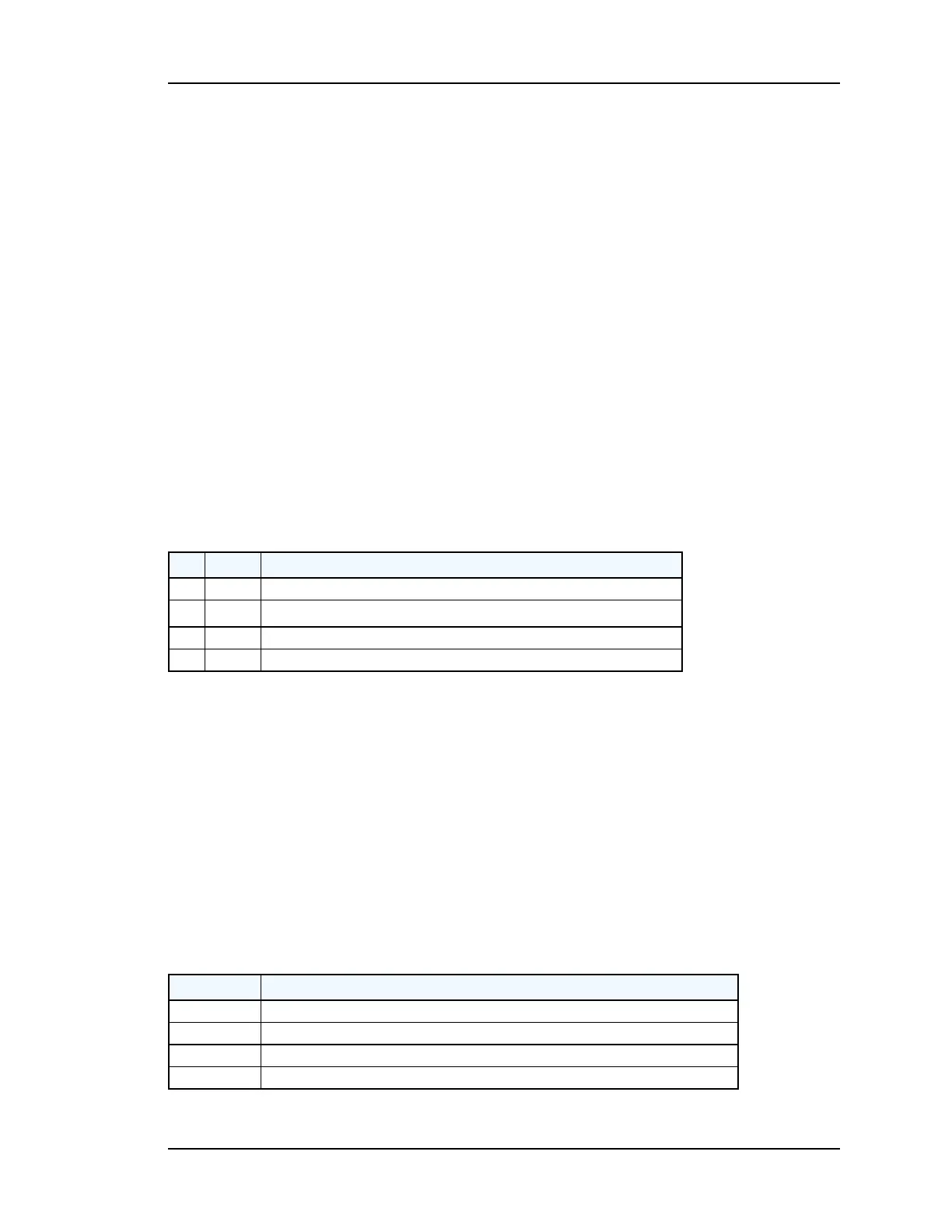
LI Value Meaning
00 0 No warning.
01 1 Leap second insertion: Last minute of the day has 61 seconds.
10 2 Leap second deletion: Last minute of the day has 59 seconds.
11 3 Alarm condition (Not synchronized)
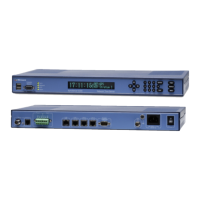
When the SyncServer or NTP daemon is started or restarted, the leap indicator is set to "11",
the alarm condition. This alarm condition makes it possible for NTP clients to recognize that
an NTP server (the SyncServer) is present, but that it has yet to validate its time from its time
sources. Once the SyncServer finds a valid source of time and sets its clock, it sets the leap
indicator to an appropriate value. The NTP Leap Change Alarm on the ADMIN - Alarms
page can be configured to generate an alarm and send notifications each time the leap indic-
ator changes state.
stratum:
This is an eight-bit integer that indicates the position of an NTP node within an NTP timing
hierarchy. It is calculated by adding 1 to the stratum of the NTP system peer.
For the SyncServer, the stratum values are defined as follows:
Stratum Definition
0 Hardware Clock when locked.
1 Primary server
2-15 Secondary server
16-255 Unsynchronized, unreachable.
For example, the SyncServer is:
997-01520-02 Rev. F1.......................................................................... Page 29



 To Next Page