OM-286308 Page 5
SECTION 2 – SAFETY PRECAUTIONS – READ BEFORE USING
Protect yourself and others from injury—read, follow, and save these important safety precautions and operating instructions.
2-1. Symbol Usage
DANGER! – Indicates a hazardous situation which, if not
avoided, will result in death or serious injury. The possible
hazards are shown in the adjoining symbols or explained
in the text.
Indicates a hazardous situation which, if not avoided,
could result in death or serious injury. The possible haz-
ards are shown in the adjoining symbols or explained in
the text.
NOTICE – Indicates statements not related to personal injury.
F
Indicates special instructions.
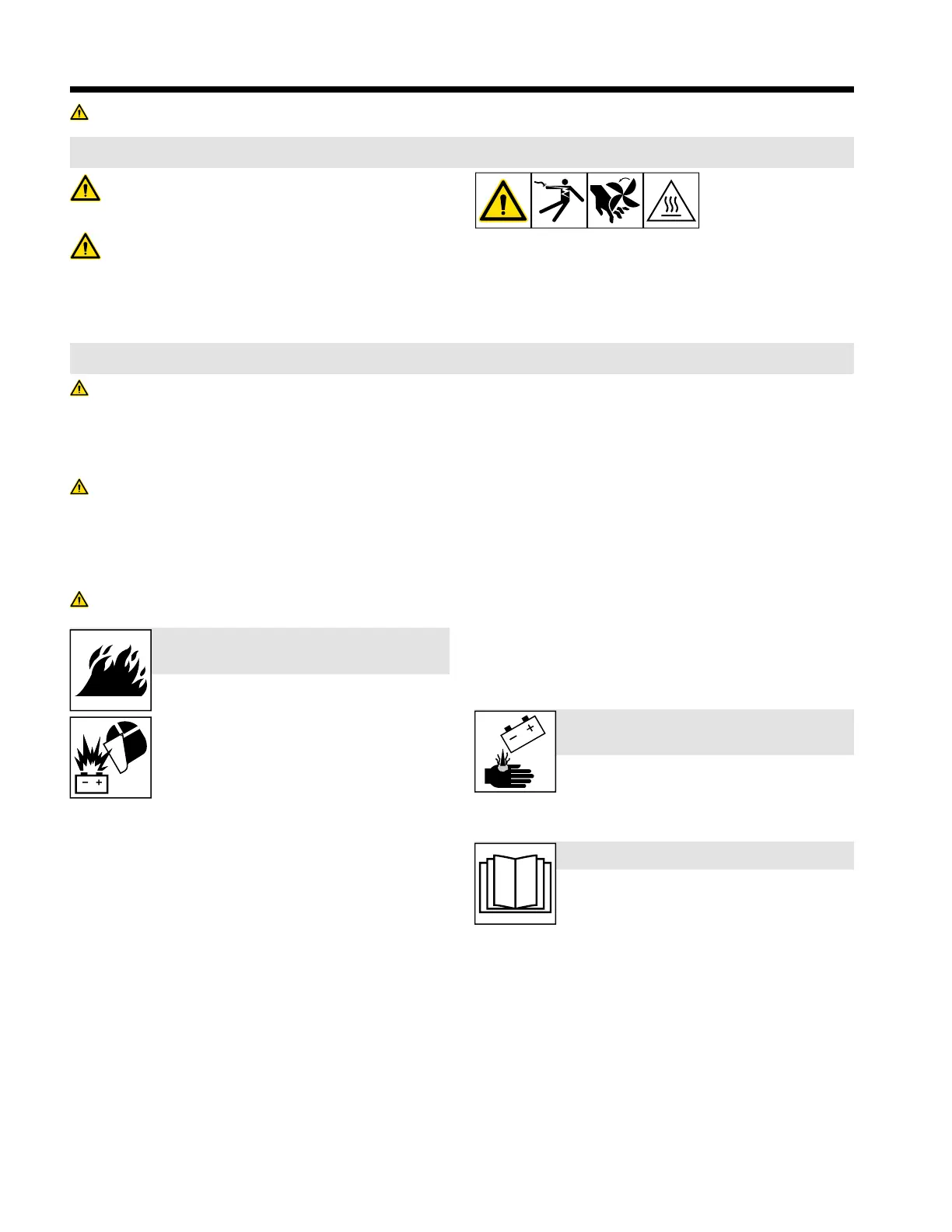
This group of symbols means Warning! Watch Out! ELECTRIC
SHOCK, MOVING PARTS, and HOT PARTS hazards. Consult
symbols and related instructions below for necessary actions to
avoid these hazards.
2-2. Hazards
The symbols shown below are used throughout this manual
to call attention to and identify possible hazards. When you
see the symbol, watch out, and follow the related instruc-
tions to avoid the hazard. The safety information given be-
low is only a summary of the more complete safety
information found in the Principal Safety Standards listed in
Section 2-4. Read and follow all Safety Standards.
Only qualified persons should install, operate, maintain,
and repair this equipment. A qualified person is defined as
one who, by possession of a recognized degree, certificate,
or professional standing, or who by extensive knowledge,
training and experience, has successfully demonstrated the
ability to solve or resolve problems relating to the subject
matter, the work, or the project and has received safety
training to recognize and avoid the hazards involved.
During operation, keep everybody, especially children,
away.
FIRE OR BATTERY EXPLOSION
hazard.
l During operation keep everyone, especially chil-
dren, away.
l Do not install or place charger on, over, or near
combustible surfaces.
l Do not charge battery near flammables.
l Examine the battery before first use. Return bat-
tery to the manufacturer if battery is damaged,
dirty, or emits an unusual odor.
l Use battery only with equipment with which it was supplied. Re-
place battery only with battery specified in Owner’s Manual. Use
of another battery can present a risk of fire or explosion.
l Keep battery dry.
l Do not use or store the battery in extremely hot or humid condi-
tions. See the Owner’s Manual for specific operating and storage
information.
l Keep battery away from fire, out of direct sunlight, and away from
other sources of heat.
l Do not use or charge the battery if it has been dropped or
damaged.
l Do not open, puncture, repair, disassemble, or modify the battery.
l Charge battery only with supplied charger in an open, well-venti-
lated location out of direct sunlight and according to supplied
instructions.
l Do not overcharge a battery or charge battery longer than speci-
fied (if charger is not equipped with automatic shutoff). See the
Owner’s Manual for specific information on battery charging.
l Do not charge battery by connecting directly to AC receptacle. Do
not connect battery charger to automobile auxiliary power
receptacle.
l Do not connect (short circuit) battery terminals to each other. Do
not allow tools, conductive materials, or other objects to touch both
battery terminals at the same time.
l Do not weld on battery or fasten any objects to battery.
l Do not heat battery in a microwave oven or any other heating
device.
l Keep battery away from sources of high voltage.
l Do not expose battery to static electricity.
l Do not use or mix battery with damaged or worn out batteries, or
other types of batteries.
BATTERY ACID can BURN SKIN and
EYES.
l Replace damaged battery.
l Do not touch materials from inside a damaged
battery.
l Flush eyes and skin immediately with water.
READ INSTRUCTIONS.
l Read and follow all labels and the Owner’s Manual
carefully before using the battery or battery charg-
er. Read the safety information at the beginning of
the manual and in each section.
l Dispose of battery according to local, state, and federal require-
ments. Do not dispose of battery in fire or water.
l Contact the equipment manufacturer if you have any questions
about the battery.





 To Next Page