24
q C) Check the rudder. Looking from behind
the airplane, move the rudder stick to the right. The
rudder should move to the right. The tail wheel should
move to the right as well. If it does not, flip the servo
reversing switch on your transmitter to change the
direction.
q D) Check the throttle. Moving the throttle
stick forward should open the carburetor barrel. If it
does not, flip the servo reversing switch on your trans-
mitter to change the direction.
q E) From behind the airplane, look at the ai-
leron on the right wing. Move the aileron stick to the
right. The aileron should move up and the other aile-
ron should move down. If it does not, flip the servo
reversing switch on your transmitter to change the
direction.
q 2) Check Control Surface Throw.
q A) The Rudder should move 3/4” left and
3/4” right from center. If it moves too far, move the
pushrod clevis to a hole in the rudder horn away from
the rudder. Do the opposite if there is not enough
throw.
q B) The elevator should move 5/16” up and
5/16” down from center. If it moves too far, move
the pushrod clevis to a hole in the elevator horn away
from the elevator. Do the opposite if there is not
enough throw.
q C) The ailerons should move 1/4” up and
1/4” down from center. To adjust the amount of aile-
ron throw, first move the pushrods on the servo arm.
Move the pushrods toward the center of the servo for
less movement. Move the pushrods farther away from
the center of the servo for more movement. If enough
movement cannot be achieved in this manner, thread
the adjustable torque rod horns farther down the torque
rods, toward the wing. It is important that both aile-
rons move the same amount, both up and down.
q D) Once the control throws and movements
are set, tubing must be added to the clevises to ensure
they do not release in the air. Cut a piece of fuel line
into 1/4” pieces and slip one piece over each clevis.
q 1) Completely charge your transmitter and re-
ceiver batteries before your first day of flying.
q 2) Check every bolt and every glue joint in the
Extra 300 to ensure everything is tight and well
bonded. This should include all of the control sur-
face hinges as well.
q 3) Double check the balance of the airplane. Do
this with the fuel tank empty.
q 4) Check the control surfaces. All should move
in the correct direction and not bind.
q 5) If your radio transmitter is equipped with dual
rate switches double check that they are on the low
rate setting for your first few flights.
q 6) Check to ensure the control surfaces are mov-
ing the proper amount for both low and high rate set-
tings.
q 7) Check the receiver antenna. It should be fully
extended and not coiled up inside the fuselage.
q 8) Properly balance the propeller. An out of
balance propeller will cause excessive vibration which
could lead to engine and/or airframe failure.
PREFLIGHT CHECK
FLYING
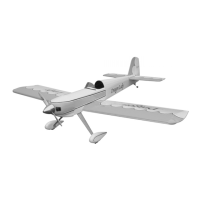
The Extra 300 is designed for those pilots who are
experienced in flying sport models. It is in no way a
trainer. If you do not feel comfortable that you are
able to test fly the airplane don't hesitate to ask some-
one for some help getting it tested and trimmed out.
Typically, aerobatic airplanes such as the Extra 300,
require some different flying techniques that you
might not be familiar with. It is very important to let
the airplane get up to flying speed before lifting off.
Pulling the plane off the ground too fast will cause
the airplane to stall and crash. You should allow the
plane to roll out until the tail is completely off the
ground and flying. Allow the airplane to roll out about
50 feet more and gently pull it off the ground and into
a shallow climb out.



 To Next Page