ABOUT ANALOGUE SYNTHESIS
An
Analogue Synthesiser can be broken down into three main elements.
1 - The Oscillator is the part of a synthesiser that generates “Waveforms” at a certain “Pitch”.
2 - The type of “Waveform” selected in the Oscillator & the settings of the “Filter” determine the “Tone” of the sound.
3 - The sound is then passed through an “Amplifier” which is controlled by an “Envelope Generator”. These alter the “Volume” of a
sound over time.
All of these three main elements can be controlled by various methods for example:
The “Pitch” of a note can be played on a keyboard or a synthesiser & additionally it can be manipulated in real time using the
“Pitch Bend Wheel” to create “Slides” & “Bends” in pitch. LFOs ( Low Frequency Oscillators ) can be used to “Wobble” the pitch of
a note at a specific rate creating a “Vibrato” effect. An Envelope Generator can also be used to “Slide” the pitch automatically.
The Filter can be manipulated by LFOs to vary the “Tone” of a sound at a specific rate creating a “Wah Wah” type of effect. An
Envelope Generator can also be used on the Filter so that the “Tone” of a sound changes over time. A feature called “Keyboard
Tracking” can also be used on the Filter so that the “Tone” of a sound changes depending on the note being played.
The Amplifier can be manipulated by Envelope Generators so that changes in the “Volume” of a sound over time can make the
sound short & percussive, or more like a piano or even like an organ. Additionally the “Velocity” at which you hit the keys can also
be used to manipulate volume making a sound more “expressive”.
The elements that manipulate these three main synthesis elements are called “Modulation Sources”.
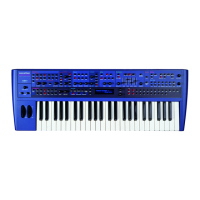
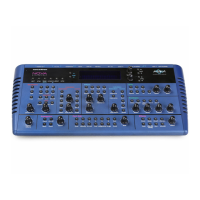
The Nova features 3 Envelope generators & 2 LFOs ( Low Frequency Oscillators ) as Modulation “Sources”. In addition to this
Velocity ( The dynamics of your keyboard playing. i.e. ppp to fff ), Aftertouch ( Pressure on the keyboard while note(s) are held ) &
the Modulation Wheel are included in a as additional “Sources” of modulation signals in a “Modulation Matrix”. This allows almost
any “Source” to modulate a given parameter. It is even possible to have combinations of different “Sources” modulating one param-
eter. In the Nova this has been neatly arranged on the front panel so that accessing all the possible combinations of modulation is
quick & easy. Below is the Modulation Matrix for the Oscillator section.
14




 To Next Page