BA_OCHSNER AIR EAGLE_414_717_V06_EN.docx Page 33 of 76
6.2 Guidelines
Connection cables 230 VAC:
Always size connection cables
according to the local
conditions.
Control cable 230 VAC:
Pumps, actuators
Sensor leads:
(outdoor sensors, etc.), sensor
leads are sensitive to EMC and
must always be routed
separately (min. 20 cm) from
230 V/400 V lines. If separation
is not possible, screened cables
should be used. Screening
should be connected to PE on
the heat pump
Max. line length 50 m!
Bus leads:
Modbus from outdoor to
indoor unit, room remote
control units, eBus from OTE
controller to room remote
control units, auxiliary
modules, underneath each
other in cascades).
These lines must always be
routed in a screened version.
The screen should be earthed
to PE on the heat pump.
OCHSNER recommends the
following conventional cable:
Y(ST)Y) 2x2x0.8
CAUTION: Always use a
twisted wire pair!
Example: MODEBUS = A/B
Example: eBus = SIGNAL/GND
Do not connect GND to the
screen!
Table 1: Cable selection
6.3 Power connection details
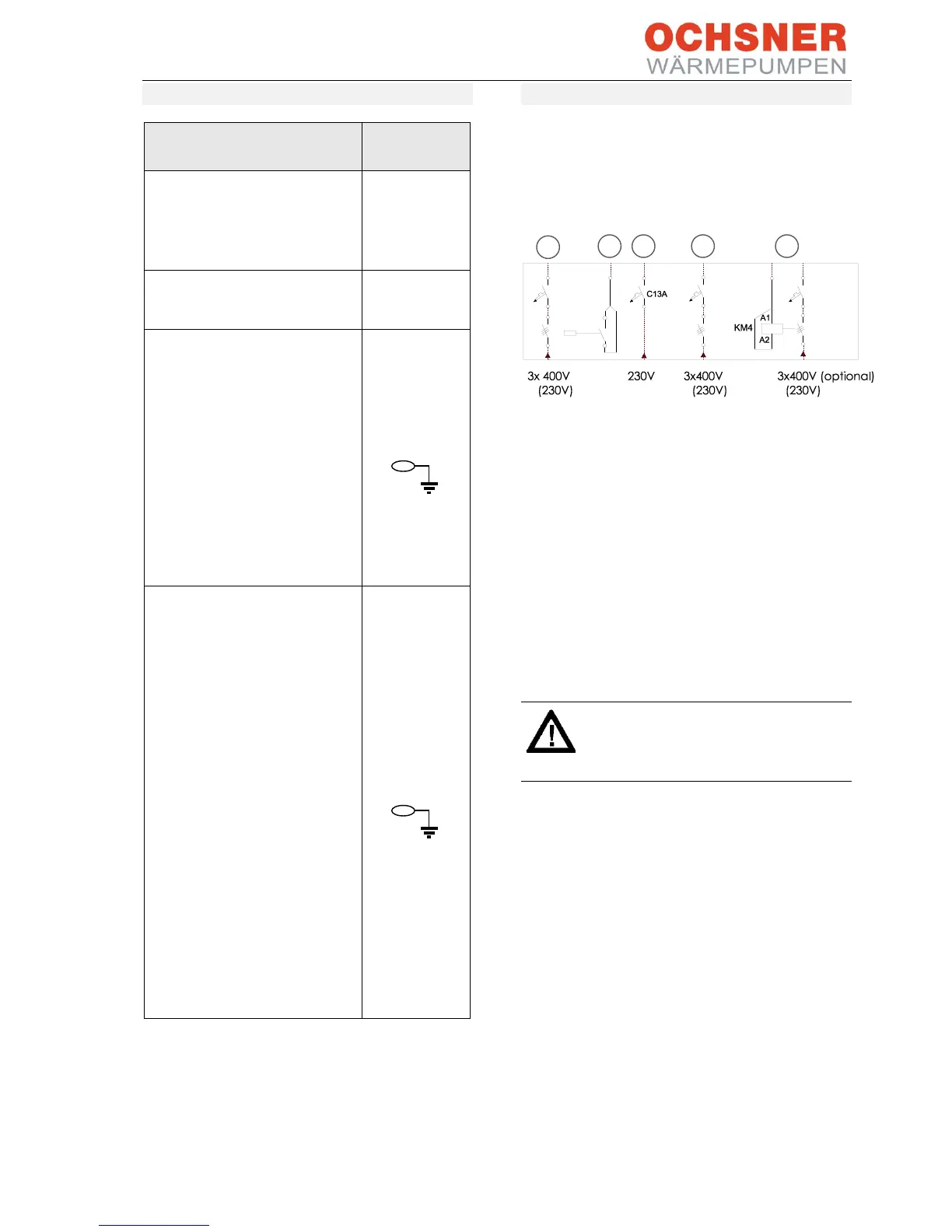
According to the wiring diagram (see section 6.15,
Wiring diagrams) the 400 VAC and 230 VAC power
supplies should be provided separately. The
following power supplies must be provided:
Figure 45: Power supply
400 V (230 V) compressor supply
PSU signal contact (indoor unit control box)
230 V controller supply (indoor unit control
box)
400 V (230 V) electric booster heater (indoor
unit control box)
Option: 400 V (230 V) DHW auxiliary heater for
anti-legionella function.
The 230 VAC controller power supply to the
outdoor unit is via terminal strip X2 in the indoor
unit control box (L N PE). This ensures that the
outdoor unit and the indoor unit are in phase.
If it is not possible to comply with the
100 mm minimum clearances between
sensor leads and 230 V/400 V, then
screened cables should be used.
The listed fuse protection ratings are guide values
only! The electrician connecting up the heat pump
is responsible for selecting the correct safety
devices.
OCHSNER does not accept liability for faults
resulting from incorrectly designed safety devices!
*PSU = power supply utility


 To Next Page