32
13. After several minutes of therapy, change both knobs to the 12:00 position,
which produces an approximate Pulse Frequency rate of 150-200. The i:e ratio
will be approximately 1:2 (most frequently used for airway clearance –
increased secretions). End therapy on these settings.
14. TRUE-IPV® treatment should continue for 15 to 20 minutes total.
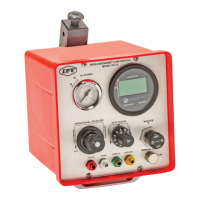
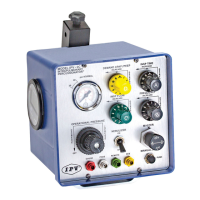
15. When treatment is complete, the IPV®-2C controller should be turned OFF.
The Phasitron®5 should be rinsed, cleaned and stored in the supplied bag,
as per hospital infection control policy, until the next treatment.
NOTE: The Phasitron® 5 is a SINGLE PATIENT, MULTIPLE USE DEVICE.
NOTE: Percussionaire® recommends cleaning per your institution’s approved
practice between treatments.
General TRUE-IPV® Therapy Protocol for Neonates
1. Verify infant has a properly placed Oral Gastric (OG) Tube, open to room air
before starting IPV treatments. OG tube must remain open as a vent
throughout duration of IPV therapy.
2. Infant should be positioned in the supine position with head
elevated > 15 degrees. Recommended semi-Fowler’s or Fowler’s position
for non-intubated patients.
3. Set Operational working pressure to ~ 30 psig; this will soften the percussion
and allow increased modulation of adjustment for Flow (ie. ne adjustment).
An Oxygen Blender and O
2
Analyzer should always be utilized with this
population. This will allow appropriate adjustment of FiO
2
and weaning of
FiO
2
as oxygen requirements improve. Generally a reduction in oxygen
requirements will be seen as the infants V/Q match is optimized.
4. Set Demand CPAP for 2 cmH
2
O by occluding Phasitron® to create seal.
5. Adjust Inspiratory Flow for a MAP of 6-7 cmH
2
O, this is approximately an
Amplitude pressure of 8-10 cmH
2
O.
6. Apply to Patient and adjust to achieve desired chest movement.
A mild chest wiggle is required for good therapy.
Carefully monitor infant for signs of hyperventilation.
WARNING: It is important to keep a respiratory drive while watching for
spontaneous breathing eorts which could lead to hyperventilation leading
to apnea after completion of therapy.
(Continued on p.33)


 To Next Page