49
4.2 General Hardware Setup
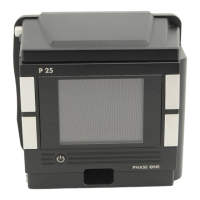
Powering up the IQ back
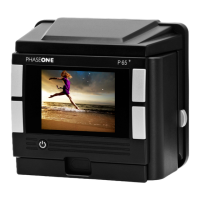
After an IQ back is connected to a camera body, insert a battery or a FireWire
800 cable and it will automatically turn on. The back is switched on/o by
pressing the power button located below the IQ back display.
ISO Settings
The IQ180 back has a default ISO spectrum from ISO 35-800. The IQ160 and
IQ140 have a default ISO spectrum from ISO 50-800. An ISO rating can be
selected from the menu system (when untethered) or in the Capture panel
of the Capture One application (when tethered).
Sensor+ technology, built into the Phase One IQ Series models, expands the
ISO range from 140 to 3200 at 20 megapixels resolution for the IQ180. The
IQ160 and IQ140 have a Senor+ ISO range from 200 to 3200 at 15 and 10
megapixels resolution respectively.
Power Management and Shutter Latency
The IQ back’s CCD needs to be constantly cleared of data from the previous
capture before the next exposure can be taken. This process requires some
power consumption. The default setting is Normal Latency, which should
remain unchanged under all ‘normal’ shooting scenarios. Only change
the setting to Zero Latency if you work on technical cameras, large format
cameras or certain manual cameras in special situations.
Double Exposure Protection
It is not possible to accidentally double expose an image by capturing
one shot quickly after another when an IQ back is used on cameras such
as the Phase One 645AF, Phase One 645D F, Mamiya 645 AFD/AFD II/AFDIII,
Hasselblad 555 ELD (DIG mode), Hasselblad H or Contax 645. The electronic
communication with the body ensures that the IQ back is ready before
allowing release of the next shot. However, users of other camera bodies that
do not use the electronic interface from the IQ will have to wait for the ready
beep signal before releasing the next shot.



 To Next Page