User interfaces | 19
15 : 3.1.3. Delay
The delay control adds time lag on signal path. This
control can be used for different scopes, such as for com-
pensating the signal delay among different sources or time
align clusters of loudspeakers and line arrays.
15 : 3.1.4. Equalization and crossover
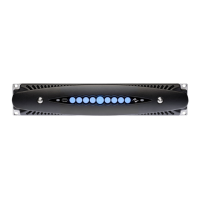
Signal equalization provides control over the tonal spec-
trum of the signal. Equalization can be used to adjust the
speaker cabinet response, in order to create the desired sound
and achieve proper loudspeakers-to-environment matching.
Crossovering refers to splitting the output signal in fre-
quency bands, such as Highs, Mids, and Lows, when the
separate bands are individually amplied and sent to speakers
matching the desired frequency range (multi-way speakers).
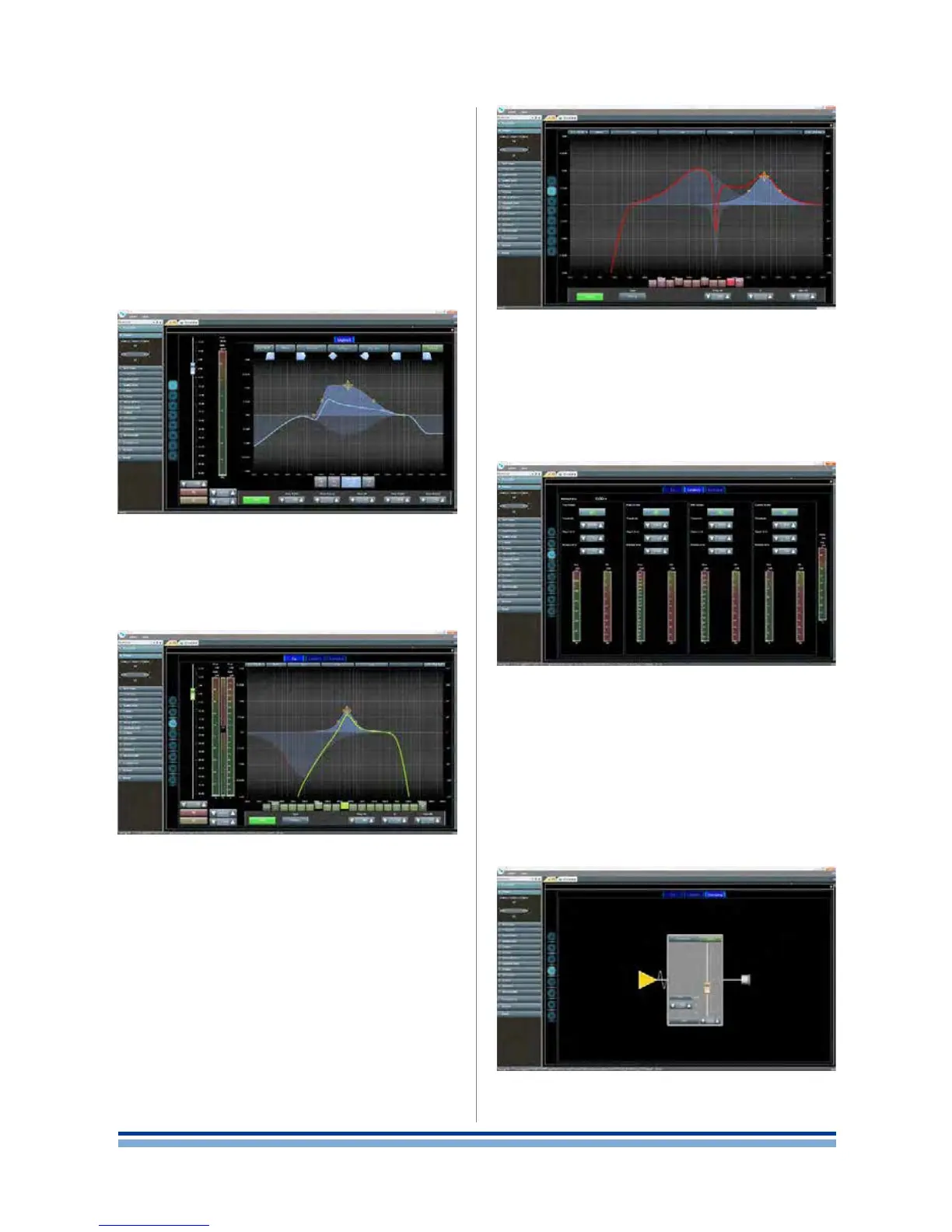
X series implements parametric EQs in three stages along
the signal path per each channel. Furthermore, thanks to the
Advanced group feature of Armonía Pro Audio Suite™, it is
possible to group many speakers (even on different ampli-
ers) and add an overall equalization.
The number of available lters depends on the stage
they are applied. X Series DSP provides the following lters
type:
15 : 3.1.5. Limiting
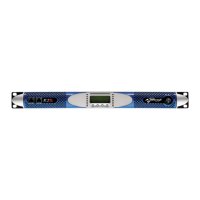
Limiters prevent signals from exceed a certain dened
level (peak or rms, voltage, current or power). Limiting is
meant to avoid output stage overload and protect the loud-
speakers from damages caused by excessive excursion or
overheating.
f Peaking
f Raised cosine
f Asymmetric rised cosine
f Low/High Shelving
f Low/High pass
f Band stop (notch)
f Band pass
f All pass
f Butterworth
f Linkwitz-Riley
f Bessel
f FIR/Custom FIR
15 : 3.1.6. Active damping control
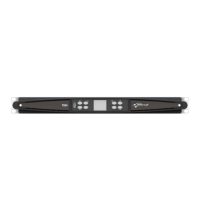
By means of the realtime adjustment of the output
impedance, X Series can compensate cable loss and load
variation, in order for the amplier to maintain greater control
over the movement of the speaker cone, as well as shaping
the transient response in the low-end band.
This unique and patented feature relies on a “virtual”
output resistor that can have either positive or negative
value to compensate cabling resistance and load variations.
FIGURE 30: Advanced equalizer.
FIGURE 31: Speaker equalizer.
FIGURE 32: Limiter.
FIGURE 33: Active DampingControl™.
FIGURE 34: Output equalizer.




 To Next Page