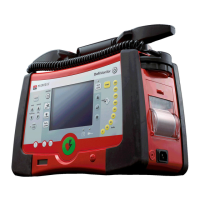
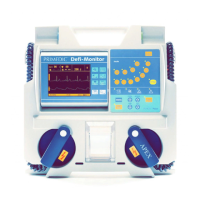
In synchronous mode, ECG markings are displayed on the monitor. To ensure safe
synchronous operation, these cardioversion markers must appear directly next to an
R-wave in each QRS complex. Precondition for this is a clear, artefact-free ECG
signal.
Before initiating cardioversion, observe the monitor display to check that
the cardioversion markers are clearly assigned to the R waves and not,
for example, reacting to pacemaker pulses or artefacts.
In synchronous mode, the trigger button must be held pressed until the cardioversion time is
reached. An acoustic signal sounds during this time. If the trigger button is released during this
time, cardioversion is not performed. If the button is held pressed and synchronisation is not
performed within 3 seconds, internal discharge is effected. If the trigger button is pressed only
briefly or no synchromarker has emerged while the button is pressed, the energy is retained in
the capacitor for 15 seconds and is then automatically discharged within the equipment.
The energy levels used for cardioversion are usually lower than for asynchronous defibrillation,
as it is not necessary to depolarise all heart muscle cells.
The energy required depends roughly on the weight of the patient. However, the indications
remain the decisive factor. The following rules of thumb apply:
Ventricular tachycardia with instable pulse:50 Joule, for each further cardioversion, select the
next highest energy level (100 J, 200 J, 300J,...) supraventricular tachycardia:
50 - 100 Joule
Atrial flutter: 50 Joule
Atrial fibrillation: 100 Joule
The values given above are merely recommendations for possible procedure in the event of
the corresponding indications.
If the cardioversion markers do not appear on the screen or appear in the wrong
position, this may be the result of extreme fluctuations in the mains supply. In this
case, the device should be disconnected from the mains, i.e. the mains plug should
be pulled out of the socket and the device operated via the integrated PRIMEDIC™
AkuPak battery.


 To Next Page