6 PROFIBUS DP Interface
If the New_Prm_Data and New_Cfg_Data are supposed to be present
imultaneously during start-up, the user must maintain the Set_Prm
nd then the Chk_Cfg acknowledgement sequence.
s
a
Bit Position
A ddress
7 6 5 4 3 2 1 0
Designation
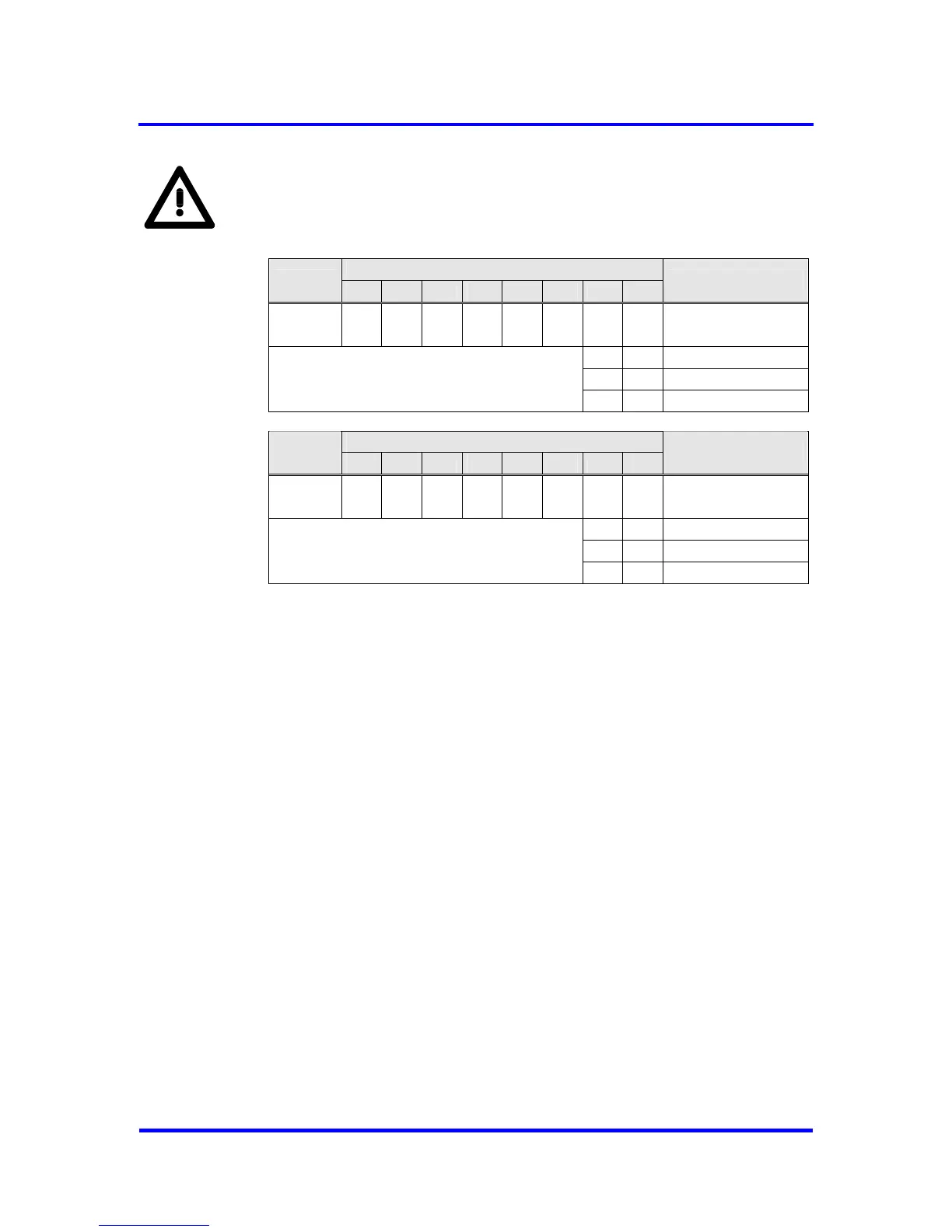
10H 0 0 0 0 0 0
⇓ ⇓
User_Cfg_
Data_Okay
0 0 User_Cfg_Finished
0 1 Cfg_Conflict
1 1 Not_Allowed
Bit Position
A ddress
7 6 5 4 3 2 1 0
Designation
11H 0 0 0 0 0 0
ay
⇓ ⇓
User_Cfg_
Data_Not_Ok
0 0 User_Cfg_Finished
0 1 Cfg_Conflict
1 1 Not_Allowed
Figure 6-8: Coding of User_Cfg_(Not)_Okay_Cmd
6.2.4 Slave_D
the request to
xchange the Diagnosis-Buffers. The user receives confirmation of the
ag in
e Status Register to find out whether the DP-Master has already fetched
the diagnosis data before the old data is exchanged for the new data.
iag (SAP 60)
Diagnosis Processing Sequence
Two buffers are available for diagnosis. These two buffers can have
different lengths. One Diagnosis-Buffer, which is sent on a diagnosis
request, is always assigned to the VPC3+C. The user can pre-process new
diagnosis data in the other buffer parallel. If the new diagnosis data are to
be sent, the user issues the New_Diag_Cmd to make
e
buffer exchange with the Diag_Buffer_Changed interrupt.
When the buffers are exchanged, the internal Diag_Flag is also set. For an
activated Diag_Flag, the VPC3+C responds during the next
Data_Exchange with high-priority response data. That signals the DP-
Master that new diagnosis data are present at the DP-Slave. The DP-
Master then fetches the new diagnosis data with a Slave_Diag telegram.
Then the Diag_Flag is cleared again. However, if the user signals
‘Diag.Stat_Diag = 1’ (that is static diagnosis, see the structure of the
Diagnosis-Buffer), the Diag_Flag still remains activated after the relevant
DP-Master has fetched the diagnosis. The user can poll the Diag_Fl
th
44 Revision 1.03
VPC3+C
User Manual
Copyright © profichip GmbH 2004-2006


 To Next Page