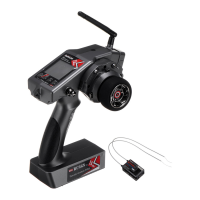
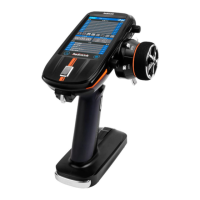
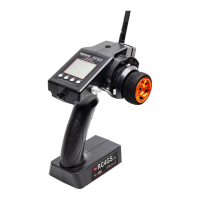
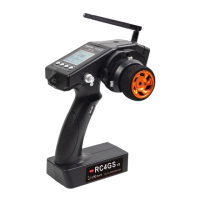
Need help?
Do you have a question about the RadioLink RC6GS and is the answer not in the manual?
Explains prohibition symbols, testing symbols, and critical safety warnings for operation.
Guide to matching transmitter/receiver code and explanation of receiver working modes.
Adjusting servo travel limits for steering, throttle, and auxiliary channels.
Explains pulse brake function and lists setup parameters like ABP, DLY, CYC, TGP, DTY, STM.
Setting servo return rate for brake release, from no return to neutral position.
Adjusting delay before ABS function activates, from immediate to 1.7 seconds.
Setting the speed of the pulse cycle for ABS brake pulsing.
Defining throttle trigger position for ABS function activation.
Setting the proportion of brake application and release time in pulse operation.
Enabling ABS operation based on steering range, or allowing full range ABS.
Adjusting acceleration amount from neutral for forward movement.
Adjusting acceleration amount from neutral for brake response.
Reversing the operational direction of servos for steering, throttle, and auxiliary channels.
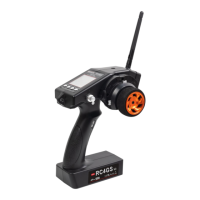
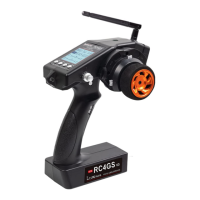
The Radiolink RC6GS is a digital 6-channel proportional RC system designed for controlling remote-controlled cars and boats. It operates on a 2.4 GHz frequency band and utilizes FHSS (Frequency Hopping Spread Spectrum) technology, along with 67 channels of pseudo-random frequency sequence hopping. This advanced spread spectrum technology, similar to that found in the AT9S system, ensures superior anti-interference capabilities across both the same frequency band and different frequency bands, as well as robust anti-spark interference. The system boasts a ground control distance of up to 400 meters, providing reliable and extended range operation.
The RC6GS transmitter is equipped with an STM32F103RB chip, while the accompanying R6FG/R6F receiver features a 32-bit industrial chip. This hardware combination allows for a rapid 12ms response time from the transmitter to the receiver, ensuring synchronous and high-performance control. The receiver, R6FG, comes with an integrated gyro and supports HV (High Voltage) servos, enhancing stability and control for various vehicle types.
To ensure safe and optimal operation, users are advised to carefully read the introduction and follow the setup instructions provided in the manual. For any operational issues, users can refer to the manual, contact dealers, or visit the Radiolink BBS and website for support. The manual also highlights that due to potential production changes, the information is subject to change without notice, and users should check the website for the latest updates.
Regular maintenance is recommended, with an annual service of Radiolink equipment during the "off-season" to ensure continued safe operation. The Radiolink website is a valuable resource for extensive programming, usage, setup, and safety information, as well as technical updates and manual corrections. For direct support, email and phone contacts are provided for both after-sales service and technical inquiries.
Safety is a paramount concern, and the manual includes important safety notices. Users are cautioned against using the device in adverse weather conditions like rain or thunderstorms, and in crowded areas or locations where its use is prohibited by law. Before operation, the throttle channel (CH2) and inch switch must be set to their lowest positions. The correct power-on sequence involves switching on the transmitter first, then connecting the receiver. For powering off, the receiver power should be turned off first, followed by the transmitter. Reversing this sequence could lead to uncontrolled situations and accidents. The transmitter requires 4 AA batteries or 2S-4S LiPo batteries, and users must check battery voltage before use, as low voltage can cause uncontrolled operation and accidents, necessitating timely battery replacement or recharging.
A strong warning is issued that the product is not a toy and is unsuitable for children under 18. Adults should keep it out of reach of children and exercise caution when operating it in their presence. Operating in rain or moisture is discouraged, as water ingress through antenna gaps can lead to vehicle instability or loss of control. If operation in wet weather is unavoidable (e.g., during a game), the transmitter should be covered with plastic bags or waterproof cloth. Operation during lightning is strictly prohibited.
The device complies with part 15 of the FCC Rules, meaning it must not cause harmful interference and must accept any interference received that might cause undesired operation. Any unauthorized changes or modifications to the equipment could void the user's authority to operate it.
The RC6GS offers a comprehensive range of functions accessible through its menu system. Upon powering on, the LCD displays the model name, transmitter name, battery voltage, steering trim, and throttle trim. The system can store data for up to 10 models, and users must ensure the correct model is selected to avoid incorrect settings. A low-voltage alarm sounds when the battery voltage drops below 4.6V, providing approximately 4 minutes of control before power-off, urging users to safely stop their model.
The function menu allows for various adjustments, including language selection (English and Chinese), model selection, End Point Adjuster (EPA) for steering, throttle, and auxiliary channels, Steering EXP (STEXP) to modify steering sensitivity around neutral and end positions, and Steering Speed (STSPD) to mitigate understeering or spinning during quick steering operations by introducing a delay.
Throttle EXP (THEXP) provides fine-tuning of throttle and brake servo operation, offering different curve types like five-point, single-point, and exponential adjustments for forward throttle, and a brake-specific exponential curve. Throttle Speed (THSPD) helps prevent wheel spin on slippery surfaces by delaying throttle servo operation, promoting smoother acceleration and reducing battery consumption.
The A.B.S. (Anti-lock Braking System) function is designed to prevent understeer during braking while cornering, especially in 4-wheel drive vehicles. It achieves this by pulsing the throttle servo intermittently, mimicking real-car ABS. Users can adjust parameters such as brake return amount, delay, pulse cycle speed, trigger point, and duty ratio. Steering mixing (STM) allows for ABS operation to be linked to steering input.
Throttle Acceleration (ACCEL) adjusts the throttle response from the neutral position, providing an initial "jump" in movement before linear response, differing from exponential curves that modify the entire throttle movement. Idle-Up (IDLUP) improves engine starting characteristics for gas-powered cars by temporarily raising the idling speed.
Sub-trim (SUBTR) allows for precise adjustment of the neutral positions for steering, throttle, and channel 3 servos. Servo Reverse (REV) enables users to reverse the direction of operation for any of the six channels. Steering Dual Rate/Throttle Dual Rate (D/R) adjusts the maximum travel of steering and throttle servos. ATL (Anti-lock Braking System) function specifically fine-tunes the braking effect.
Programmable Mixes (PMIX) allow for complex mixing between any two channels (steering, throttle, CH3, CH4, CH5, CH6), enabling advanced control configurations. The AUX function allows users to assign CH3, CH4, CH5, and CH6 to either VR (variable rate) or SW (switch) controls, which is particularly useful for RC crawlers to control functions like transfer case, shift gear, front locker, and rear locker.
Users can also customize model names (NAME) for easier identification of the 10 storable models. The Low Voltage Alarm is adjustable to suit different battery types (Li2S, Li3, Ni4S) and voltage thresholds, ensuring timely warnings to prevent battery over-discharge and loss of control. Gyro Sensitivity (GYRO) can be adjusted or turned off, with options for standard (STD) or VR-controlled sensitivity.
Finally, the Fail Safe (F/S) function allows users to set specific servo positions for all channels in case of signal loss, ensuring the model reacts predictably and safely. A Reset (RESET) function is available to restore all model memory data to factory defaults, which is useful for starting fresh with new model settings. Users are warned that resetting permanently erases all programming information, which cannot be recovered.
The manual concludes by thanking users for choosing the product and expressing hope that it brings happiness.
 General
| Channels | 6 |
|---|---|
| Frequency | 2.4GHz |
| Model Memory | 10 models |
| Telemetry | Yes |
| Spread Spectrum | FHSS |
| Channel Bandwidth | 400KHz |
| Modulation Mode | GFSK |
| Low Voltage Alert | Yes |
| Antenna Length | 106mm |
| Display | LCD |
| Range | 600 meters |
| Power Supply | 2S LiPo |
| Compatibility | R8EF, R8FM, R8F receivers |
| Model Type | Car, Boat |
| Operating Voltage | 4.8 - 15V DC |
| Screen | 128x64 LCD |
| Max Range | 600m |
| Receiver | R7FG |

 To Next Page