Need help?
Do you have a question about the Rain Bird ESP-SMT and is the answer not in the manual?
Introduces the company and its commitment to water efficiency.
Highlights the company's focus on developing water-efficient products and technologies.
Details the state-of-the-art smart modular control system and its benefits.
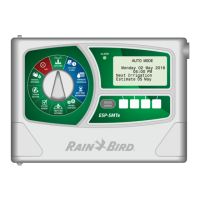
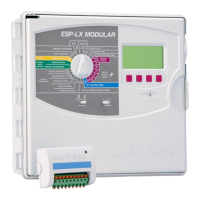
Describes the physical controls, display, and indicators on the controller panel.
Guides users through configuring the controller using a zip code.
Guides users through configuring the controller with custom location data.
Guides new users through the zone setup process step-by-step.
Sets up irrigation schedules based on time intervals rather than weather data.
Configures zone settings specifically for grass lawn types.
Configures zone settings for plant types other than grass lawns.
Allows users to define custom factors for plant types and density.
Adjusts irrigation based on the shade exposure of the zone.
Displays a summary of all entered zone information for review.
Copies zone settings from one zone to other zones.
Reviews the controller's current settings from configuration and special features.
Reviews all zone-specific settings entered in input and special feature sections.
Reviews the next estimated irrigation cycle based on past climatic conditions.
Reviews current temperature and rainfall data from the weather sensor.
Reviews daily logs of temperature, ET, and rainfall from the weather sensor.
Reviews watering events and alarm/note conditions in various views.
Restores saved settings to the controller's contractor default program.
Allows manual watering of individual zones or combinations with specific run times.
Provides instructions for selecting a location and installing the controller unit.
Lists the necessary tools for installing the controller and its components.
Describes the entry points for routing wires into the controller cabinet.
Selects an optimal outdoor location for the weather sensor for accurate measurements.
Step-by-step guide for physically mounting and connecting the weather sensor.
Explains the basic operation of the sprinkler system valves and controller.
Provides detailed descriptions of various soil types and their characteristics.
Outlines a procedure to determine soil type using a simple jar test.
A tool used to classify soil based on texture using percentage of sand, silt, and clay.
Explains the smart irrigation schedule automation based on weather and site data.
Defines and calculates the water available to plants based on soil type and root depth.
Explains the irrigation scheduling method based on soil moisture depletion.
Describes how to prevent runoff by splitting irrigation into cycles and soaks.
Explains how to determine the Net Application Rate for optimizing schedules and preventing runoff.
A method to estimate precipitation rate and efficiency based on sprinkler coverage.
The most accurate method to determine irrigation uniformity using catchment devices.
 General
| Brand | Rain Bird |
|---|---|
| Model | ESP-SMT |
| Category | Controller |
| Language | English |

 To Next Page