SRT55D Off-Highway Truck
5-4
Safety, Operation and Maintenance Manual
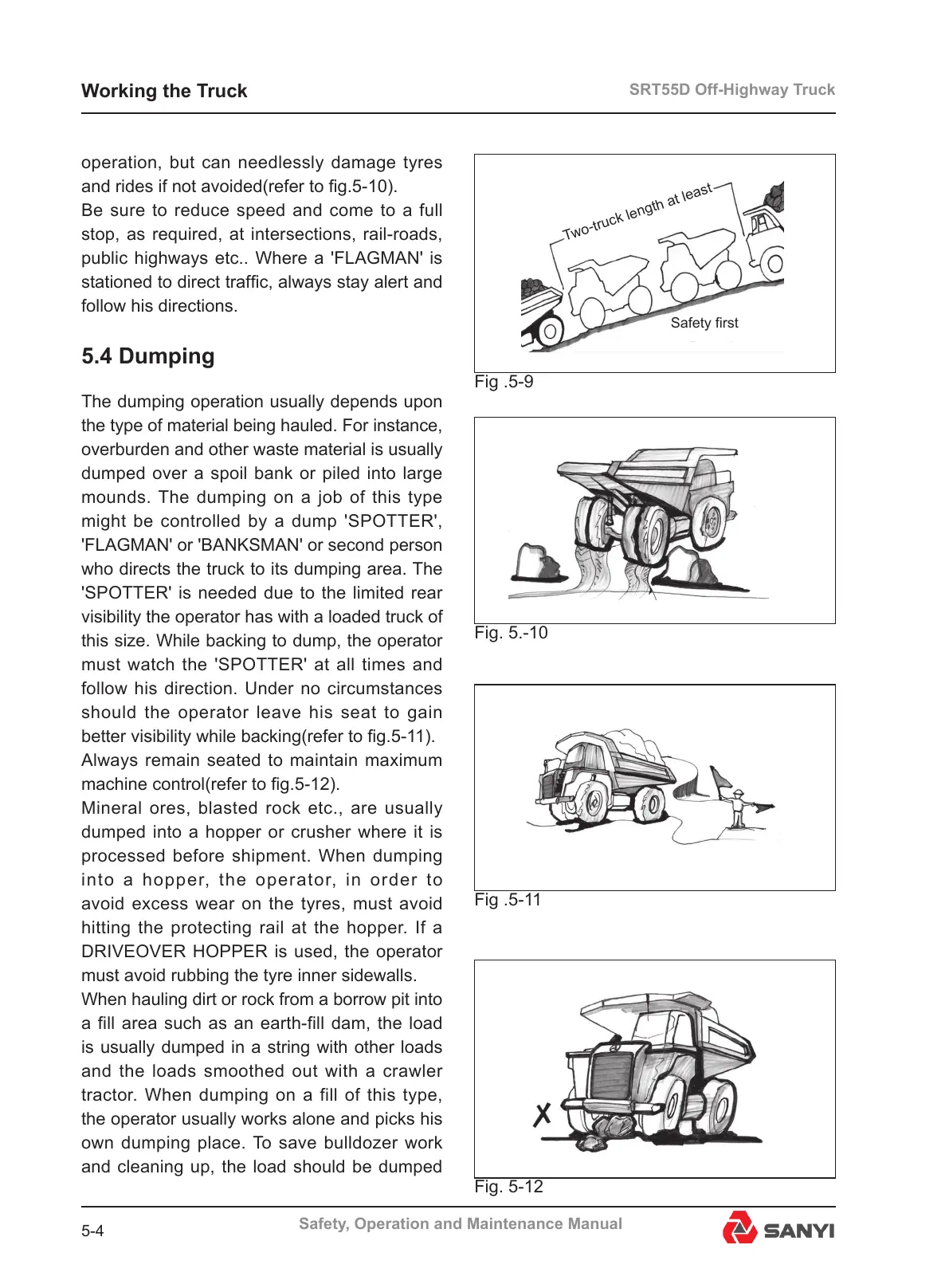
Fig. 5-12
operation, but can needlessly damage tyres
and rides if not avoided(refer to g.5-10).
Be sure to reduce speed and come to a full
stop, as required, at intersections, rail-roads,
public highways etc.. Where a 'FLAGMAN' is
stationed to direct trafc, always stay alert and
follow his directions.
5.4 Dumping
The dumping operation usually depends upon
the type of material being hauled. For instance,
overburden and other waste material is usually
dumped over a spoil bank or piled into large
mounds. The dumping on a job of this type
might be controlled by a dump 'SPOTTER',
'FLAGMAN' or 'BANKSMAN' or second person
who directs the truck to its dumping area. The
'SPOTTER' is needed due to the limited rear
visibility the operator has with a loaded truck of
this size. While backing to dump, the operator
must watch the 'SPOTTER' at all times and
follow his direction. Under no circumstances
should the operator leave his seat to gain
better visibility while backing(refer to g.5-11).
Always remain seated to maintain maximum
machine control(refer to g.5-12).
Mineral ores, blasted rock etc., are usually
dumped into a hopper or crusher where it is
processed before shipment. When dumping
into a hopper, the operator, in order to
avoid excess wear on the tyres, must avoid
hitting the protecting rail at the hopper. If a
DRIVEOVER HOPPER is used, the operator
must avoid rubbing the tyre inner sidewalls.
When hauling dirt or rock from a borrow pit into
a fill area such as an earth-fill dam, the load
is usually dumped in a string with other loads
and the loads smoothed out with a crawler
tractor. When dumping on a fill of this type,
the operator usually works alone and picks his
own dumping place. To save bulldozer work
and cleaning up, the load should be dumped
Safety rst
Two-truck length at least
Fig .5-9
Fig. 5.-10
Fig .5-11
Working the Truck


 To Next Page