Operation
Startup 250:Users:Danny:Desktop:Operation manuals:line pumps:maverick
(P305):pHseriesOPERATION.fm
23
Operation Manual - SP 305
The SP 305 has electric brakes as standard equipment.
Be sure that the electrical connections from the towing
vehicle are secure and working, and always use the
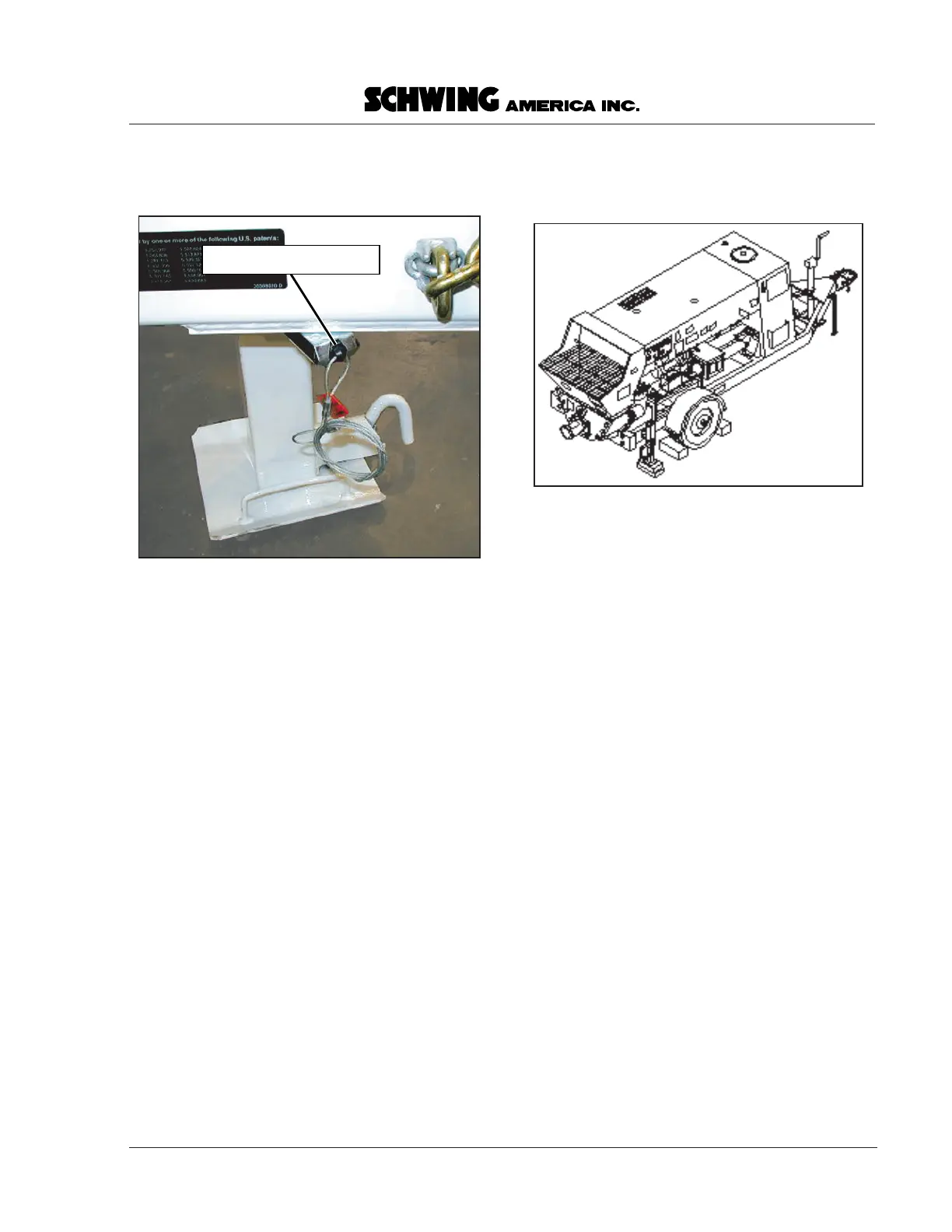
breakaway switch (Figure 6.)
Setting Up
Arrival at the job
When you arrive on the job, first check with the job
supervisor to determine where you should set up. If
possible, choose a spot that allows hopper access for
two ready-mix trucks. A flat, firm, and dry location is
ideal. Find your source of water for the waterbox and
cleanout.
If the weather is above freezing, fill your waterbox as
soon as you can. If it is below freezing, wait until just
before you being pumping to fill the water box.
Laying pipe
Generally, it is best to set up the outlet pipe and/or hose
from the required point of discharge backwards
towards the pump. When the pipe is in place, move the
pump to meet the pipe, then chock the wheels and set
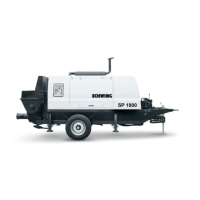
the manual outriggers (Figure 7).
NOTE!
In some circumstances, you must start
setting the delivery system from the pump
and work towards the point of discharge.
(Example: If the pump cannot be moved at
all, you must start laying pipe at the pump.)
Lay out the pipe in such a fashion that you
will not have to add pipe or hose during the
pour, only remove it.
Be sure that all clamps are pinned and tight.
Never join two different sizes of pipes or hoses without
a reducer. The longer the reducer, the less pressure it
will take to make the reduction.
Never join two different pipe styles (for example, a
metric coupling with a heavy-duty coupling). There is
no clamp made that will be able to keep that spot
together. If you have to change pipe styles, you must
use an adapter pipe.
Any and all pipes, hoses, clamps, adapters, or reducers
that you use
must
be able to withstand the maximum
pressure of the concrete pump. The maximum concrete
pressure that your pump can create is stamped into the
main ID tag, as described in the
Introduction
section of
this operation manual. Know this pressure number for
your unit, and be sure all pipe and hose components
you use can withstand this pressure.
Use only pipe and hoses that are in good shape. Do not
use pipe that has dents or thin spots. Do not use hose
that is frayed, has loose ends, or has loose rubber on
the inside.
Lay out the remote control cable so that you will be
able to see the point of discharge when pumping
begins. Be careful not to leave the unit alone while it is
pumping, however, because children are attracted to
construction machines. An ideal spot for the remote
gives you visual access to both the point of placement
and the pump. If that is not possible, you must have a
spotter for either the point of placement or the pump.
brkaway.eps
Breakaway switch and cable
Figure 6
The breakaway switch
Figure 7
Proper cribbing and chocking


 To Next Page