Operation
Startup 250:Users:Danny:Desktop:Operation manuals:line pumps:maverick
(P305):pHseriesOPERATION.fm
31
Operation Manual - SP 305
cylinders. This air will compress during the
pushing stroke and explode into the hopper when
the concrete valve switches (Figure 20).
• As discussed in the safety rules section of this
manual, do not let the ready-mix driver wash out
his drum or chute in your hopper. This may cause
plugging because the cement and other fine
particles are washed away from the course
aggregate. The same holds true if it is raining hard;
try to protect the hopper from getting so much
water that the aggregates start to separate.
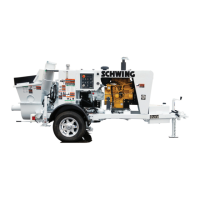
• On many jobs, pipe or hose will be removed as the
day goes on. Wash the removed pipe, hose, clamps,
and gaskets so the concrete residue doesn’t harden
(Figure 21).
Cleanout
Clean the delivery system
Begin the cleanout procedure as soon as the pour is
finished. Start by pumping out as much concrete from
the hopper as possible. Again,
be sure that you do not
empty the hopper to the point that air can be
sucked into the concrete cylinders!
Clean out the delivery line. It is very important that all
concrete is removed from the delivery system. If even a
small amount of concrete is allowed to set in a pipe or
hose, it will probably cause a plug the next time the
pipe or hose is used. Cleaning the delivery system can
be done one of four ways:
1.
Pump out the delivery system using the
concrete pump’s pressure.
Fill the hopper with
water and pump until you reach the minimum
hopper level. Refill the hopper with water and
continue pumping. When the concrete has
disappeared from the hopper and concrete valve
area, stop the pump, reverse it to remove any
residual pressure, and disconnect the delivery
system from the concrete valve outlet. Open the
cleanout door and rinse the hopper. Use the rake
to pull concrete from the valve through the outlet
pipe, and rinse the valve. Shift the valve, and
rinse the open cylinder. Put a sponge ball in the
delivery system, and reconnect the line to the
pump outlet. Refill the hopper with water, and
pump until you reach the minimum hopper level.
Refill the hopper and, again, pump until you
reach the minimum hopper level. Continue doing
this until the sponge ball has been pumped out of
the delivery system. This is the method used by
most operators in most circumstances. It has the
advantage of getting most of the concrete out of
the hopper and material cylinders while you are
cleaning the pipeline. The disadvantage of this
method is that it takes a large water supply to get
the entire system and pump clean.
2.
Manually clean the delivery system.
Reverse
the pump to remove any pressure in the delivery
system. Stop the pump and the engine.
Disconnect the delivery system at all connection
points, manually empty the hoses and pipes, and
immediately wash them inside and out. For long
hoses, you can pour 5 or 10 gallons of water in
one end of the hose, then walk the hose towards
the other end, lifting as you go, so the water will
always travel downhill towards the far end. This
method is best and quickest when there are only
a few pipes or hoses to clean. It has the
advantage of taking the least amount of water to
finish. If you find that you must use this method
for long delivery systems (if the unit is broken,
for example), get some help so that you can clean
out the unit before the concrete sets. If no help is
available, you should know that if concrete sets,
it ruins whatever is holding it. It is harder and
more expensive to replace the concrete valve and
material cylinders than to replace a delivery
system, so adjust your cleanout accordingly.
000522.eps
Figure 21
Wash system as it is removed


 To Next Page