Definition product variants
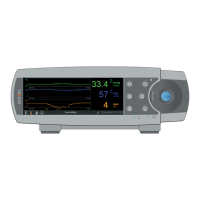
LuMon Monitor Neo (with activated Neonates/Infants configuration)
SensorBeltConnector (to link SensorBelts to the LuMon Monitor Adult)
LuMon Connector (to link LuMon Belts to the LuMon Monitor Neo)
SensorBelt/LuMon Belt Adult (for adults and children/available in 4 sizes)
LuMon Belt Neo (for neonates and infants /available in 7 sizes)
ContactAgent
LuMon Contact Spray
NeoContactAgent
Measuring tape Adults/Children
Measuring tape Neonates/Infants
Table 14-2: Sentec EIT related terminology
Definition/Measurement units (if applicable)
Mean of the
Plethysmogram
over an
Analysis Interval
of a fixed, preset duration.
Aeration is related to the mean lung volume.
Quantified in arbitrary, not displayed, units. Auto-scaled trend display.
Index
calculated once per
Analysis Interval
TB-II
mode.
Time interval over which the LuMon System determines the minimum, the
maximum or the mean of the
Plethysmogram
.
Modes used by the LuMon System to analyze the
Plethysmogram
, specifically,
to determine end-expiratory and end-inspiratory time points needed for the
calculation of breathing-related
EIT images
and
indices
as well as the mean of the
Plethysmogram
over an
Analysis Interval
. Furthermore, the extent of available
EIT
data
depends on the selected Analysis Mode. Available Analysis Modes are
breath-based
(BB) mode and
time-based
(TB-I and TB-II) modes. See 9.7.
One of the available
Analysis Modes
. See 9.7.1
The plane defined by a belt being applied to chest. A slightly oblique
plane for belts used on adults and children; a transverse plane for belts used on
neonates and infants. See 5.3.
The remaining time a belt can be used.
When a new belt is connected to a LuMon System, a timer begins to count down
from the preset belt time to zero. The countdown interrupts if the belt is
disconnected and resumes when reconnected. An icon on the LuMon Monitor
indicates the belt time and highlights if the belt time has elapsed.
Quantified in hours.
breath-by-
breath
or
breath-based
(BB)
Either a designation of one of the
Analysis Modes
or a statement used to describe
that something occurs or is done for each breath.
breathing-
related EIT
images and
indices
EIT images
and
indices
for whose determination i) data being available at end-
expiratory or end-inspiratory time points is used or ii) data being available at end-
expiratory time points is subtracted from data being available at associated end-
inspiratory time points within
Analysis Intervals
.
In
BB mode
, these time points correspond to the start and the end of inspirations
of detected breaths. In
TB-I mode,
the minima and maxima within 15 seconds
intervals, that can occur in any order, are assumed to be related to breaths, their
occurrences are interpreted as end-expiratory and end-inspiratory time points of
not necessarily the same breath.
Examples include the
Stretch Image
, the
Silent Spaces Image
and
indices
such as
EELI, EILI, FLS,
Silent Spaces
, DSS, NSS and the CoV.
Center of
homogeneous
Ventilation
(CoV
hom
)
Center of Ventilation if ventilation is homogeneously distributed within the
Lung
ROI,
In case of homogeneous ventilation, it is assumed that the
Relative Tidal Stretch
values of all
Lung Pixels
are the same and contribute equally as weights in the
computation of the
Center of Ventilation
.
Notice that CoV
hom
coincides with the geometrical center of the
Lung ROI.
Represented as an image point. Coordinates are not displayed.
Index
calculated when
data are entered, that are
required to determine the
Thorax ROI
and
Lung ROI
best fitting the specific
patient
BB
and
TB-I
modes.


 To Next Page