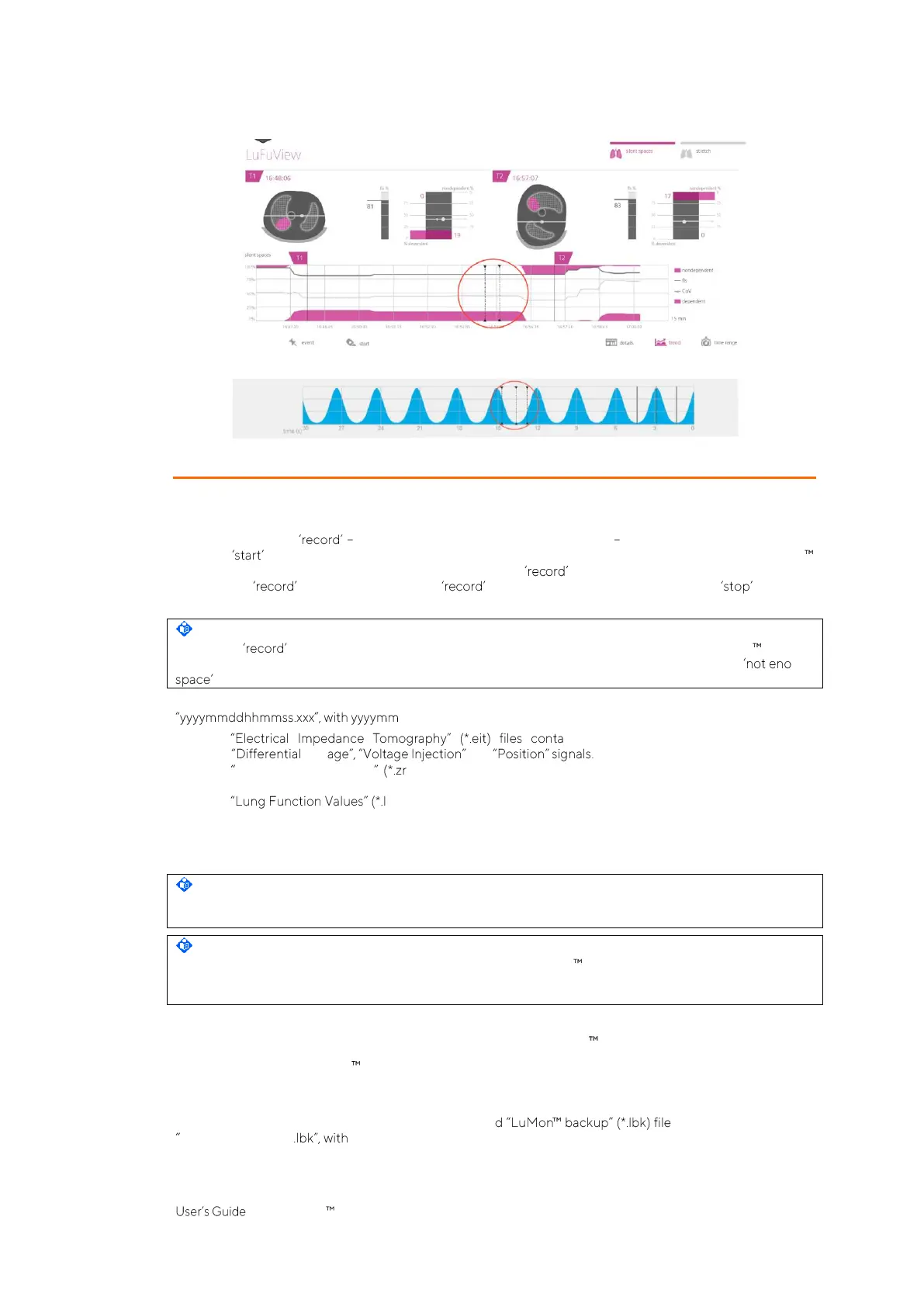
Figure 9-19: Operator events in trends (top) and on the Plethysmogram (bottom) are identified by dotted black
vertical lines with triangles at both ends.
9.12 Recording or exporting data
9.12.1 Recording data on a USB memory device
Pressing the button which is available on all views (Figure 6-5) when it is displayed in grey and
indicates activates online recording of
EIT data
on the USB memory device connected to the LuMon
Monitor. To indicate that recording is in progress the button is displayed in blue and a white dot flashes
in the button . Touching on the button when it is displayed in blue and indicates stops data
recording.
NOTE
The button is not active (dimmed grey) if no USB memory device is connected to the LuMon Monitor.
If the free space on the USB memory device is less than 1GB then the button remains inactive and ugh
is displayed.
On the USB memory device
EIT data
are recorded in the three different binary files, whose filenames follow
ddhhmmss referring to the time where the specific file was created:
• in the measured
EIT raw data
, notably
Volt and
• Zero Reference Images i) files contain reconstructed
zero reference images
(i.e. the regional
impedance distribution within the
Thorax ROI
for a given image frame) and the
Plethysmogram
(9.4).
• fv) files contain
EIT images
(
Stretch Image, Silent Spaces Image
), values for
Respiratory Rate
and various
indices
such as EELI, EILI,
Aeration
, DSS, NSS, FLS, CoV(v), and CoV(h)
as well as operator events (9.6, 9.8, 9.9, 9.10, 9.11).
Other than the gender, weight, height, and underbust girth, these files do not contain patient data.
NOTE
In long recordings (>15 minutes), the recorded data might extend over multiple files to avoid excessively large
file handling.
NOTE
Irrespective of the currently selected
Analysis Mode
(9.7), the LuMon System in the background permanently
analyzes the measured
EIT raw data
with all
Analysis Modes
and stores or outputs the results obtained with each
mode.
9.12.2 Exporting EIT data from the internal memory of the LuMon Monitor
During monitoring the LuMon Monitor continuously stores the measured
EIT data
and operator events (9.11)
in its non-volatile, internal memory according to the FIFO (First In First Out) principle. The memory capacity of
20 GB provides at least 4 hours of monitoring data.
The
EIT data
and operator events are stored in so-calle s whose filenames follow
yyyymmddhhmmss yyyymmddhhmmss referring to the time where the specific file was created. *.lbk
files contain the same data as *.zri and *.lfv files (9.12.1).


 To Next Page