11
3.7 Desiccant Dry-Down Technology
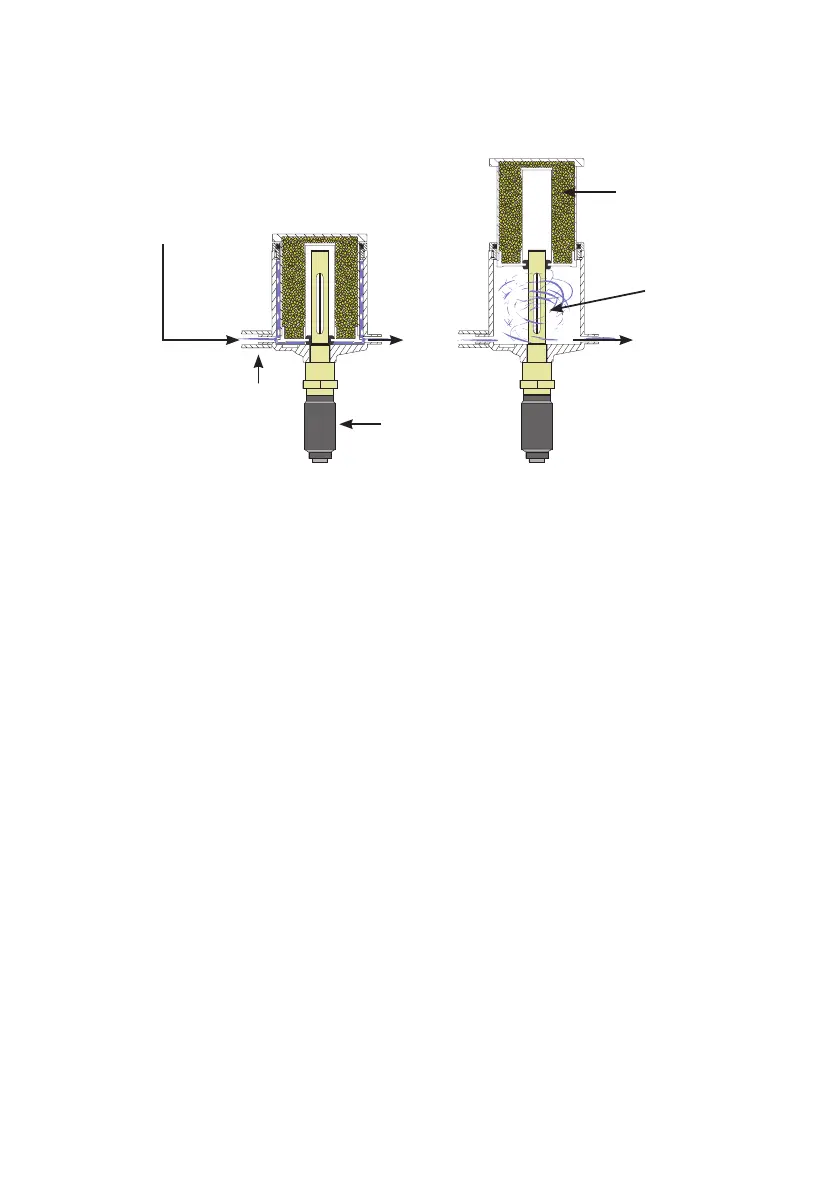
Keeping the sensor dry between tests ensures that the SDHmini is ready to carry
out rapid spot checks. The unique design of the desiccant head achieves this by
surrounding the sensor with desiccant, keeping the sensor dry. The head is then
lied for sampling, exposing the sensor to the sample gas.
Between tests the sensor is not allowed to come into contact with ambient air. The
chamber is designed so that the void space and chamber wall surfaces are purged
with sample gas before exposure of the sensor, giving faster, more accurate and
reliable results.
3.8 Sample Connecons
The SDHmini is supplied with two connecons: a Fir Tree on one side and a Swagelok
compression ng for ¼”, ⅛”, 6 mm OD pipe or another Fir Tree ng (as specied
on your order) on the other. Either can be used as the inlet connecon (6).
PTFE and stainless steel are recommended materials for sample pipes. Some specialist
exible tubing may be suitable as sample pipe but common exible tubing such as
PVC, nylon, polythene or rubber, should not be used, as they are permeable and
water vapour from the atmosphere will diuse through them into the sample gas.
A 2 m PTFE sample pipe is supplied for use with the Fir Tree connecon. The rst
me this is used it is advisable to warm the end that will go over the Fir Tree for a few
seconds with a heat source to soen it slightly, which helps to get a gas ght seal.
Dry-Down Posion Read Posion
The unique design
allows purging of the
gas in the “Dry-Down
Posion” which will
bring all surfaces and
voids to equilibrium.
Sample exhaust
Sample gas
inlet pipe
Sensor
The desiccant and
sensor are always
isolated from
atmospheric air to
ensure an accurate
reading.
Sensor exposed
to gas sample.
Sensor surrounded by desiccant
ensuring it is dry, ready for the
next measurement.


 To Next Page