3.4 Piping Schemac Component Index
Sample Isolaon Valve - This is a recommended item as it allows access to
the sample system without interrupng the main process line.
Filter Unit – A lter unit is recommended when the samples are likely
to contain parculate maer. If the air/gas sample contains heavy
hydrocarbon condensate, the lter must be of the coalescing type with a
drain. The lter unit should be posioned as close to the sample point as
praccal.
Sample Tube – This should be stainless steel for dry air or gas applicaons
but copper or carbon steel can be used where weer gases are to be
measured. If any secon of the sample tube must be exible then PTFE
should be used. In most cases, 3 mm OD (⅛”) is sucient as it provides
good system response me with minimum ow. 6 mm OD (¼”) tube can
be used where pressure drops across the 3 mm tube are too high.
Pressure Reducon Valve or Pressure Regulator – the sample is measured
at atmospheric pressure requiring that valve 4 is ed to the system.
Flow Control Valve.
Sample Connecon.
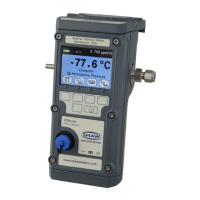
SDHmini.
Flow Indicator – The recommended sample ow is 2 to 5 L/min.
Sample Exhaust – The exhaust is vented to atmosphere or returned to an
atmospheric pressure line.
3.5 Purging the Sample Connecon
Refer to the Piping Installaon Schemac in secon 3.3.
It is advisable to carry out an inial purge of the sample loop without connecng
the instrument, in order to avoid the possibility of sensor damage on start-up.
Open the sample isolaon valve (1) slowly, unl there is a small ow of air/gas at
atmospheric pressure from the pressure reducon valve (4). Allow the air/gas to
exhaust through the sample connecon (9).
Connue this for two minutes to remove any residual moisture from the sample
pipe work and components. Check that no liquid or parculate contaminaon,
which could damage the sensor, is passing through the sample pipe. Direcng the
sample onto a piece of white paper (such as a lter paper) will make it easier to
see any dust or oil mist in the sample.
1.
2.
3.
4.
5.
6.
7.
8.
9.
9


 To Next Page