If
air drv
\
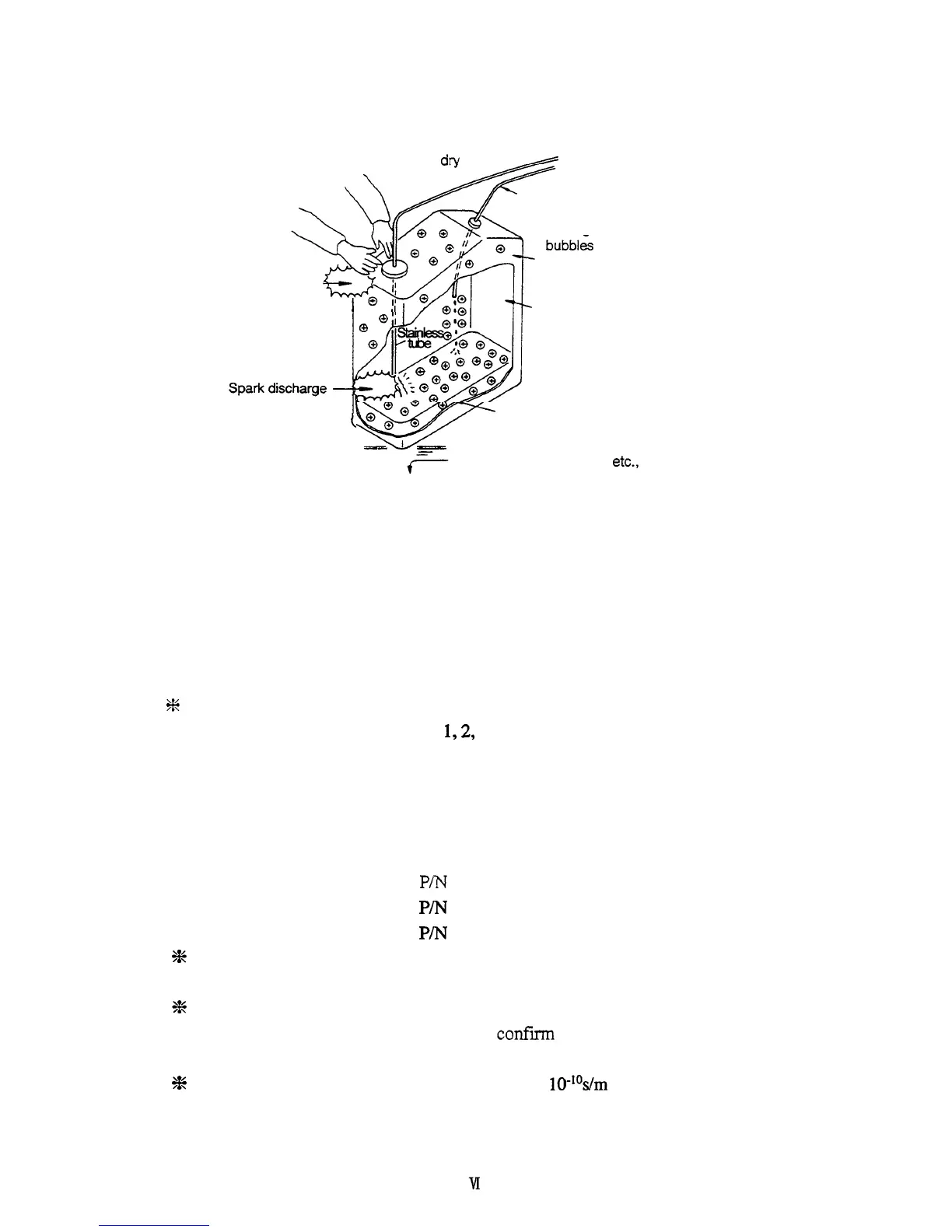
Liquid is flowing at high
speed
through a
small
diameter tube.
*Charge is easily accumulated if
bubbles are included in the liquid.
Insulated vessel
(like polyethylene)
Spark discharge
-
””;”oyc
I
Ill
/
Inflammable gas is stored in the
head space
of
the vessel.
(\
n\
Inflammable organic solvent is
charged
to
a great extent.
e
-
-
-
-
Floor covered
with
rubber, etc.,
provides unwanted insulation.
Fig.
2
Conditions which may cause Accidents
2.
Preventive Measures against Accidents
The principal preventive measure is the prevention of “charging and storage of static
electricity” among those items shown in “Mechanism
of
Static Electrical Discharge
Accident.” The preventive measures are shown below. It is recommended to exercise two
or more measures simultaneously.
3K
Particularly when a large quantity of flammable solvent is held in a large vessel,
be
sure
to observe the preventive measures
1,2,
and
3.
Preventive measure
1.
Use metallic (conductive) waste liquid vessel which is well grounded.
This
releases the
charge of the waste liquid and vessel to ground.
The following items are available.
(1)
Grounding
wire
with clip P/N
228
-
21353
-
91
(2)
Metallic
18
liter can
P/N
038
-
00044
(3)
Metallic
4
liter can
P/N
038
-
00043
-
01
3K
+E
Be sure to ground the vessel properly. Disconnecting of grounding wire or poor
grounding defeat the purpose of using
a
metallic vessel.
There are some metallic cans which have no conductivity
due
to
an
oxidized coating
or lacquer on their surface. Be
sure
to
confirm
the grounding
of
vessels by a tester
before application.
When a liquid with almost no conductivity (of
10-lOs/m or less) is discharged into the
vessel, it is necessary to
mix
it with another liquid with some conductivity. (The other
liquid can be placed in the vessel
in
advance.)
%



 To Next Page